Why Is the Church Afraid of Biblical Scholarship?
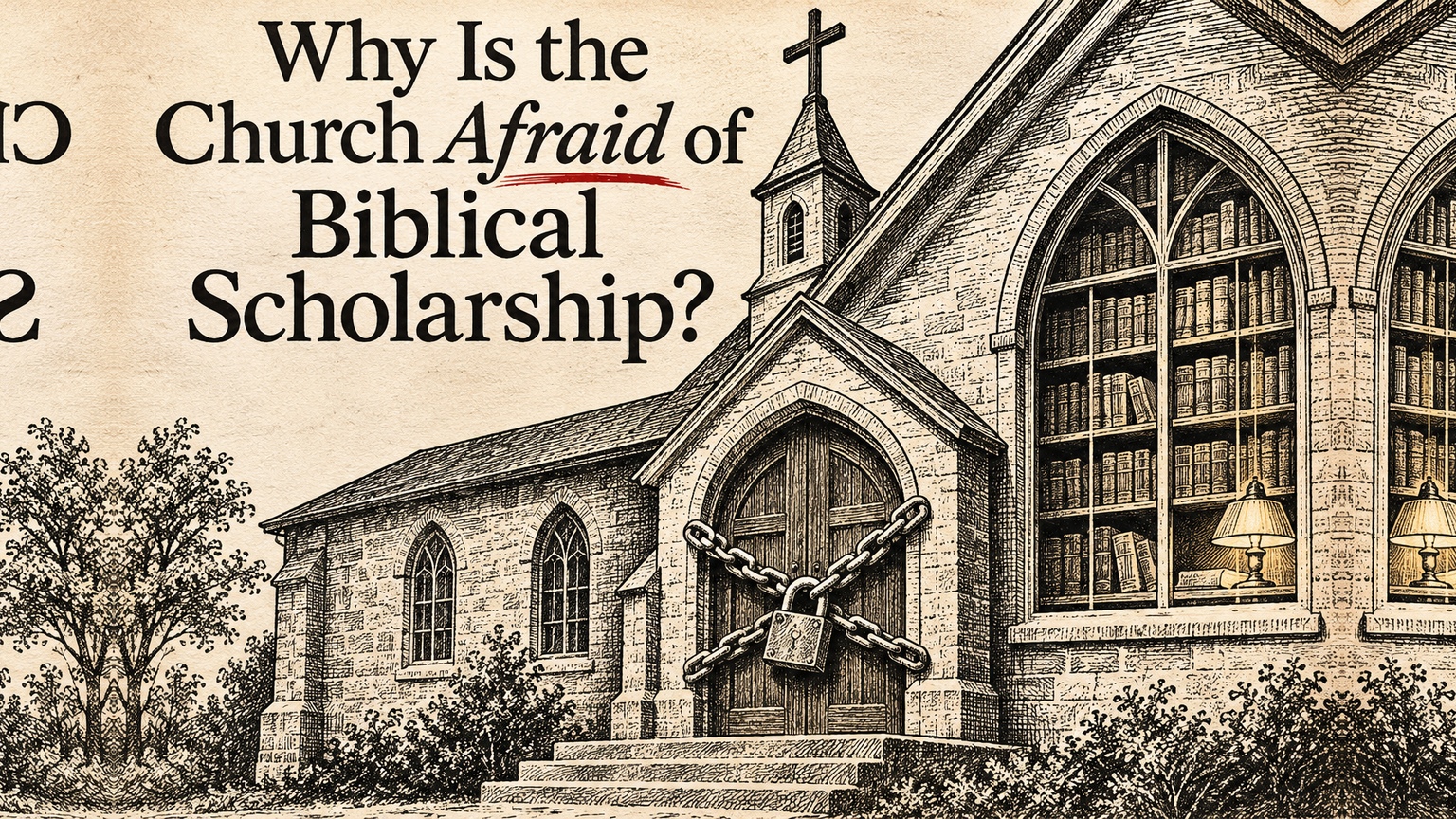
Spend a few hours listening to biblical scholars, reading academic literature, examining peer-reviewed research, and exploring the historical, linguistic, literary, and archaeological questions surrounding the Bible. Then turn on a sermon. Listen to a devotional. Attend a Sunday school class.
You may find yourself asking a rather disturbing question: Are these people even studying the same book?
I have been spending considerable time listening to biblical scholars, individuals with academic credentials who have devoted years, sometimes decades, to the study of Scripture. I listen to discussions about the composition of biblical books, historical context, ancient Near Eastern literature, textual criticism, authorship, archaeology, and the countless interpretive problems that emerge from a serious investigation of the biblical text.
Then I listen to sermons.
The difference is staggering.
It is not simply that one discussion is more academic and the other more practical. It is that the questions being asked in one world frequently do not even exist in the other.
There are entire conversations taking place within biblical scholarship that many Christians will never hear about. They can attend church for forty years, listen to thousands of sermons, participate in countless Bible studies, and remain completely unaware of some of the most significant questions surrounding the book they claim is the very Word of God.
How is that possible?
More importantly, why does the church seem so determined to keep it that way?
The church claims to have the highest possible view of Scripture. It tells us that the Bible is inspired, authoritative, sufficient, and worthy of our deepest study. Yet much of the church demonstrates remarkably little interest in the most serious academic investigation of that very book.
We claim to love the Bible, but we seem remarkably uninterested in discovering anything about it that might make us uncomfortable.
We claim to submit to the authority of Scripture, but we frequently refuse to entertain the possibility that our understanding of Scripture might be wrong.
We claim to be people of the truth, but we often construct entire educational environments designed to ensure that we never encounter information that seriously challenges what we already believe.
That is not a high view of Scripture.
That is a high view of ourselves.
One of the fundamental differences between academic biblical scholarship and much of the church is that scholarship begins with questions, while the church often begins with answers.
The scholar examines the evidence, considers competing explanations, investigates historical circumstances, analyzes language, and attempts to arrive at a conclusion. That conclusion may change. New evidence may emerge. A previously accepted argument may prove inadequate. A position held for decades may have to be abandoned.
The church often operates in precisely the opposite direction.
The conclusions have already been established. The doctrinal statement has already been written. The theological system has already been constructed. The pastor has already committed himself to a particular understanding of the Bible.
Now the task is to study the Bible in a way that preserves those conclusions.
We call that Bible study.
But is it?
If the conclusions are established before the investigation begins, and those conclusions cannot be abandoned regardless of what the investigation reveals, what exactly are we doing?
We are not investigating the Bible. We are defending a system.
And there is a massive difference between the two.
The church has become remarkably effective at creating an alternative intellectual ecosystem. We have our own publishing houses, conferences, seminaries, commentaries, study Bibles, podcasts, and approved theological authorities.
A Reformed Christian reads Reformed authors. A dispensationalist reads dispensational authors. A Baptist reads Baptist authors. A Lutheran reads Lutheran authors.
They attend conferences where the speakers largely agree with them. They listen to sermons that reinforce their beliefs. They purchase books recommended by people who share their theological commitments.
They can spend decades studying theology without ever seriously encountering the strongest arguments against their own theological system.
And then they congratulate themselves on how much they have studied.
You can have a library containing thousands of books and still live in an intellectual echo chamber.
Now, I am not suggesting that confessional scholarship is inherently inferior or that Christians cannot produce excellent academic work. They can, and they do. Nor am I suggesting that academic credentials make someone correct or that peer-reviewed scholarship is infallible.
The issue is not whether a scholar is a Christian, an atheist, an agnostic, a conservative, or a liberal.
The issue is whether the arguments are sound, whether the evidence supports the conclusions, and whether we are willing to examine that evidence honestly.
But much of the church does not seem particularly interested in that process.
We want scholarship that confirms our beliefs. We want archaeological discoveries that prove the Bible. We want manuscript evidence that supports our doctrine of preservation. We want historians who defend the reliability of the Gospels. We want linguists who confirm our interpretation of a particular passage.
When scholarship supports us, we celebrate it.
When scholarship challenges us, suddenly we are warned about the dangers of human wisdom, secular presuppositions, academic arrogance, and the importance of simply believing God’s Word.
Which is it?
Is scholarship valuable or dangerous?
Is historical evidence important or irrelevant?
Does linguistic analysis matter or not?
You cannot celebrate the academic credentials of a scholar when he agrees with you and then dismiss the academic credentials of another scholar because he does not.
You cannot appeal to historical evidence when it supports your theology and then retreat into an appeal to faith when the historical evidence creates problems for your theology.
That is not intellectual consistency. That is intellectual convenience.
And perhaps nowhere is this problem more evident than in the way Christians are introduced to opposing arguments.
They are encouraged to read the Christian response to a biblical scholar, but not necessarily the biblical scholar himself. They are encouraged to read apologetic responses to historical criticism, but not necessarily the historical-critical scholarship being criticized.
They encounter opposing arguments through people whose stated purpose is to refute those arguments.
Imagine studying Christianity exclusively through books written by atheists whose objective is to disprove Christianity. Would Christians consider that a fair or adequate investigation of their beliefs?
Of course not.
Then why do we consider it acceptable to investigate biblical scholarship almost exclusively through Christian authors whose objective is to defend our existing beliefs against it?
We are not encouraging meaningful engagement. We are controlling exposure.
And what happens when a Christian eventually encounters the actual scholarship?
Sometimes they discover that the arguments are far more sophisticated than they were led to believe. They discover that the questions are not new. They discover that some of the apologetic responses they were given did not accurately represent the positions they claimed to refute.
They may discover that the church spent years telling them that certain problems did not exist, while scholars had been discussing those very problems for generations.
And then we wonder why people experience a crisis of faith.
Perhaps the church, in its determination to protect people’s faith, has contributed to the very crisis it was attempting to prevent.
There is another reality we need to confront. Meaningful engagement with biblical scholarship can threaten the authority structures of the church.
Imagine a pastor who has spent twenty years teaching a particular interpretation of Scripture. He begins seriously investigating the academic literature and discovers that the historical, linguistic, or textual evidence does not support what he has been teaching.
What happens next?
Does he stand before the congregation and announce that he has been wrong?
Does he reconsider his theological system?
Does he acknowledge that the issue is considerably more complicated than he previously understood?
In an academic environment, changing your position in response to evidence can be considered a sign of intellectual integrity.
In a church environment, it can get you fired.
You can lose your position. You can lose your reputation. You can be accused of compromise, liberalism, unbelief, or abandoning the authority of Scripture.
Think about the environment that creates.
A pastor is expected to study the Bible deeply enough to defend the church’s beliefs, but not so independently that he might overturn them.
How can we possibly expect meaningful biblical investigation under those conditions?
And what makes this even more disturbing is that the church has frequently confused the authority of Scripture with the authority of its interpretation of Scripture.
Those are not the same thing.
Questioning whether a particular biblical prophecy refers to Jesus is not necessarily questioning Jesus.
Questioning whether Moses wrote every word of the Pentateuch is not necessarily rejecting the authority of the Pentateuch.
Questioning whether a passage teaches a particular doctrine is not necessarily rejecting that doctrine, much less rejecting the Bible.
But in many churches, those distinctions have disappeared.
The church has become so convinced of its own interpretation that it can no longer recognize it as an interpretation. It has become synonymous with the Bible itself.
Consequently, when someone challenges the interpretation, they are accused of challenging Scripture.
When someone challenges Scripture as the church understands it, they are accused of challenging God.
And suddenly, an exegetical disagreement becomes a question of spiritual faithfulness.
That is an extraordinarily dangerous environment in which to attempt biblical study.
I encounter this constantly in my own study of Scripture. A systematic theology textbook makes a claim about an Old Testament passage. A pastor makes a confident assertion about what a biblical narrative means. A devotional author tells us that a particular verse provides a promise for our lives.
I begin asking questions.
Where does the text say that? What is the historical context? What does the language actually communicate? What was the author addressing? How does the passage function within the larger literary argument? Does the New Testament actually make the connection being claimed?
And so often, the more you investigate, the more you discover that what was presented with absolute certainty is actually questionable, complicated, or simply unsupported.
The church desperately needs to recover the ability to say, “We don’t know.”
It needs to recover the ability to say, “There are several possible interpretations.”
It needs to recover the ability to say, “The evidence does not support what we have traditionally taught.”
And perhaps most importantly, it needs to recover the ability to say, “We were wrong.”
Instead, we continue producing sermons that reduce enormously complex biblical texts to three points of practical application.
We take the book of Job, with its profound literary structure, competing theological arguments, and disturbing questions about divine sovereignty and human suffering, and turn it into a sermon offering five things to remember when life gets difficult.
We take ancient Israelite poetry and turn it into motivational advice.
We take historical narratives and transform them into lessons about how to make better decisions.
We take prophetic literature addressed to particular people in particular historical circumstances and turn it into promises about our individual futures.
And we call this biblical preaching.
A congregation does not need an academic lecture every Sunday morning. I understand that. The church has pastoral responsibilities. People are suffering. People need to hear the Gospel. People need comfort, encouragement, and hope.
But why should any of that require intellectual superficiality?
Why should preaching the Bible require us to ignore what we know about the Bible?
Why should pastoral care require us to manufacture applications that the text does not actually support?
Why can’t the church preach the Gospel while also introducing people to the complexity, history, literature, and difficult questions of Scripture?
The Bible does not become less profound when we investigate it more seriously. It becomes more profound.
The problem is that serious investigation may reveal that some of our sermons, theological systems, devotional interpretations, and cherished traditions are not nearly as profound as we thought they were.
And perhaps that is what we are really afraid of.
I am not calling for the church to abandon theology in favor of academic scholarship. I am not suggesting that Christians must accept every conclusion reached by a university professor. Scholars disagree. Academic consensus changes. Methodological assumptions deserve scrutiny. Historical claims must be examined, and arguments must be tested.
But that examination must be genuine.
If a scholar makes an argument that challenges Christianity, engage the argument.
If the evidence appears to contradict your interpretation, examine the evidence.
If the scholarship is flawed, demonstrate where it is flawed.
If the argument is logically inconsistent, expose the inconsistency.
But if the scholar is right and you are wrong, have the intellectual integrity to admit it.
That should not be a controversial demand within a religion that claims to be devoted to truth.
Imagine what the church could become if it actually embraced this approach.
Imagine Christians studying Genesis and being introduced to the major scholarly debates surrounding its composition and historical context. Imagine Christians examining the four Gospels and seriously investigating their differences without immediately rushing to harmonize them. Imagine Christians studying Isaiah and exploring the questions surrounding its authorship and composition.
Imagine a Sunday school class where people are encouraged to read competing scholarly perspectives and discuss them openly.
Imagine a church where asking difficult questions is not viewed as evidence of spiritual weakness.
Imagine a pastor who can stand before his congregation and acknowledge that he has changed his mind because the evidence demanded it.
Imagine a Christianity that is so committed to truth that it is willing to discover that it has been wrong.
Would that destroy the church?
Or would it finally produce a church that takes the study of Scripture as seriously as it claims to?
The scholarship exists. The journals exist. The books exist. The lectures exist. The debates have been taking place for generations. And today, through the internet, an ordinary Christian has access to an extraordinary amount of material that previous generations could never have imagined accessing.
The church cannot claim that the information is unavailable.
The question is whether the church actually wants people to encounter it.
Because underneath this entire discussion is a question that I believe the church desperately needs to answer.
Does the church actually want to discover what the Bible says, or does it want the Bible to continue saying what the church needs it to say?
Those are two fundamentally different objectives.
And I am increasingly convinced that much of the church is not afraid that biblical scholarship will demonstrate that the Bible is wrong.
It is afraid that biblical scholarship will demonstrate that the church has been wrong about the Bible.
And for an institution that claims to submit to the authority of Scripture, that may be the most disturbing realization of all.

Standing Before an Ocean