Why Do We Baptize Infants? Examining the Biblical Argument
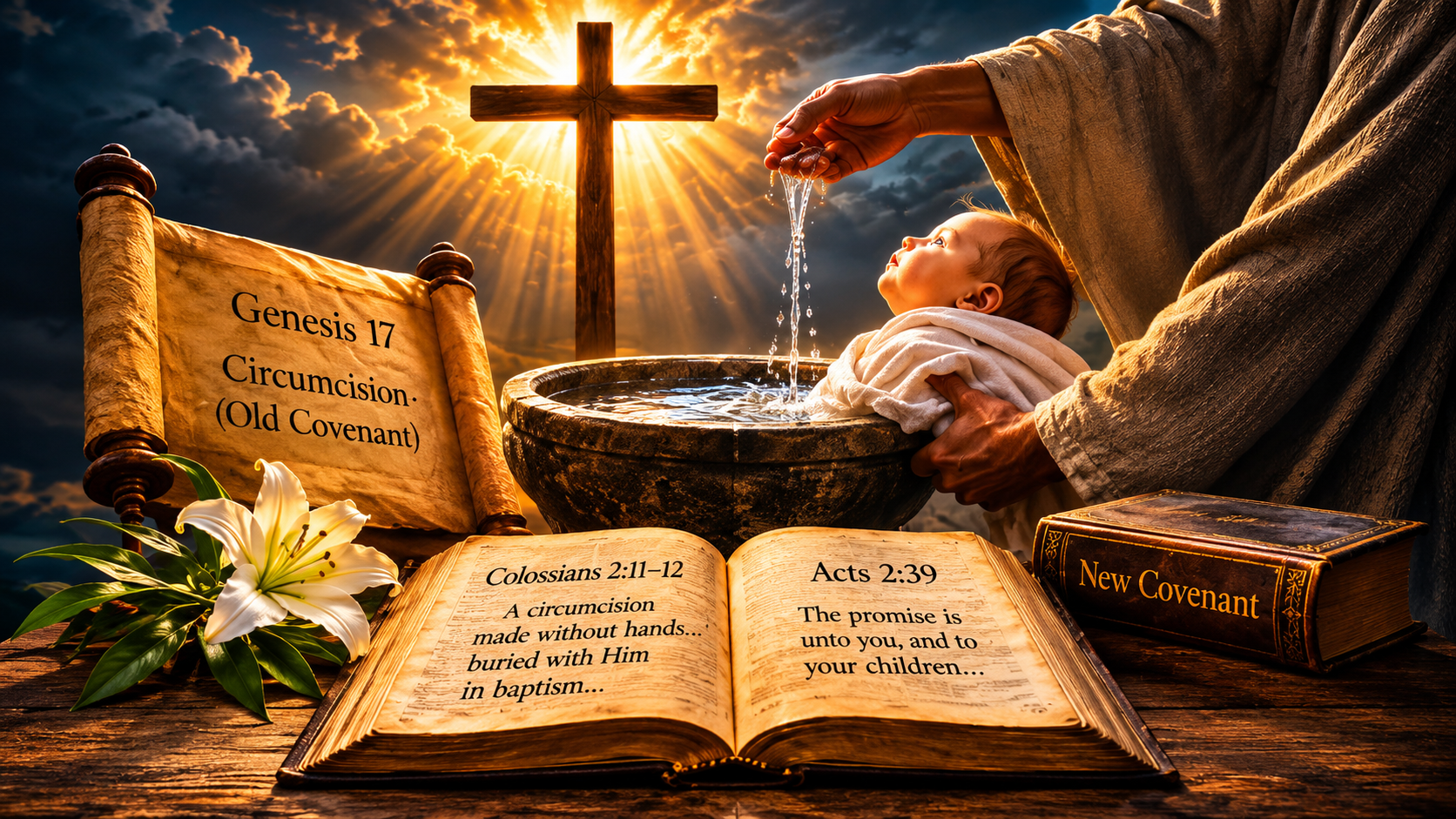
Why Do We Baptize Infants? Examining the Biblical Argument
An examination of a featured SermonAudio sermon, its covenant theology, and the hermeneutical questions it raises.
On November 9, 2026, SermonAudio featured a sermon titled “Why Do We Baptize Our Infants? (Baptism)”, preached by Rev. Joshua Engelsma on July 14, 2024.
Listen to the sermon on SermonAudio
The title raises an important theological question: Why do certain Christian traditions baptize infants?
For Christians who practice infant baptism, the answer is often rooted in their understanding of God’s covenant, the relationship between the Old and New Testaments, and the significance of baptism as a sacrament.
For Christians who reject infant baptism, the central concern is whether the New Testament actually establishes this practice.
These disagreements are not insignificant. They involve fundamental questions about biblical interpretation, the nature of the church, the relationship between faith and baptism, and the authority of theological tradition.
The purpose of this examination is not simply to defend one denominational position against another. It is to listen carefully to the sermon, accurately represent its arguments, and then ask whether those arguments are established by Scripture.
We must distinguish between what Scripture explicitly teaches, what Scripture may reasonably imply, and what a theological system assumes.
That distinction is essential.
1. What Is the Sermon’s Basic Answer?
Rev. Engelsma organizes his sermon around three themes:
- Covenant membership
- Covenant sign
- Covenant rearing
His argument can be summarized as follows.
First, the children of believers belong to God’s covenant.
Drawing primarily from Genesis 17, he argues that God established his covenant not only with Abraham but also with Abraham’s descendants.
He understands this covenant as fundamentally a relationship of friendship between God and his people through Jesus Christ.
Importantly, he does not teach that every child born to believing parents is necessarily saved. He argues that God’s saving covenant belongs exclusively to the elect, although all children of believers live within the external sphere of the covenant.
Second, baptism has replaced circumcision as the covenant sign.
Under the Old Testament, male infants received circumcision as the sign of God’s covenant with Abraham.
According to the sermon, the New Testament replaces circumcision with baptism.
Consequently, if children received the covenant sign under the Old Testament, they should receive the corresponding sign under the New Testament.
Third, children should be raised as covenant children.
The preacher argues that Christian parents should regard their children as members of the covenant community rather than treating them as outsiders awaiting conversion.
He acknowledges the necessity of faith, repentance, gospel instruction, and correction. Nevertheless, he maintains that Christian children should be raised from the perspective that they belong to God’s covenant.
The sermon therefore presents infant baptism as a necessary consequence of covenant theology.
Its central argument is essentially this:
God included believers’ children in his covenant under the Old Testament. Circumcision was the covenant sign. Baptism has replaced circumcision. Therefore, believers’ children must now be baptized.
That is the argument we must examine.
2. The First Hermeneutical Problem: Does Genesis 17 Establish Infant Baptism?
Genesis 17 is foundational to the sermon.
God declares to Abraham:
“And I will establish my covenant between me and thee and thy seed after thee in their generations for an everlasting covenant.” (Genesis 17:7, KJV)
The preacher correctly observes that God’s covenant with Abraham included his descendants.
He also correctly observes that circumcision was commanded for male infants on the eighth day.
These are not disputed facts.
The interpretive difficulty begins when we move from what Genesis 17 actually establishes to what the preacher concludes Christians must practice.
Genesis 17 explicitly commands circumcision.
It does not explicitly command infant baptism.
It does not identify baptism as the replacement for circumcision.
It does not establish that every regulation governing the administration of circumcision must be transferred to Christian baptism.
Those conclusions require additional arguments.
The preacher’s position depends upon the proposition that the Abrahamic covenant and the New Covenant possess sufficient continuity that the recipients of the covenant sign must remain substantially the same.
But this is precisely what must be demonstrated.
It cannot simply be assumed.
Consider several important questions.
Why does the New Testament describe the New Covenant as new?
What significance should we attach to Jeremiah 31:31–34, particularly its description of a covenant in which all its members know the Lord?
How does Hebrews 8 interpret that covenant?
Does the New Testament describe membership in the New Covenant primarily through physical descent, family relationships, faith, regeneration, or some combination of these?
And even if children belong to the visible Christian community, does that necessarily establish that they must receive baptism?
These questions cannot be resolved merely by pointing to the inclusion of children under the Abrahamic covenant.
The existence of a covenant sign under one covenant administration does not, by itself, establish the recipients of a different sign under a later administration.
That relationship must be demonstrated from Scripture.
To be fair, the preacher does attempt to establish continuity through additional passages. His argument is not based on Genesis 17 alone.
Nevertheless, the question remains whether those passages actually prove the continuity he requires.
3. The Second Hermeneutical Problem: Does Colossians 2 Teach That Baptism Replaced Circumcision?
This is arguably the most important passage in the entire argument.
Colossians 2:11–12 connects circumcision and baptism within Paul’s discussion of union with Christ.
The preacher interprets this relationship as evidence that baptism replaced circumcision as the covenant sign.
But we must examine exactly what Paul says.
In verse 11, Paul speaks of a circumcision made without hands.
That language is critical.
Paul is not describing ordinary physical circumcision. He is describing a spiritual reality accomplished in Christ.
He then connects this spiritual circumcision with being buried and raised with Christ in baptism.
The passage certainly establishes a theological relationship between circumcision, baptism, and union with Christ.
But does it explicitly declare that water baptism has replaced physical circumcision as the outward covenant sign?
No.
That is an inference.
It may be defended within a broader theological argument, but it should not be presented as the explicit statement of Colossians 2.
Furthermore, verse 12 connects resurrection with Christ to faith in the working of God.
This introduces another important consideration.
If Paul’s emphasis is on spiritual circumcision, union with Christ, and faith, then we must be careful not to transform the passage into a discussion primarily about the age at which baptism should be administered.
Paul does not mention infants.
He does not command their baptism.
He does not discuss whether the children of believers should receive baptism before professing faith.
The immediate context concerns the believer’s completeness and union with Christ, not a detailed explanation of baptismal eligibility.
The hermeneutical danger is allowing a theological conclusion to determine what a passage must mean rather than allowing the passage to establish the conclusion.
This does not automatically disprove infant baptism.
It does mean that Colossians 2 cannot simply be cited as though Paul explicitly announced a replacement ordinance with identical rules concerning recipients.
4. The Third Hermeneutical Problem: Acts 2:39 and the Promise to Children
The sermon appeals to Peter’s statement at Pentecost:
“For the promise is unto you, and to your children, and to all that are afar off, even as many as the Lord our God shall call.” (Acts 2:39, KJV)
The reference to children is significant.
But we must read the entire statement.
Peter does not simply say that the promise belongs to his audience and their children.
He also includes those who are far off.
And he concludes with the qualification:
“Even as many as the Lord our God shall call.”
The context is Peter’s proclamation of Christ, the response of his hearers, repentance, baptism, and the promise of the Holy Spirit.
Acts 2:38 specifically calls the hearers to repent and be baptized.
Acts 2:41 reports that those who received Peter’s word were baptized.
The text does not explicitly state that infants were baptized.
The preacher understands the reference to children as supporting the continuity of God’s covenant with believers and their offspring.
That is a possible theological inference.
But the text itself does not establish that the children mentioned must receive baptism as infants.
The phrase could encompass the next generation as recipients of the gospel promise, while the concluding qualification identifies those whom God calls.
Indeed, the preacher’s own emphasis on divine election should make that qualification especially significant.
A promise extending to future generations is not necessarily a command to administer baptism to every infant born within those generations.
Those are different propositions.
To move from one to the other requires an additional premise that must itself be justified.
5. The Fourth Hermeneutical Problem: Jesus Welcoming Children
The sermon also appeals to Mark 10:14, where Jesus welcomes little children and declares that the kingdom of God belongs to such as these.
This is an important passage.
It demonstrates Christ’s concern for children and directly challenges any suggestion that children are unimportant or unwelcome in relation to God’s kingdom.
However, the passage does not describe Jesus baptizing these children.
Nor does it command the disciples to baptize them.
Jesus receives them, blesses them, and uses the occasion to teach about receiving the kingdom of God.
The preacher is correct to emphasize that children should not be excluded from consideration within the life and ministry of the church.
But the passage does not answer the specific question raised by the sermon title.
Jesus welcoming children and Jesus commanding infant baptism are not identical claims.
We must not treat the first as though it automatically establishes the second.
6. The Fifth Hermeneutical Problem: Household Baptisms
The preacher appeals to the household baptisms recorded in Acts.
He argues that it is difficult to imagine that none of the households included children.
He acknowledges that Scripture does not specifically identify infants in these households.
This admission is important.
The argument depends partly upon a probability judgment concerning ancient household composition.
But even if children were present, that would not necessarily establish that infants were present.
And even if infants were present, we would still need to establish whether they were included among those baptized.
Consider Acts 16.
In the account of the Philippian jailer, Paul and Silas speak the word of the Lord to him and to those in his house.
The household is baptized, and the narrative connects the event with belief and rejoicing.
There are interpretive questions about the precise relationship between the jailer’s faith and the response of his household.
Nevertheless, the passage cannot simply be reduced to the observation that an entire household was baptized.
The surrounding narrative matters.
Likewise, Acts 18:8 describes Crispus believing in the Lord with his entire household.
The fact that households were baptized does not establish the ages of every recipient.
Nor does it demonstrate that baptism was administered without regard to personal faith.
We should be equally careful in the opposite direction.
The absence of an explicit reference to infants does not prove that infants were absent.
But neither does the possibility of their presence establish that they were baptized.
A historical possibility is not the same thing as a biblical command.
The preacher’s argument moves beyond what the historical narratives explicitly establish.
7. A Major Logical Problem: Baptizing Everyone for the Sake of the Elect
One of the most striking portions of the sermon concerns the relationship between election and infant baptism.
Rev. Engelsma explicitly rejects the idea that every child of believing parents belongs to God’s saving covenant.
He argues that God’s covenant, in its saving reality, belongs only to the elect.
He also acknowledges that parents cannot determine which of their children are elect.
His conclusion is that all the children of believers should be baptized for the sake of the elect among them.
This creates an important logical question.
If the covenant sign properly belongs to those who possess the saving reality of the covenant, and that saving reality belongs only to the elect, how does the inability to identify the elect establish an obligation to baptize every child?
The preacher’s answer is that the elect must receive the sign, so all children receive it.
But notice what has happened.
The inability to identify those who possess the saving reality becomes the justification for administering the sign to everyone within a particular family category.
That conclusion does not follow from election alone.
It requires an additional principle: that God commands the sign to be administered to all children of believers regardless of whether they possess the saving reality.
And that is precisely the principle the sermon is attempting to prove.
The argument therefore risks circularity.
It effectively reasons:
- The elect children must receive the covenant sign.
- We cannot identify the elect children.
- Therefore, all children of believers must receive the covenant sign.
But why does uncertainty about election establish this particular rule?
Why not another rule?
What biblical command establishes believing parentage as the determining criterion for baptism?
This question becomes especially important because the preacher insists that the children of unbelievers do not possess the same covenant standing.
The practical administration of baptism therefore depends on parentage, even though he maintains that the saving reality depends exclusively upon divine election.
That distinction is not necessarily a formal contradiction. Reformed theology can distinguish the visible administration of the covenant from its saving reality.
However, the distinction must be biblically established.
Simply invoking election does not demonstrate why every child of believers must be baptized.
8. Another Logical Problem: The Sign and the Reality
The preacher repeatedly argues that the elect children of believers possess the reality of covenant life and therefore must receive the sign.
This raises a significant question about the relationship between the sign and the thing signified.
If baptism is a sign of a saving reality already possessed, how does the church know that reality exists in a particular infant?
The preacher admits that it does not.
Nevertheless, he argues that the infant should receive the sign.
Now consider the relationship between this argument and his criticism of believer’s baptism.
He objects to the idea that children must demonstrate conscious faith and repentance before receiving baptism.
But the believer’s-baptism position does not ordinarily claim that ministers can infallibly identify the elect.
Rather, it argues that baptism should be administered on the basis of the publicly identifiable response of faith and repentance.
That distinction matters.
A credible profession of faith does not establish infallible knowledge of regeneration.
It provides an observable basis for administering the ordinance.
The preacher’s alternative is to administer baptism on the basis of covenant parentage, while acknowledging that the saving reality may be absent.
Both positions must address the possibility of false appearances.
But the preacher cannot simply dismiss believer’s baptism because a profession of faith might be false.
His own position acknowledges that the outward sign may be administered to someone who does not possess the inward reality.
The question is not which position eliminates uncertainty.
Neither does.
The question is which criterion for administering baptism is established by the New Testament.
That question requires direct biblical argument rather than an appeal to the impossibility of knowing election.
9. A Historical Problem: The Characterization of the Anabaptists
The sermon also offers a historical description of the Anabaptists during the Reformation.
The preacher associates them with radicalism, rejection of civil authority, and rebellion.
There is a historical basis for connecting certain radical Reformation movements with revolutionary activity.
The Münster rebellion of 1534–1535 is a particularly significant example.
However, it would be historically inaccurate to treat all Anabaptists as sharing the same political or revolutionary commitments.
The movement was diverse.
Some groups were revolutionary, while others were explicitly committed to nonviolence.
The Swiss Brethren and later Mennonite traditions provide important examples of Anabaptist commitments to nonresistance and separation from coercive political power.
The Schleitheim Confession of 1527, for example, reflects a very different vision from the revolutionary movement associated with Münster.
Therefore, any historical discussion must distinguish among the various Anabaptist movements.
To his credit, Rev. Engelsma acknowledges that modern Baptists do not necessarily share the views of sixteenth-century Anabaptists.
Nevertheless, the historical presentation risks leaving listeners with an overly generalized picture of the movement.
There is also a logical concern.
Even if every Anabaptist had been politically radical, that would not establish that their rejection of infant baptism was biblically incorrect.
The theological argument must be evaluated independently of the political conduct of particular historical groups.
Historical association is not biblical refutation.
10. Is There a Problem with the Claim That There Is Only One Covenant?
The preacher repeatedly emphasizes that there is one covenant of grace and one people of God throughout the Old and New Testaments.
This is foundational to his argument.
But we must distinguish between theological synthesis and explicit biblical terminology.
Scripture certainly presents profound continuity in God’s redemptive purpose.
Abraham was justified by faith.
Christ is the fulfillment of God’s promises.
Gentile believers are included among Abraham’s spiritual descendants through faith in Christ.
Galatians 3 and Romans 4 are especially important.
Nevertheless, Scripture also explicitly identifies multiple historical covenants.
The covenant with Abraham, the covenant made at Sinai, and the New Covenant are not described as identical in every respect.
Jeremiah 31 declares that the New Covenant will not be like the covenant made when God brought Israel out of Egypt.
Hebrews 8 emphasizes the significance of that distinction.
Therefore, saying that there is one overarching redemptive purpose does not automatically establish that every covenant has identical membership requirements or identical signs.
Continuity must not erase discontinuity.
Likewise, discontinuity must not erase continuity.
A responsible hermeneutic must account for both.
The preacher’s argument tends to make continuity the controlling assumption.
But the New Testament must be allowed to define both what continues and what changes.
We cannot simply assume that because infants received circumcision under the Abrahamic covenant, infants must receive baptism under the New Covenant.
That is the very conclusion requiring demonstration.
11. A Further Problem: What About the New Testament’s Actual Baptismal Pattern?
One of the most important considerations is the pattern of baptism in the New Testament.
In Acts 2, Peter proclaims Christ, calls for repentance, and those who receive his word are baptized.
In Acts 8, the Samaritans believe Philip’s preaching and are baptized.
The Ethiopian eunuch hears the gospel and receives baptism.
In Acts 10, the Holy Spirit falls upon Cornelius and those hearing the word, and Peter commands that they be baptized.
In Acts 18, Crispus believes with his household, and many Corinthians hear, believe, and are baptized.
These accounts establish a recurring relationship between the proclamation of the gospel, faith, and baptism.
We must acknowledge an important limitation.
These are primarily accounts of the gospel reaching new converts.
A defender of infant baptism may reasonably argue that these passages do not directly settle what should happen to children subsequently born into Christian families.
That is a legitimate observation.
Nevertheless, the New Testament’s explicit examples must carry substantial interpretive weight.
The recurring pattern is not irrelevant merely because it concerns conversion.
If a different practice is required for the children of believers, that practice also needs biblical justification.
We cannot treat the explicit pattern as insufficient while treating an inferred replacement of circumcision as decisive.
The standard of proof must remain consistent.
12. The Problem of Moving from Permission to Obligation
Perhaps the most important logical distinction in this entire discussion is the difference between permission and obligation.
Even if someone successfully argues that infant baptism is consistent with New Covenant theology, that does not automatically establish that infant baptism is commanded.
Those are two different claims.
One says that Scripture permits the practice.
The other says that Scripture requires the practice.
Rev. Engelsma argues for the stronger conclusion.
He maintains that baptizing infants belongs to the proper administration of the sacraments.
He also treats the command to circumcise infants under the Old Testament as effectively establishing a command to baptize infants under the New Testament.
But this requires proving more than theological compatibility.
It requires demonstrating that the covenant sign has been replaced, that the recipients remain the same, and that the resulting obligation carries forward.
Each step must be established.
If any essential premise remains unproven, the conclusion does not follow as a necessary biblical obligation.
This is not merely a technical distinction.
It concerns the authority with which ministers speak.
There is a profound difference between saying, “Our theological tradition understands these passages to support infant baptism,” and saying, “God commands Christian parents to baptize their infants.”
The second statement claims divine authority.
That claim demands corresponding biblical evidence.
13. What the Sermon Gets Right
A critical examination should also acknowledge the sermon’s strengths.
The preacher correctly emphasizes that salvation is grounded in God’s grace rather than human achievement.
He recognizes that outward religious signs do not automatically establish that every recipient is saved.
He takes seriously the importance of Christian parents teaching their children the gospel.
He also warns against reducing Christian parenting to a system of rules and behavioral conformity.
His concern that parents should teach the gospel rather than merely produce outwardly obedient children is especially worthwhile.
The sermon also correctly recognizes that the Old and New Testaments cannot be interpreted as unrelated collections of religious documents.
God’s redemptive purpose must be understood in relation to the whole of Scripture.
These are important theological concerns.
However, the presence of sound theological observations does not automatically validate every conclusion drawn from them.
We must distinguish between a sermon’s valuable pastoral instruction and the strength of its central exegetical argument.
14. The Fundamental Hermeneutical Question
The central issue is not whether infant baptism has a long history.
It does.
Nor is the issue whether respected theologians have defended it.
They have.
Nor is the issue whether Reformed covenant theology can construct an internally coherent explanation for the practice.
It can.
The question is whether the specific biblical passages used in this sermon establish the practice as a necessary obligation.
Genesis 17 establishes the circumcision of male infants under the Abrahamic covenant.
Colossians 2 connects spiritual circumcision with union with Christ and baptism.
Acts 2:39 extends the promise to children and those far off, with reference to those whom God calls.
Mark 10 demonstrates Christ’s welcome and blessing of children.
The household baptism narratives establish that households were baptized, but do not explicitly identify infant recipients.
Each passage contributes something important to the theological discussion.
But none explicitly commands the baptism of infants.
That fact does not, by itself, prove infant baptism is wrong. Biblical doctrines can sometimes be established by necessary inference rather than a single explicit command.
However, a necessary inference must actually be necessary.
It cannot merely be possible, plausible, traditional, or consistent with an established theological framework.
A theological conclusion is not established simply because a system can accommodate it.
It must arise from a sound interpretation of the biblical evidence.
Conclusion: Did the Sermon Answer Its Own Question?
The sermon certainly explains why Rev. Engelsma and his theological tradition baptize infants.
Its answer is clear.
They baptize infants because they understand the children of believers to belong to the covenant community, regard baptism as the New Testament replacement for circumcision, and believe that the continuity of God’s covenant requires children to receive the covenant sign.
That is an accurate summary of the position presented.
But explaining why a tradition practices something is not necessarily the same as establishing that Scripture commands it.
The most significant weakness in the sermon is the repeated movement from theological inference to biblical obligation without adequately demonstrating every step.
The argument depends heavily upon a particular understanding of covenant continuity.
That understanding then governs how Genesis 17, Colossians 2, Acts 2, and the household baptism narratives are interpreted.
The danger is that the theological framework may become the controlling authority rather than the conclusion reached through careful exegesis.
This is precisely why hermeneutics matters.
We must be willing to ask whether we are discovering our theology in Scripture or reading our theology into Scripture.
That question must be asked of Baptists, Presbyterians, Lutherans, Reformed Christians, and every other theological tradition.
No tradition should be exempt.
The fact that an interpretation has been repeated for centuries does not make it correct.
The fact that a theological argument is internally coherent does not establish that its premises are biblical.
And the fact that a practice can be defended through a collection of biblical references does not necessarily mean those references teach what the practice requires.
Ultimately, the question is not whether infant baptism can be explained through covenant theology.
It can.
The question is whether covenant theology has accurately interpreted the biblical texts upon which that explanation depends.
We must never confuse a theological system’s explanation of Scripture with Scripture’s establishment of that theological system.
That is the challenge raised by this sermon, and it is a challenge worth taking seriously regardless of one’s position on baptism.

Theology Central 2026: Year in Review