Biblical Illiteracy: How Many More Times!
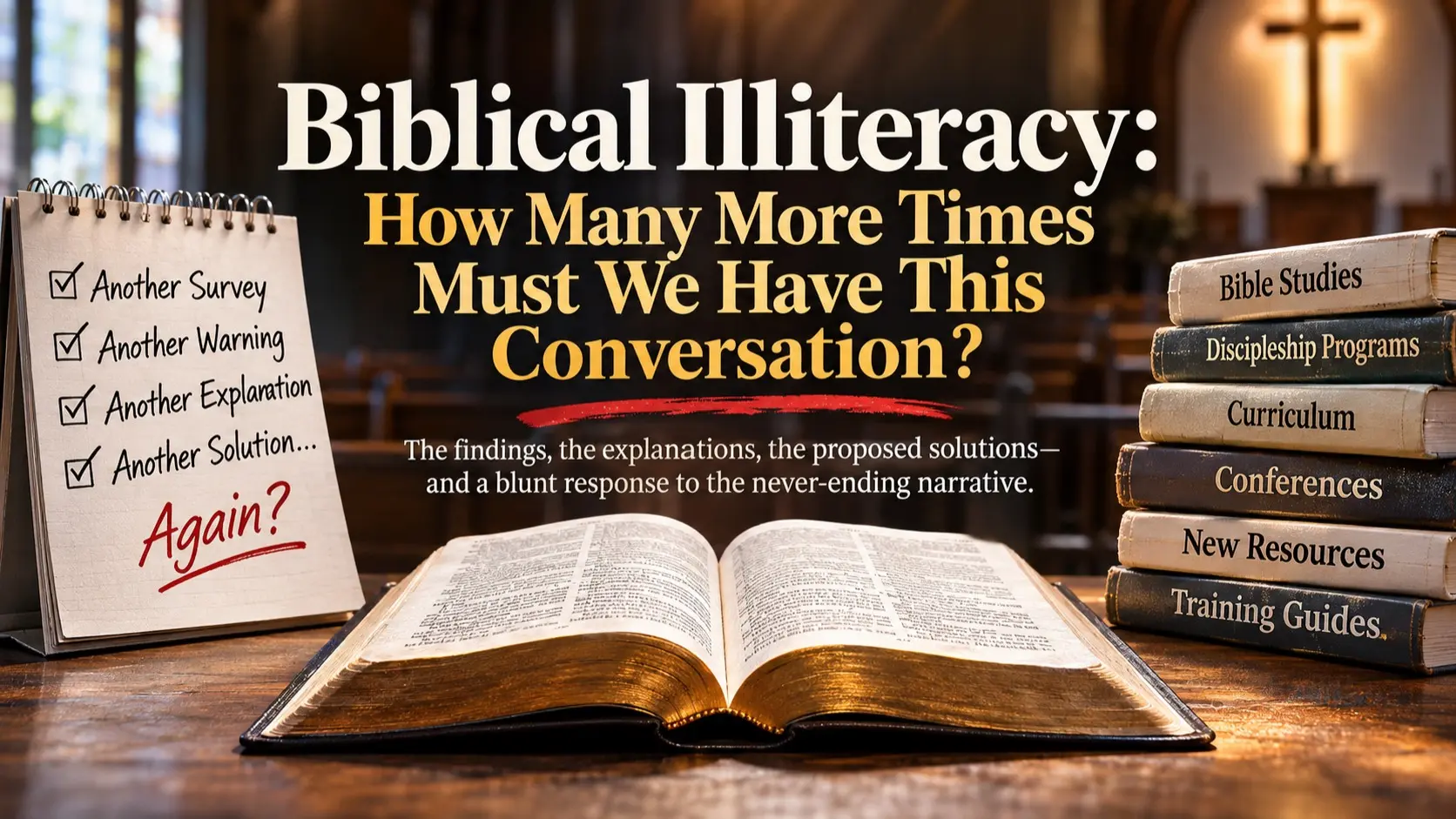
Biblical Illiteracy: How Many More Times Must We Have This Conversation?
Another survey. Another warning. Another explanation. Another proposed solution. At what point do we confront the uncomfortable questions nobody seems willing to answer?
Here We Go Again
I am going to be very direct. I am getting tired of this conversation.
I am tired of the endless articles warning us about biblical illiteracy. I am tired of the alarming statistics. I am tired of being told that Christians don’t know their Bibles. I am tired of hearing that churches need to do a better job of teaching Scripture. And I am particularly tired of the seemingly endless parade of proposed solutions.
How many years have we been having this conversation? How many surveys have been conducted? How many conferences have been organized? How many books have been written? How many Bible study programs have been developed?
And somehow, after all these years, here we are again.
On November 3, 2026, The Gospel Coalition published an article by Jen Wilkin titled “Your Church May Know Less Bible Than You Think (And What to Do About It).”
Let me be clear from the beginning. I am not suggesting that biblical illiteracy is imaginary. I am not disputing that many professing Christians lack even a basic understanding of Scripture. I am not arguing that churches should abandon biblical education.
My frustration is something entirely different.
We have been identifying this problem for decades. We have more biblical resources available than any previous generation could have imagined. We spend enormous amounts of money maintaining churches, ministries, publishing operations, educational institutions, and conferences.
Yet we keep hearing the same diagnosis.
At some point, shouldn’t we begin asking whether we have fundamentally misunderstood the problem?
And perhaps even more importantly, shouldn’t we start asking some uncomfortable questions about the people who claim to have the solutions?
The Latest Findings: How Little Do Churchgoers Know?
Wilkin’s article discusses a new Lifeway Research survey involving more than 2,000 Christians who attend church during a typical month.
The survey examined eight categories of biblical knowledge, including biblical people, events, passages, and the structure of Scripture. According to the article, researchers intentionally selected questions concerning material they believed should be reasonably familiar rather than obscure biblical details.
The findings are certainly concerning.
-
Approximately two-thirds of respondents scored below 60.
-
Fifty-five percent could not correctly identify Israel’s first king.
-
Only 11 percent correctly arranged four major Old Testament events in chronological order.
-
Only 27 percent correctly arranged four major New Testament events.
-
Forty-four percent failed to identify Mark as one of the Gospels.
-
Approximately two-thirds incorrectly believed Hezekiah was a book of the Bible.
-
Forty-four percent believed the Gospel of Thomas belonged in the Bible.
These are the findings as reported in Wilkin’s article. They describe the performance of the surveyed churchgoers, not necessarily every professing Christian in America.
Still, the results are disturbing.
We are not discussing whether people can explain the complex theological arguments of Romans 9–11, identify the historical circumstances surrounding the composition of Isaiah, or evaluate the textual differences between the Masoretic Text and the Septuagint.
We are discussing basic familiarity with biblical books, people, and events.
But before we go any further, there is a question we should not ignore.
What exactly does biblical literacy mean?
Is it the ability to identify biblical characters? Is it knowing the chronological order of biblical events? Is it understanding the structure of Scripture? Is it the ability to interpret passages in their historical and literary contexts?
These are related, but they are not identical.
Someone can correctly identify Saul as Israel’s first king while completely misunderstanding the significance of Israel’s demand for a king in 1 Samuel 8.
Someone can memorize dozens of Bible verses while consistently removing those verses from their contexts.
Someone can score very well on a biblical knowledge examination while possessing a deeply confused understanding of the gospel.
Therefore, even if we successfully improve these survey results, we have not necessarily solved the deeper problems of biblical interpretation and theological understanding.
But for the moment, let’s accept the findings as evidence of a serious problem.
What explanation does the article offer?
The Explanation: A Culture That Doesn’t Read and Churches That Don’t Teach Effectively
Wilkin places the problem within a broader cultural decline in reading.
She cites figures indicating that Americans over age fifteen spent an average of 21.9 minutes reading on a given day in 2003, compared with 18.3 minutes in 2010 and 16.2 minutes in 2025.
Her concern is that we are becoming a culture increasingly dependent on images, short-form information, and material that has already been interpreted and summarized for us.
Christians, she argues, have not escaped this cultural transformation.
Instead of reading Scripture, we frequently consume sermons, podcasts, devotionals, and books about Scripture. We become familiar with what other people say about the Bible without necessarily developing familiarity with the biblical text itself.
I think there is considerable truth in that observation.
Wilkin then moves to the institutional problem.
She describes biblical illiteracy as a failure of discipleship strategies.
She references a 2024 Lifeway Research survey of 2,620 Protestant pastors. According to the figures she reports, 52 percent were satisfied with discipleship and spiritual formation in their churches, while only 29 percent said they regularly evaluated discipleship progress.
Perhaps most significantly, 89 percent identified sermons as an approach their churches used for adult discipleship.
Wilkin argues that sermons matter enormously but cannot independently carry the responsibility of biblical education. She characterizes sermons as largely passive, one-directional learning environments and questions whether churches have relied too heavily on preaching and community discussion groups.
She compares the situation to education in a public school. Students would not be expected to master mathematics simply by listening to occasional lectures and then discussing how those lectures applied to their personal lives.
Her point is that churches need more intentional, structured educational instruction.
The Proposed Solution: Return to Serious Biblical Education
To be fair, Wilkin is not primarily calling for some revolutionary new product or fashionable educational gimmick.
She explicitly argues that churches need to recover older, proven educational practices.
Her recommendations include establishing dedicated learning environments, developing a clear sequence of biblical instruction, placing knowledgeable teachers in those environments, and recognizing that effective teaching requires more than simply asking congregants what they would like to study.
She also emphasizes interactive instruction and teachers who genuinely love their subject.
The article directs readers to a Lifeway biblical literacy assessment containing 25 questions and to a Gospel Coalition conference session addressing the recovery of effective Christian education.
There is nothing inherently unreasonable about these recommendations.
Churches should teach Scripture carefully. Teachers should understand their subjects. Educational programs should have clear objectives. Congregations should not confuse social interaction with serious biblical instruction.
I agree with much of that.
But here is where my frustration begins.
How many times are we going to identify the same problem, propose another educational adjustment, and then act surprised when the next survey tells us biblical illiteracy remains widespread?
Wilkin herself acknowledges that she was writing about the biblical literacy crisis for The Gospel Coalition back in 2012.
Fourteen years later, she is still addressing the problem.
That is an extraordinary admission, and I think it deserves more attention.
Because at some point, the question is no longer simply whether biblical illiteracy exists.
The question becomes why our responses have apparently accomplished so little.
First: When Are We Going to Hold Christians Personally Responsible?
Here is something I believe needs to be said much more frequently and much more directly.
If you are biblically illiterate, there is a very real possibility that the primary responsibility belongs to you.
Not your pastor.
Not your church.
Not your Sunday school teacher.
You.
We are living in an age of almost unimaginable access to biblical information.
Think about what is available.
Multiple Bible translations. Study Bibles. Audio Bibles. Free Bible applications. Bible dictionaries. Commentaries. Historical resources. Language tools. University lectures. Seminary courses. Sermon archives. Podcasts. Articles. Videos. Reading plans. Online theological libraries.
Many of these resources are available completely free.
A person with a smartphone can access more biblical information in an afternoon than many Christians throughout history could access in an entire lifetime.
We are not suffering from a shortage of resources.
We are drowning in them.
And yet we continue to discuss biblical illiteracy as though Christians are desperately waiting for someone to provide them with an opportunity to learn.
At what point do we acknowledge the possibility that many people simply do not care enough to learn?
At what point do we acknowledge that some people have no serious desire to study Scripture?
At what point do we stop pretending that every failure to learn must be explained by a failure in someone else’s teaching strategy?
Of course, there are legitimate exceptions. Some people face educational barriers, disabilities, language difficulties, or genuine confusion caused by poor instruction. Access to information also does not automatically guarantee comprehension.
But those realities cannot become a universal excuse.
If someone has attended church for twenty years, owns multiple Bibles, has access to endless resources, and still has almost no familiarity with Scripture, surely personal responsibility must enter the discussion.
We cannot force people to value what they have no interest in learning.
We can provide instruction. We can encourage study. We can make resources accessible. We can answer questions.
But we cannot manufacture desire through another curriculum.
And if the fundamental problem is indifference, then continuing to propose educational programs without confronting that indifference may accomplish very little.
Second: If Preaching God’s Word Cannot Teach People God’s Word, What Exactly Is the Point?
This particular argument about sermons drives me absolutely crazy.
We are repeatedly told that sermons are insufficient to correct biblical illiteracy.
Think about how ridiculous that can sound.
The preaching of God’s Word cannot adequately address people’s ignorance of God’s Word?
Seriously?
Then what exactly have we been doing every Sunday?
What have pastors been doing for decades?
Why do we gather to hear Scripture read, explained, proclaimed, and applied?
I understand the distinction between saying that sermons alone cannot provide comprehensive biblical education and saying that sermons cannot meaningfully teach Scripture.
Those are different claims.
A thirty-minute sermon cannot cover every book of the Bible or replace years of personal study.
But if someone attends church consistently for twenty years, that person may have listened to approximately a thousand Sunday sermons, even before counting additional services, Bible studies, and other instruction.
A thousand sermons!
And we are supposed to believe that preaching cannot make a substantial difference in that person’s biblical knowledge?
Perhaps we should ask what was happening during those thousand sermons.
Were biblical books being explained?
Were congregations learning historical context?
Were they being taught how biblical arguments develop?
Were difficult passages examined carefully?
Were people learning to distinguish interpretation from application?
Or were they listening to inspirational speeches, motivational presentations, personal anecdotes, and moralistic lessons with a few biblical verses attached?
Maybe the problem isn’t that sermons are inherently inadequate.
Maybe the problem is that too many sermons are inadequate.
Consider Nehemiah 8:8, where the people read from the Law of God and explained its meaning so the people could understand what was being read.
Consider Paul’s instruction in 1 Timothy 4:13 to devote attention to the public reading of Scripture, exhortation, and teaching.
Consider the instruction in 2 Timothy 4:2 to preach the Word.
Public proclamation and instruction are not incidental to the church’s responsibility.
They are central to it.
Now, preaching has purposes beyond improving biblical knowledge. It proclaims Christ, announces the gospel, confronts sin, and comforts those burdened by guilt and suffering. Its value cannot be reduced to performance on a written examination.
But surely we should expect the faithful exposition of Scripture to produce some meaningful understanding of Scripture over time.
If it does not, we need to ask serious questions about what is being preached.
And perhaps even more uncomfortable questions about the people doing the preaching.
Third: How Much Money Are We Spending, and What Are We Accomplishing?
Here is another question that needs to be asked.
What does it cost to keep an average American church operating for one year?
Think about the expenses.
Buildings. Utilities. Insurance. Maintenance. Salaries. Benefits. Technology. Administrative expenses. Educational programs. Ministry budgets.
Now multiply those expenditures across thousands upon thousands of congregations.
We are talking about an enormous financial investment in maintaining the institutional life of American Christianity.
And after all that spending, we are still being told that churchgoers cannot identify basic biblical people, books, and events.
Does anybody else find this disturbing?
Churches exist for more than biblical education. They gather for worship, administer pastoral care, serve their communities, and carry out numerous responsibilities that cannot be measured by a literacy survey.
I understand that.
But teaching Scripture is not some optional activity that churches undertake when the budget allows.
It is fundamental to their calling.
So if a church spends substantial amounts of money year after year while its congregation remains largely ignorant of Scripture, shouldn’t someone ask whether its priorities are correct?
Shouldn’t someone ask whether its teaching ministry is effective?
Shouldn’t someone ask whether the institution has become better at maintaining itself than accomplishing its stated responsibilities?
I am not suggesting that every church is failing or that every dollar spent on a building is wasted.
I am asking why financial accountability and educational effectiveness are so rarely brought together in these discussions.
We should be willing to evaluate the results of what we are funding.
And if we are spending enormous sums maintaining churches that consistently fail to teach their congregations the basic content of Scripture, then yes, we should be willing to discuss whether some of that money is being wasted.
Fourth: The Never-Ending Biblical Illiteracy Industry
Here is another part of this entire discussion that has become exhausting.
The problem is announced.
The statistics are presented.
The church is warned.
The need for change is emphasized.
And inevitably, somewhere in the larger conversation, we are introduced to another book, another study guide, another curriculum, another conference, another educational initiative, or another parachurch ministry.
Apparently, the Christian world never runs out of resources designed to solve biblical illiteracy.
And yet it never seems to run out of biblical illiteracy either.
That should make us stop and think.
I want to be fair to Wilkin. Her particular article explicitly criticizes the tendency to purchase the latest study from a Christian publisher without a serious educational strategy. She advocates recovering established teaching practices rather than inventing something new. The article points readers to a free assessment and a conference presentation, not to a mandatory commercial purchase.
So I am not accusing her of deliberately exploiting the problem.
My concern is with the broader Christian educational and publishing ecosystem.
There is an enormous market built around helping Christians understand the Bible.
Books are published. Curricula are developed. Conferences are promoted. Ministries raise money. Educational programs are marketed.
Some of these resources are excellent. Some have undoubtedly helped people.
But where is the accountability?
Where are the long-term evaluations demonstrating that these solutions are actually correcting the problem?
Where is the willingness to admit that a particular approach failed?
And how many times are Christians expected to purchase another resource before someone acknowledges that the availability of resources may not be the central issue?
There is something deeply troubling about a religious culture that continually produces solutions to a crisis that it continually announces has not been solved.
At the very least, we should stop confusing the production of educational material with the achievement of educational results.
Publishing another Bible study is not the same thing as producing biblical literacy.
Fifth: Perhaps We Are Measuring the Wrong Things
There is another serious problem with this conversation.
We frequently reduce biblical literacy to factual knowledge.
Can someone identify a biblical character? Can someone name the books of the Bible? Can someone place events in chronological order?
Those things matter.
But what happens when someone knows all those answers and still cannot interpret Scripture responsibly?
What happens when someone can quote Jeremiah 29:11 but has no understanding of the historical circumstances of the Babylonian exile?
What happens when someone can recite Philippians 4:13 but treats the verse as a guarantee of personal success?
What happens when someone knows the story of David and Goliath but assumes the central point is that God will help them defeat their personal giants?
What happens when someone knows the Sermon on the Mount but turns it into a program for achieving the righteousness necessary to earn God’s acceptance?
We may be producing people who know biblical facts while remaining profoundly confused about biblical meaning.
And this raises another uncomfortable possibility.
What if some churches are not merely failing to correct biblical illiteracy?
What if they are actively contributing to biblical misunderstanding?
What if years of sermons, devotionals, and Bible studies have taught people to approach Scripture primarily as a collection of inspirational statements, moral examples, and promises about their personal circumstances?
Then the problem is much deeper than the inability to identify Israel’s first king.
We have a hermeneutical problem.
We have a theological problem.
And perhaps we have a preaching problem.
A person can know an extraordinary amount of information about the Bible while misunderstanding its central message.
Biblical knowledge is essential, but knowledge must be joined to responsible interpretation.
Otherwise, we risk creating Christians who are increasingly confident in interpretations that the biblical texts do not actually support.
Sixth: What If the Problem Is Not Primarily Educational?
This is the question I keep returning to.
What if many Christians are biblically illiterate because studying Scripture simply isn’t important to them?
Not because they lack a Bible.
Not because they cannot find a commentary.
Not because nobody has created the right curriculum.
Not because the church has failed to offer enough programs.
But because they have chosen to devote their time, attention, energy, and interest to other things.
We need to be willing to consider that possibility.
People find ways to learn about things they genuinely care about.
They learn about sports, entertainment, politics, technology, hobbies, investments, and countless other subjects.
They research. They listen. They watch. They read. They ask questions. They seek out experts.
They become remarkably knowledgeable about subjects that capture their interest.
Yet when the subject is Scripture, we are repeatedly told that the church needs to develop a better educational system.
Perhaps it does.
But perhaps we also need to ask why so many people who profess to believe the Bible is God’s Word demonstrate so little interest in understanding it.
That question is uncomfortable because it concerns desire, priorities, and personal responsibility.
And those are not problems that can necessarily be corrected by reorganizing a Sunday school program.
I am not claiming that every biblically illiterate Christian is indifferent or insincere. That would go beyond what the evidence establishes.
But I am arguing that indifference must be treated as a serious possible explanation rather than something we avoid discussing.
We should not automatically assume that everyone who lacks biblical knowledge is desperately eager to learn and merely waiting for the right teaching method.
Some may simply not want to make the effort.
And no amount of institutional restructuring can guarantee that they will.
Seventh: When Will We Hold Everyone Accountable?
Here is what I find so frustrating about the entire discussion.
Congregations can blame their churches.
Pastors can blame their congregations.
Educational specialists can blame ineffective teaching methods.
Publishers can offer more resources.
Parachurch ministries can propose additional programs.
And everyone can agree that biblical illiteracy is a terrible problem.
But agreement that a problem exists is not the same thing as solving it.
At some point, responsibility must be shared.
Christians must take responsibility for what they choose to read, study, and learn.
Pastors must take responsibility for what they preach and teach.
Churches must take responsibility for their educational priorities and the use of their financial resources.
Christian publishers and educational organizations should be willing to evaluate whether their proposed solutions actually accomplish what they promise.
And researchers must be careful not to confuse factual biblical knowledge with the much broader questions of interpretation and theological understanding.
Nobody should be exempt from scrutiny.
And nobody should be permitted to use the existence of biblical illiteracy as an excuse to avoid examining their own contribution to the problem.
Conclusion: Enough With the Endless Announcements
I do not need another survey to convince me that biblical illiteracy exists.
I do not need another article telling me that Christians should know their Bibles.
I do not need another conference explaining that churches need to teach Scripture.
I understand the problem.
I have heard about it for years.
What I want to know is why we are still having the same conversation.
Why, after decades of warnings, are we still discussing such basic failures?
Why, with unprecedented access to biblical information, are so many Christians unfamiliar with Scripture?
Why, after thousands of sermons and enormous institutional expenditures, are congregations still struggling with elementary biblical knowledge?
Why does the Christian publishing world continue producing educational resources without any apparent end to the crisis those resources are supposed to address?
And why are we so reluctant to consider that some Christians simply have little desire to study the Bible?
I am not calling for the abandonment of biblical education.
I am calling for something much more demanding.
Stop treating biblical illiteracy as though it is a newly discovered emergency. Stop assuming that another program is necessarily the answer. Stop excusing personal indifference. Stop treating preaching as though it is incapable of teaching Scripture. Stop spending money without asking whether the teaching ministry is accomplishing anything. And stop confusing familiarity with biblical facts with the ability to interpret Scripture faithfully.
We need serious biblical teaching.
We need responsible interpretation.
We need pastors who actually explain Scripture.
We need Christians who take personal responsibility for learning.
And we need the courage to examine whether our institutions are accomplishing what they claim to exist to accomplish.
The next time another survey announces that Christians don’t know their Bibles, perhaps we should resist the temptation to act shocked.
Perhaps we should ask a far more important question.
After all these years, all these sermons, all these books, all these programs, and all this money, why haven’t we made more progress?
And perhaps the most uncomfortable question of all:
What if the problem is not that Christians lack opportunities to know the Bible, but that far too many simply do not care enough to know it?
Until we are willing to confront that possibility, I suspect we will be reading another article about the biblical illiteracy crisis next year.
And the year after that.
And the year after that.
With another survey.
Another warning.
And, inevitably, another proposed solution.
At some point, enough is enough.
Primary article discussed: Jen Wilkin, “Your Church May Know Less Bible Than You Think (And What to Do About It),” The Gospel Coalition, November 3, 2026. Survey findings and the author’s recommendations are summarized from that article. The criticisms and conclusions presented here are an independent response, not claims made by Wilkin.

