Ohio State Fraternity Incident: The Dangerous Price of Belonging
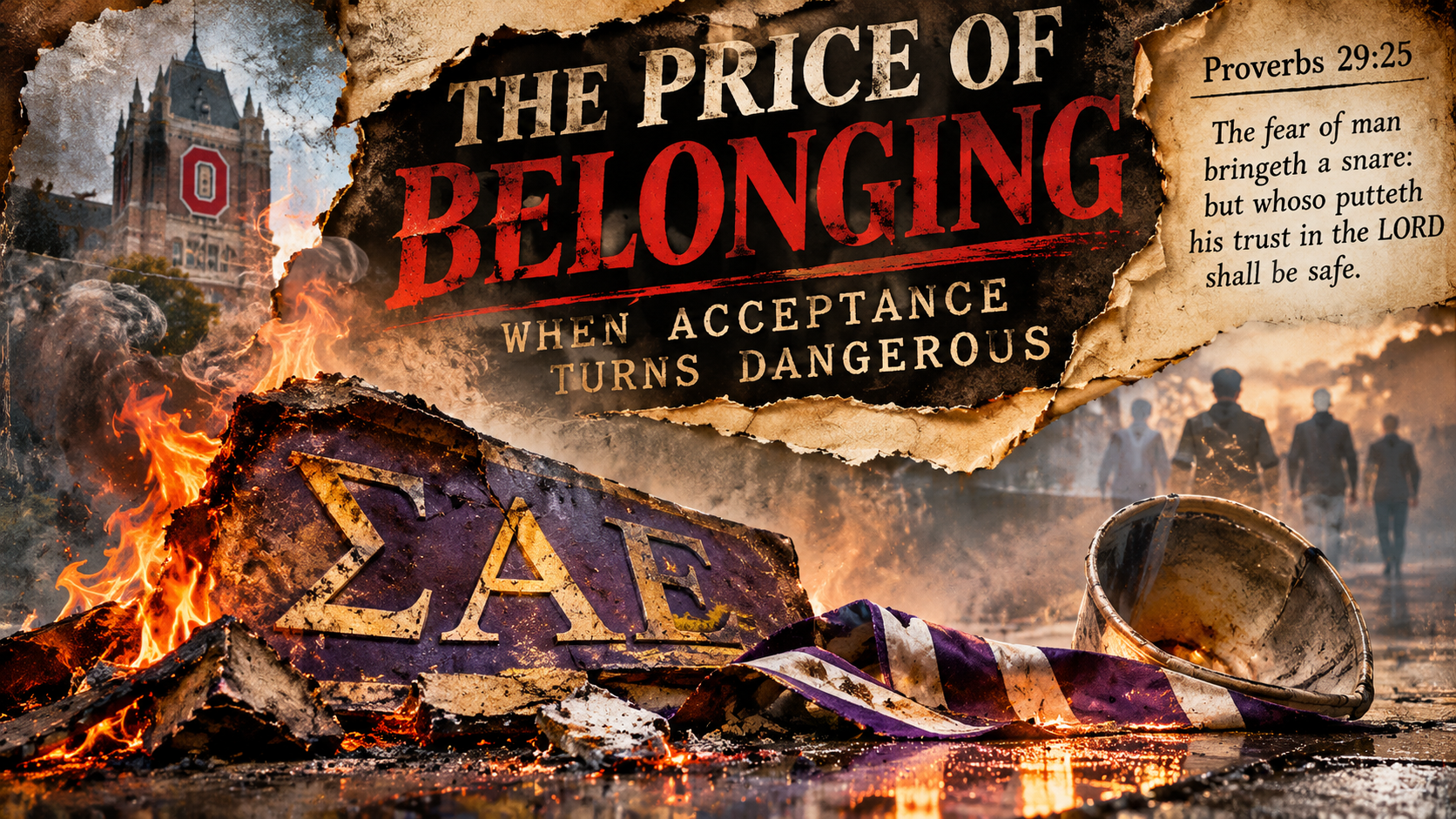
The Fear of Man: What Are We Willing to Sacrifice to Belong?
An emotional and theological response to the Ohio State fraternity incident
There are certain news stories that leave me shaking my head. Others make me angry. Some leave me frustrated with the world in which we live.
And then there are stories that make me almost physically sick because I cannot comprehend the thinking, the behavior, or the willingness of human beings to participate in something so utterly ridiculous and potentially destructive.
The recent news out of Ohio State University is one of those stories.
On November 9, 2026, reports emerged that Ohio State had temporarily suspended the Sigma Alpha Epsilon fraternity following a disturbing incident captured on video. The footage appeared to show two individuals catching fire, with one person’s burning clothing apparently igniting another person’s clothing. People could be heard shouting and laughing, while others eventually intervened. The individuals involved were reportedly receiving medical care.
Authorities are investigating the circumstances. We do not yet know exactly what happened, whether hazing was involved, or how responsibility should be assigned.
Those distinctions matter. We should never turn allegations into established facts simply because a story provokes a powerful emotional reaction.
But the incident immediately brought to my mind something that has frustrated me for as long as I can remember: the willingness of human beings to humiliate themselves, surrender their dignity, compromise their convictions, and sometimes risk their very lives simply to be accepted by other human beings.
I will never understand it.
I do not understand it now. I did not understand it when I was in high school. And I suspect I will never understand it.
What is so valuable about belonging to a fraternity, a club, a social group, or some supposedly exclusive organization that someone would willingly submit to humiliation, abuse, degradation, or dangerous behavior to gain admission?
For what?
A membership?
A title?
A group of friends?
The privilege of wearing certain letters on a shirt?
The ability to say that you belong?
Is that really worth surrendering your judgment, your dignity, your safety, or potentially your life?
And perhaps the more troubling question is this:
Has the human desire for acceptance become so powerful that it can overwhelm rational thought, moral judgment, and even the instinct for self-preservation?
I Refused to Play Their Games
This subject is personal to me because I remember dealing with this mentality when I was in high school.
There were expectations about what you were supposed to do, how you were supposed to behave, and what you were supposed to tolerate to fit in.
And I refused.
I was not interested in participating in someone else’s stupid games simply to obtain their approval.
I was not interested in humiliating myself to make someone else laugh.
I was not interested in allowing another person to exercise some imaginary authority over me because they belonged to a particular group or occupied a particular position in a ridiculous social hierarchy.
I refused to play their stupid reindeer games.
And yes, that refusal sometimes made things more difficult.
Refusing to participate does not necessarily make you popular. It does not guarantee that people will respect your decision. Sometimes it makes you a target for further ridicule or exclusion.
But I could never understand why I should surrender my judgment simply because someone else demanded it.
Why should their opinion of me become more important than my own convictions?
Why should I participate in something I believe is wrong merely because refusing might make me unpopular?
Why should I give another human being that much power over my life?
I am not suggesting that I have always been courageous, that I have never feared people, or that I have never compromised in other areas of life.
I am a sinner like everyone else.
But this particular kind of social manipulation has always provoked a strong reaction in me.
And when I read stories involving hazing, humiliation, injury, and sometimes death, that reaction becomes even stronger.
Because behind these incidents lies a profoundly disturbing question about human nature.
How Desperate Are We to Be Accepted?
Human beings are social creatures.
We desire friendship, companionship, community, affection, recognition, and belonging.
There is nothing inherently wrong with those desires.
In Genesis 2:18, God declares that it is not good for the man to be alone. Although that passage directly introduces the creation of the woman and the marriage relationship, it also reminds us that human beings were not created for complete isolation.
Scripture repeatedly emphasizes fellowship, mutual care, love, encouragement, and life together.
The problem is not the desire to belong.
The problem begins when the desire to belong becomes so powerful that we are willing to sacrifice what is right to obtain it.
Consider what happens in an abusive hazing environment.
An individual wants to become part of a group. That group possesses something the individual desires: status, friendship, social opportunity, identity, or acceptance.
But acceptance comes with conditions.
You must prove yourself.
You must demonstrate loyalty.
You must endure humiliation.
You must submit to the authority of existing members.
You must participate in activities you might otherwise reject.
And suddenly the question is no longer whether something is reasonable, moral, or safe.
The question becomes whether refusing will cost you your place in the group.
This is where social pressure becomes dangerous.
People may do things in groups that they would never consider doing alone. They may suppress objections because everyone else appears comfortable. They may interpret their own discomfort as weakness. They may convince themselves that suffering is simply the price of admission.
And the more they have already endured, the more difficult it may become to walk away.
After all, if you have already tolerated humiliation for several weeks, admitting that the entire process is ridiculous may mean acknowledging that you suffered for nothing.
So the cycle continues.
But none of this makes the behavior rational or acceptable.
It merely helps explain how people can become trapped in destructive social systems.
And Scripture has a great deal to say about this problem.
Proverbs 29:25 — The Fear of Man Is a Snare
One of the clearest biblical statements concerning this subject appears in Proverbs 29:25:
“The fear of man bringeth a snare: but whoso putteth his trust in the LORD shall be safe.”
The word translated snare communicates the idea of a trap.
That is a powerful image.
The fear of man does not merely make life uncomfortable.
It can trap us.
It can restrict our choices.
It can influence our behavior.
It can lead us to act against our better judgment.
It can make us prisoners of other people’s expectations.
In its wisdom-literature context, the proverb contrasts the danger of fearing human beings with the security of trusting the Lord.
It is not promising that trusting God guarantees physical protection from every danger. Faithful people can suffer terribly.
Rather, it identifies the fundamental danger of allowing fear of human beings to govern our decisions instead of trusting God.
And consider how directly that principle speaks to the problem of hazing.
What if I refuse?
What if they laugh at me?
What if they reject me?
What if I lose my opportunity to belong?
What if everyone thinks I am weak?
What if I become an outsider?
Those questions can become a trap.
And once caught in that trap, a person may begin doing things that violate common sense, personal convictions, and basic moral responsibility.
But we should also recognize something else.
The biblical warning does not apply only to the person being pressured.
It applies to the person exercising the pressure.
What kind of individual derives satisfaction from humiliating another human being?
What kind of group makes degradation a condition of acceptance?
What kind of supposed friendship requires someone to surrender personal dignity before being welcomed?
If a relationship requires humiliation, intimidation, or danger as the price of admission, we should seriously question whether that relationship deserves to be pursued at all.
John 12:42–43 — Loving Human Praise More Than God’s Praise
Another revealing passage appears in John 12:42–43.
John tells us that many among the rulers believed in Jesus, but because of the Pharisees they would not openly confess him, fearing exclusion from the synagogue.
Then John provides this devastating explanation:
“For they loved the praise of men more than the praise of God.”
Consider the situation.
These individuals faced a conflict between their response to Jesus and the social consequences of publicly identifying with him.
Their fear of exclusion influenced their behavior.
The immediate context is not fraternity hazing, social clubs, or peer pressure among students.
It concerns the response of religious authorities to Jesus and the consequences of confessing him.
We must respect that context.
But the underlying moral conflict is unmistakable.
Human approval can become so valuable to us that it influences whether we act according to what we believe is true.
The approval of others becomes a controlling force.
And this raises an uncomfortable question.
How much of what we do is motivated by conviction, and how much is motivated by the desire to be accepted?
How often do we remain silent because speaking might make us unpopular?
How often do we participate because refusing would make us different?
How often do we compromise because we cannot tolerate the possibility that someone might reject us?
This is not merely a problem among college students.
It is a human problem.
And Christians are certainly not immune.
Galatians 1:10 — Whose Approval Are We Seeking?
The apostle Paul asks a striking question in Galatians 1:10:
“For do I now persuade men, or God? or do I seek to please men? for if I yet pleased men, I should not be the servant of Christ.”
The context is critically important.
Paul is defending the divine origin and authority of the gospel he preached. He has just pronounced a severe warning against anyone proclaiming a different gospel.
His point is not that Christians should be rude, indifferent to others, or incapable of accommodating legitimate preferences.
In fact, elsewhere Paul describes adjusting his conduct for the benefit of others in the service of the gospel.
The issue in Galatians is whether Paul will alter the gospel to obtain human approval.
He will not.
And that distinction is essential.
There is a difference between loving people and living for their approval.
There is a difference between seeking peace and surrendering truth.
There is a difference between showing consideration and allowing other people to dictate our convictions.
The Christian is called to love others, but not to make human approval the ultimate authority.
And this confronts us with a serious question.
If we cannot tolerate rejection by a social group, how prepared are we to endure rejection for the sake of Christ?
If the possibility of being laughed at can make us abandon common sense, what happens when faithfulness to Scripture carries a genuine social cost?
Exodus 23:2 — You Shall Not Follow a Multitude to Do Evil
There is another passage that deserves our attention.
Exodus 23:2 begins:
“Thou shalt not follow a multitude to do evil.”
In its immediate context, this command concerns justice, testimony, and the danger of allowing a crowd to distort what is right in a legal matter.
It is not originally a general discussion of social conformity.
Nevertheless, the command reveals a moral principle that extends beyond its immediate judicial setting.
The number of people participating in something does not determine whether it is right.
A crowd does not create moral authority.
Popularity does not establish truth.
Tradition does not justify cruelty.
And the fact that something has supposedly been done for generations does not make it acceptable.
I find this particularly relevant to hazing traditions.
How often are destructive practices defended with statements such as:
We all had to go through it.
It is just tradition.
It builds character.
It creates brotherhood.
It proves commitment.
It is part of the experience.
But none of those explanations establishes that the behavior is morally defensible.
If something is degrading, dangerous, abusive, or cruel, the fact that previous generations endured it does not justify repeating it.
Perhaps the appropriate response to a destructive tradition is not to preserve it.
Perhaps the appropriate response is to end it.
The Sin of Those Who Demand Submission
I want to make something very clear.
It would be a serious mistake to examine hazing only by asking why people agree to participate.
That question matters, but it is not the only question.
We must also examine those who create, encourage, and enforce these practices.
Why does humiliating another person become entertainment?
Why does exercising power over someone become a source of satisfaction?
Why do groups sometimes celebrate behavior that would be recognized as cruelty outside the group?
Here we should consider Mark 10:42–45.
Jesus contrasts the way rulers among the Gentiles exercise authority with the pattern expected among his disciples.
He explains that greatness among his followers is expressed through service rather than domination.
The immediate context concerns ambition, status, and authority among the disciples.
It is not a direct prohibition of college hazing.
But the contrast is striking.
In one system, greatness is associated with exercising power over others.
In the kingdom ethic Jesus teaches, greatness is expressed through serving others.
Consider the difference.
One person says, “If you want to belong, you must submit to my demands.”
Christ teaches his disciples to serve rather than dominate.
One system makes acceptance dependent upon humiliation.
The other calls people away from self-exaltation and toward humble service.
What kind of moral character is being cultivated when an organization teaches its members that authority provides an opportunity to degrade others?
And what does it say about a group’s understanding of friendship if its members are expected to endure abuse before being welcomed?
These questions should trouble us.
Deeply.
Christians Are Not Immune to the Same Problem
Before we become too comfortable condemning fraternities, we should examine our own religious communities.
Because the fear of man does not disappear when someone walks through the doors of a church.
It can simply take a different form.
Christians can become obsessed with acceptance.
Acceptance by a pastor.
Acceptance by church leadership.
Acceptance by a denomination.
Acceptance by a theological movement.
Acceptance by a particular group of believers.
And sometimes that desire for acceptance can lead people to remain silent about serious concerns, tolerate mistreatment, or conform to expectations they have never carefully examined in Scripture.
A person may be afraid to ask a question because it could make them appear spiritually immature.
Someone may hesitate to challenge an interpretation because everyone else seems to agree.
Another person may remain in an unhealthy religious environment because leaving would mean losing friendships, identity, and community.
And religious leaders can exploit these fears.
The pressure may not involve physical humiliation.
It may involve spiritual intimidation, public embarrassment, threats of exclusion, or the suggestion that questioning human authority demonstrates rebellion against God.
We must be careful here.
Not every disagreement with church leadership is evidence of abuse. Not every church expectation is illegitimate. Scripture does teach respect for appropriate authority, accountability, and mutual submission.
But no human leader possesses unlimited authority over another person’s conscience.
And no religious community should confuse loyalty to its own traditions with faithfulness to Christ.
In Acts 5:29, Peter and the apostles declare:
“We ought to obey God rather than men.”
The context involves an explicit prohibition against proclaiming Jesus.
The apostles are not offering a general excuse for rejecting all human authority.
They are establishing that human commands cannot override obedience to God.
That principle should make us extremely cautious about surrendering our moral judgment to any human institution, whether secular or religious.
The Deeper Problem: When Acceptance Becomes an Idol
I think this is where the theological examination becomes especially important.
The desire for acceptance is not inherently sinful.
The desire for friendship is not inherently sinful.
The desire to belong to a community is not inherently sinful.
But even legitimate desires can become disordered.
Something good can become something we demand at almost any cost.
And when acceptance becomes so important that we are willing to violate conscience, compromise truth, or participate in evil to obtain it, acceptance has begun functioning as an ultimate authority.
In theological terms, it has become an idol.
Not necessarily an idol made of wood or stone.
An idol of approval.
An idol of popularity.
An idol of belonging.
An idol of status.
An idol of human recognition.
And this idol can be extraordinarily demanding.
It may demand our silence.
It may demand our conformity.
It may demand our participation in wrongdoing.
It may demand that we ignore the suffering of others.
It may demand that we surrender our convictions.
And in the most tragic circumstances, the pursuit of acceptance can become entangled with behavior that results in serious injury or death.
But here is the terrible irony.
The acceptance that people sacrifice so much to obtain may come from individuals who have demonstrated that they do not genuinely care about their well-being.
If someone requires you to endure humiliation or danger to prove that you deserve their friendship, what exactly have they demonstrated about the quality of that friendship?
If a group will not accept you unless you surrender your dignity, why should its acceptance be considered valuable?
And if belonging requires abandoning what is right, what have you actually gained?
The Gospel Offers a Radically Different Perspective
There is a danger in turning this entire discussion into a moralistic lecture.
Be strong.
Stand up for yourself.
Do not follow the crowd.
Have courage.
Make better decisions.
Those may be reasonable practical exhortations.
But Christianity offers something deeper than simply telling people to develop stronger personalities.
The gospel confronts our desperate search for acceptance by directing us away from human approval and toward what God has accomplished in Jesus Christ.
Consider Ephesians 1:6.
Paul speaks of God’s grace:
“Wherein he hath made us accepted in the beloved.”
The wording comes from the King James Version. The underlying Greek emphasizes God’s gracious favor bestowed upon believers in Christ.
This is not a promise that Christians will always feel socially accepted.
It is not a guarantee that loneliness, rejection, or exclusion will disappear.
Nor is Paul teaching that everyone is automatically accepted by God apart from Christ.
He is describing the gracious blessings believers possess in union with Christ.
And that is the crucial distinction.
Our standing before God is not secured by impressing other human beings.
It is not earned through humiliating initiation rituals.
It is not obtained by achieving social status.
It is not established by our popularity.
It rests upon God’s grace in Christ.
And because our standing before God rests upon Christ rather than our performance, we do not need to construct our ultimate identity around the approval of other sinners.
This does not mean we suddenly stop caring what anyone thinks.
It does not mean rejection ceases to hurt.
It does not mean the desire for friendship disappears.
But it does mean that human acceptance does not determine our standing before God.
The gospel gives us a foundation that no fraternity, club, social circle, or religious clique can provide.
What About Those Who Are Afraid to Say No?
I also want to acknowledge something important.
It is easy to look at someone who submits to hazing and ask why they did not simply walk away.
And I understand that reaction because it is often my immediate reaction.
Just say no.
Leave.
Refuse.
Why participate?
But we should recognize that people do not all experience social pressure in the same way.
Some individuals have endured years of rejection.
Some are desperately lonely.
Some have little confidence in their ability to establish friendships.
Some have been conditioned to believe that acceptance must be earned through submission.
Others may find themselves in situations involving intimidation, threats, coercion, or an escalating sense that they cannot safely withdraw.
Understanding these pressures does not make dangerous behavior acceptable.
But it should prevent us from assuming that everyone who becomes involved is simply foolish.
There is a difference between explaining a person’s vulnerability and excusing the conduct of those who exploit it.
And the more vulnerable someone is, the more reprehensible it becomes when others manipulate that vulnerability for entertainment, status, or power.
We should want young people to develop the confidence to refuse destructive demands.
But we should also demand accountability from those who create the demands.
What Are We Teaching Young People About Belonging?
This question extends far beyond fraternities.
What are we teaching children and teenagers about popularity?
What are we teaching them about rejection?
What are we teaching them about friendship?
What are we teaching them about the courage to stand alone?
Do we teach them that being accepted is one of life’s highest achievements?
Do we encourage them to organize their identities around social status?
Do we communicate that exclusion is a catastrophe to be avoided at almost any cost?
Or do we teach them that some groups are simply not worth joining?
That some friendships are not worth pursuing?
That some invitations should be declined?
That some traditions should be rejected?
That sometimes the right decision will leave you standing alone?
And perhaps most importantly, do we demonstrate those principles in our own lives?
Because adults can be just as controlled by the fear of man as teenagers.
We may not endure fraternity initiation rituals, but we may compromise our convictions to protect professional relationships, social standing, religious acceptance, or public reputation.
The setting changes.
The underlying temptation remains.
My Final Reaction: I Still Do Not Understand It
I return to the story out of Ohio State University.
Two individuals apparently caught fire during an incident associated with a fraternity gathering.
The university has suspended the fraternity while the matter is investigated.
We do not yet know the complete circumstances, and we should not pretend otherwise.
But the images are disturbing.
And the larger history of dangerous hazing practices makes the incident especially troubling.
I cannot comprehend why anyone would consider humiliation, abuse, or physical danger an acceptable price for admission into a social organization.
I cannot comprehend why supposedly mature individuals would find entertainment in degrading other human beings.
I cannot comprehend why traditions that place people in danger continue to be defended simply because previous generations participated in them.
And I cannot comprehend why belonging to a group could become so important that a person would surrender basic judgment to obtain it.
But perhaps Scripture helps explain what I find so difficult to understand.
The fear of man is a snare.
The praise of men can become more desirable than the praise of God.
The desire to please others can compete with faithfulness to Christ.
And human beings, because of sin, are capable of turning even legitimate desires into destructive idols.
That includes the desire to belong.
I am not suggesting that I am above these temptations. I have my own sins, weaknesses, fears, and failures.
But I remain convinced that there are moments when a person must be willing to say:
No.
I will not participate.
I will not humiliate myself for your entertainment.
I will not mistreat someone else to gain your approval.
I will not pretend that something is acceptable simply because everyone else is doing it.
I will not surrender my conscience because your group has decided that conformity is the price of admission.
And if refusing means I do not belong, then I do not belong.
Because there are things far worse than being rejected by a group of people.
There is the danger of becoming so desperate for their acceptance that we lose the ability to recognize what is right.
There is the danger of allowing their opinions to become our ultimate authority.
There is the danger of participating in evil simply because we fear standing alone.
And there is the danger of forgetting that the acceptance which matters most is not something we earn by satisfying the demands of other sinners.
For the Christian, our standing before God rests upon Jesus Christ.
Not popularity.
Not social status.
Not conformity.
Not initiation.
Not the approval of a crowd.
Christ.
And perhaps that is where our thinking about acceptance, rejection, friendship, and belonging must ultimately begin.
“The fear of man bringeth a snare: but whoso putteth his trust in the LORD shall be safe.” — Proverbs 29:25
The question is not merely whether we want to belong.
The question is:
What are we willing to sacrifice to belong, and whose approval have we allowed to become more important than truth, conscience, and faithfulness to God?
That is a question worth asking long after this particular news story disappears from the headlines.
News reference: Associated Press, November 9, 2026, “Ohio State suspends fraternity while investigating a video showing men engulfed in flames.”

Make the Bad Man Go Away! Another Encounter with Modalism