Make the Bad Man Go Away! Another Encounter with Modalism
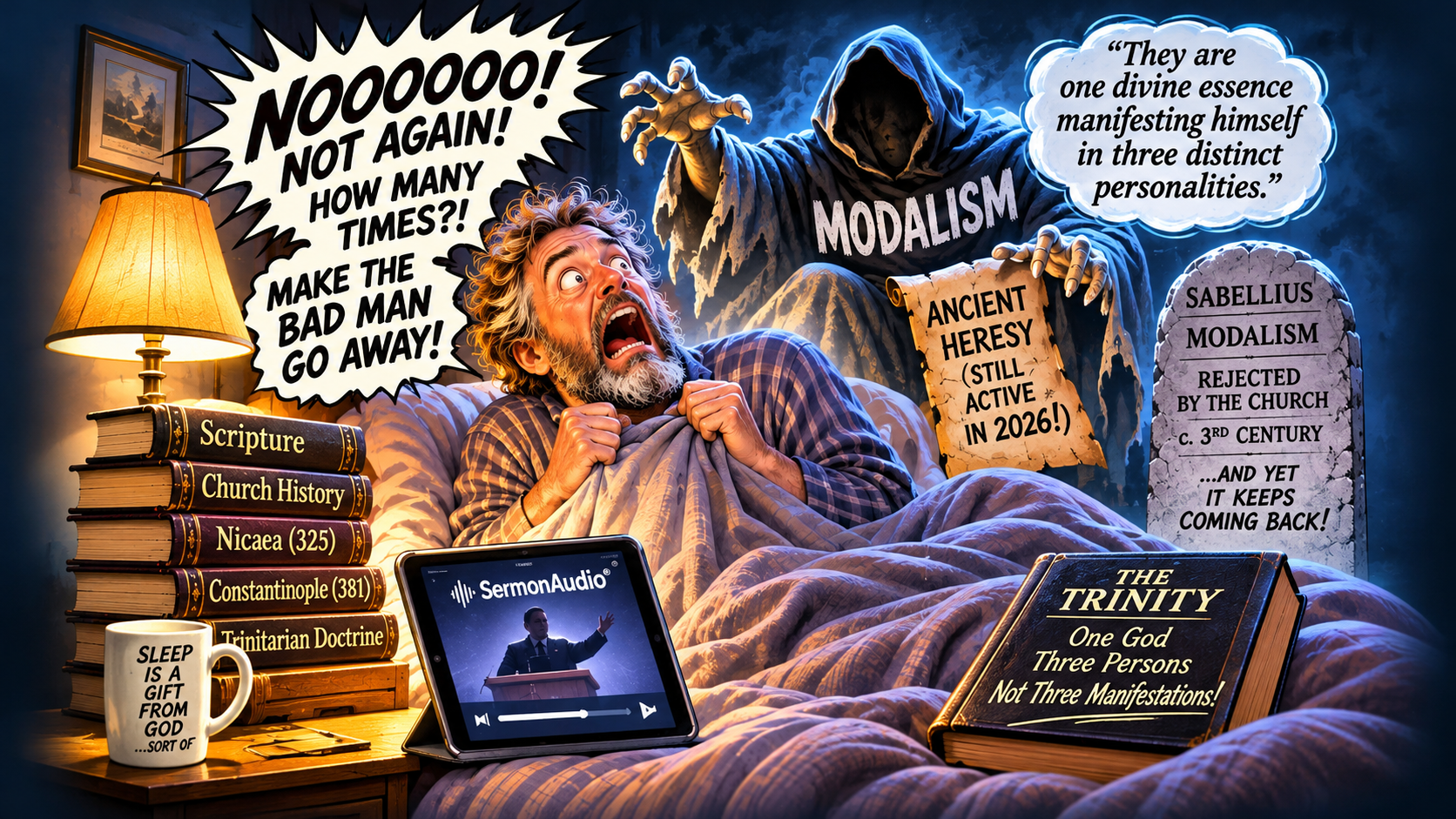
I desperately need sleep.
Not just a little sleep. Not a quick nap. I need the kind of sleep where you close your eyes, the world disappears, and for a few blessed hours, you don’t have to think about anything.
So, I have what seems like a wonderful idea.
I’ll open SermonAudio, find a sermon, lie back, close my eyes, and peacefully drift off while listening to the preaching of God’s Word.
Doesn’t that sound wonderfully spiritual?
What a beautiful picture of Christian devotion! A weary believer, resting quietly, listening to the Scriptures being proclaimed. Perhaps I should have someone paint the scene. Maybe add a little heavenly light shining through the window. A Bible resting nearby. The peaceful expression of a man whose final conscious thoughts are occupied with the glorious truths of God.
How pious! How reverent! How deeply spiritual!
And so, I hit play.
I settle back.
I close my eyes.
The sermon begins.
I’m listening. I’m relaxing. I’m finally beginning to think that perhaps, just perhaps, sleep is coming.
And then it happens.
Like something out of a horror movie, I hear a sentence that immediately sends a chill down my theological spine.
My eyes shoot wide open.
My entire body suddenly comes back to life.
NOOOOOOOOOOOOO!
NOT AGAIN!
NO! NO! NO! NO!
HOW MANY TIMES?
HOW MANY TIMES MUST WE GO THROUGH THIS?
MAKE THE BAD MAN GO AWAY!
I wanted to scream. I wanted to throw something. For one brief, irrational moment, I seriously contemplated smashing my iPad into approximately one million pieces.
Fortunately, I resisted that temptation.
Instead, I’m using the very same iPad to share my frustration, my exasperation, and what is rapidly approaching theological despair.
What could possibly have caused such a reaction?
What horrific statement could transform a peaceful attempt to fall asleep into an emergency theological intervention?
One word.
MODALISM.
Yes. Modalism.
Again.
In 2026.
I cannot believe we’re still doing this.
The Sentence That Destroyed My Sleep
I was listening to a sermon from Dr. Manfred Langer, The Revelation of Jesus Christ, Part 22, an exposition of Revelation 15. https://www.sermonaudio.com/sermons/11102652225632
As the sermon reached Revelation 15:3–4, the preacher discussed the worship of the Almighty God.
He began by affirming that there is only one Almighty God.
Wonderful.
He then referred to the triune God: Father, Son, and Holy Spirit.
Excellent.
And then came the sentence that ruined everything:
“But we worship the triune God, God the Father, God the Son, and God the Holy Spirit. They are one divine essence manifesting himself in three distinct personalities.”
There it is.
Read that sentence again.
“One divine essence manifesting himself in three distinct personalities.”
I realize some people may read those words and wonder what the problem is.
After all, he mentioned the Father, Son, and Holy Spirit. He affirmed one divine essence. He used the word triune.
What more could anyone possibly want?
Well, how about an explanation of the Trinity that doesn’t sound dangerously similar to an ancient heresy?
Would that really be asking too much?
An Ancient Heresy That Refuses to Disappear
Modalism is not some new theological controversy that suddenly appeared last Tuesday.
We’re talking about a theological error that the Christian church confronted approximately eighteen centuries ago.
Modalism, commonly associated with Sabellianism, understands the Father, Son, and Holy Spirit not as three eternally distinct divine persons but as different modes or manifestations of the one God.
In other words, instead of three distinct persons who are the one God, we have one divine person appearing or operating in different ways.
That is not the historic Christian doctrine of the Trinity.
The orthodox doctrine affirms that there is one God, one undivided divine essence, eternally existing in three distinct persons: Father, Son, and Holy Spirit.
Not three gods.
Not one person wearing three masks.
Not one divine individual who changes roles depending upon the situation.
Three distinct, coequal, coeternal persons, each fully God, sharing the one undivided divine essence.
The Father is not the Son. The Son is not the Holy Spirit. The Holy Spirit is not the Father.
Yet the Father is God, the Son is God, and the Holy Spirit is God.
And there is only one God.
Now, does that exhaustively explain the mystery of the Trinity?
Of course not.
But it establishes essential biblical boundaries.
And those boundaries matter.
But Is This Pastor Actually a Modalist?
Here is where I want to be extremely careful.
I am not accusing Dr. Langer of consciously embracing modalism.
I am not suggesting that he has deliberately rejected the historic Christian doctrine of the Trinity.
I am not claiming that he has studied Sabellianism, accepted its theological propositions, and decided to introduce them into his congregation.
In fact, I suspect that is not what happened at all.
His reference to three distinct personalities may indicate that he genuinely intends to affirm personal distinctions within the Godhead.
The problem is that his explanation combines that language with the idea of one divine essence manifesting himself in three personalities.
That creates serious ambiguity.
The word manifestation is not inherently heretical. Scripture speaks of God revealing and manifesting himself. But manifestation cannot replace eternal personal distinction as the explanation of the Trinity.
And this brings me to my actual concern.
I fear that many pastors who would sincerely reject modalism as a formal doctrine nevertheless function as practical modalists in the way they explain the Trinity.
They may not believe they are teaching heresy.
They may not intend to teach heresy.
They may never have heard of Sabellius.
But through ignorance, inadequate theological training, unfamiliarity with church history, or simply careless language, they communicate explanations that sound remarkably similar to the very doctrines the historic church rejected.
And then their congregations learn those explanations.
That is what concerns me.
That is what frustrates me.
That is what makes me want to scream into my pillow when I’m desperately trying to fall asleep.
The Congregation Learns What the Pastor Teaches
Consider what happens when a pastor stands before a congregation and explains that God is one divine essence manifesting himself in three personalities.
What does the average person hear?
What does the person who has never studied the Trinity understand?
What does the teenager sitting in the congregation take away?
What does the new Christian learn?
Perhaps some understand the statement correctly because they already possess a sound understanding of Trinitarian theology.
But others may conclude that the Father, Son, and Holy Spirit are simply three ways that one divine person manifests himself.
And why wouldn’t they?
That’s a natural possible interpretation of the language they just heard.
The pastor says he believes in the Trinity.
The congregation believes in the Trinity.
Everyone agrees that the Trinity is important.
And yet the actual explanation being communicated may undermine the very doctrine everyone claims to affirm.
Do you see the problem?
You can sincerely profess an orthodox doctrine while repeatedly communicating an unorthodox explanation of that doctrine.
And when that explanation comes from the pulpit, it carries the authority of the person entrusted with teaching the congregation.
The congregation may not know that there is a problem.
They may repeat the same definition to their children.
Those children may eventually repeat it to someone else.
And so an ancient theological error can continue circulating among people who would be genuinely horrified to discover that their explanation resembles heresy.
That is a deeply troubling possibility.
Did We Learn Nothing from Church History?
One of the most frustrating aspects of this entire situation is that Christianity has already spent centuries wrestling with these questions.
The early church did not engage in theological controversy merely because theologians enjoyed arguing over terminology.
They were attempting to understand and faithfully articulate what Scripture teaches about God.
The controversies surrounding the Trinity were not insignificant academic disagreements.
They concerned the identity of the Father, the Son, and the Holy Spirit.
They concerned the deity of Christ.
They concerned the unity of God.
They concerned how the biblical testimony could be faithfully confessed without denying either God’s oneness or the real distinctions between Father, Son, and Holy Spirit.
The Council of Nicaea in AD 325 addressed the controversy surrounding Arius and the relationship of the Son to the Father.
The Council of Constantinople in AD 381 further clarified the church’s Trinitarian confession, including the deity of the Holy Spirit.
The theological language developed through these controversies was not accidental.
Words mattered.
Distinctions mattered.
Definitions mattered.
And yet, here we are in 2026, nearly seventeen centuries after Nicaea, and pastors are still using language that can confuse the distinction between one divine essence and three eternal persons.
I find that astonishing.
I find it frustrating.
And increasingly, I find it discouraging.
Not because I expect every pastor to possess an advanced degree in historical theology.
Not because I expect every sermon to include an exhaustive examination of patristic literature.
But because I would think that someone entrusted with teaching Christianity should possess a basic understanding of Christianity’s foundational doctrines.
Is that really an unreasonable expectation?
Scripture Does Not Present Three Temporary Manifestations
The biblical evidence itself should prevent us from reducing the Trinity to three manifestations of one divine person.
Consider Matthew 3:16–17.
Jesus is baptized.
The Holy Spirit descends like a dove.
The Father speaks from heaven.
The text presents the Father, Son, and Holy Spirit as distinguishable personal agents.
Or consider John 17:5, where Jesus speaks to the Father about the glory he had with him before the world existed.
That is not merely a description of God assuming different roles during the earthly ministry of Jesus.
The Son speaks of a relationship with the Father that precedes creation.
Consider John 14:16.
Jesus says that he will ask the Father, and the Father will give another Helper.
The Son asks.
The Father gives.
The Holy Spirit comes.
These distinctions cannot adequately be explained by suggesting that one divine person simply manifests himself in three different ways.
The historic doctrine of the Trinity exists because the church sought to account for the whole biblical testimony.
It was not invented to make Christianity unnecessarily complicated.
It was formulated to protect what Scripture actually teaches.
James 3:1 Should Make Every Teacher Tremble
James 3:1 says:
“My brethren, be not many masters, knowing that we shall receive the greater condemnation.” (KJV)
Teaching God’s Word is an enormous responsibility.
It is not a casual undertaking.
It is not simply standing before people and sharing religious thoughts.
It involves handling Scripture, explaining doctrine, making theological claims, and influencing how other people understand God.
And that responsibility should produce humility, caution, diligence, and a willingness to be corrected.
No pastor is infallible.
No teacher possesses perfect theological understanding.
I certainly do not.
I have made mistakes. I will make more mistakes. I have misunderstood passages. I have had to reconsider interpretations. I have had to acknowledge that conclusions I previously reached were wrong.
That is one reason I so frequently refer to my own interpretations as my hermeneutical hypothesis.
I am wrestling with Scripture, theology, and difficult questions. I am trying to understand. I am trying to learn. I am trying to correct my thinking when the evidence requires it.
But surely there is a difference between struggling with a difficult biblical passage and failing to accurately communicate one of Christianity’s most foundational doctrines.
And surely there is a responsibility to learn from the theological controversies that have already been examined, debated, and clarified throughout church history.
We don’t have to reinvent the Trinity every Sunday.
We don’t have to invent new analogies.
We don’t have to explain the Father, Son, and Holy Spirit as three roles, three masks, or three manifestations.
We can simply teach what Scripture teaches and use the careful distinctions the church developed to guard against misunderstanding.
The Real Problem Is Not One Pastor or One Sermon
I want to emphasize something.
This article is not ultimately about Dr. Langer.
His sermon simply provided the occasion for expressing a frustration that has been building for years.
I have heard similar explanations from numerous pastors and teachers.
Sometimes God is compared to water existing as ice, liquid, and steam.
Sometimes the Trinity is explained through one man who is a father, a husband, and a son.
Sometimes we’re told that God manifests himself in three different roles.
And I find myself asking the same question again and again.
Why?
Why do we keep doing this?
Why are we so determined to explain the Trinity through analogies that risk undermining the very doctrine we’re attempting to defend?
Why are pastors apparently unfamiliar with the historical theological problems associated with these explanations?
And why do congregations so rarely seem equipped to recognize the problem?
I don’t believe the solution is to accuse every pastor who uses an unfortunate analogy of being a deliberate heretic.
That would be irresponsible.
But neither should we dismiss the problem by saying, “Well, we know what he meant.”
Do we?
And even if we know what he intended, does everyone listening understand it correctly?
The responsibility of a teacher is not merely to possess the right intention. It is to communicate the truth accurately.
What Makes This So Discouraging
Here is where my frustration begins to turn into something approaching despair.
We live in an age of extraordinary access to theological information.
We have Bibles in countless translations.
We have centuries of theological writings available online.
We have church histories, historical creeds, confessions, lectures, courses, books, articles, and digital libraries.
We have more opportunities to study the history of Christian doctrine than almost any generation before us.
And yet we continue hearing the same theological mistakes.
The same problematic analogies.
The same careless definitions.
The same ancient errors appearing in modern sermons.
I understand that information does not automatically produce knowledge.
I understand that access to resources does not guarantee careful study.
But at some point, shouldn’t we expect better?
At some point, shouldn’t the church be able to demonstrate that it has learned something from its own history?
At some point, shouldn’t pastors know enough about the doctrine of the Trinity to recognize language that could communicate modalism?
I am not demanding theological perfection.
I am asking for theological responsibility.
And I am increasingly troubled by the distance between those two things.
A Final Plea from One Very Tired Listener
So here I am.
Still tired.
Still needing sleep.
Still holding an iPad that, thankfully, has survived another theological crisis.
And still wondering how many more times I am going to hear a pastor explain the Trinity in language that sounds suspiciously like Sabellianism.
Perhaps someone reading this thinks I am overreacting.
Perhaps someone believes this is nothing more than an argument over words.
But when those words concern the identity of God, the eternal relationship between the Father, Son, and Holy Spirit, and the foundational doctrines of Christianity, words are not insignificant.
They matter.
They matter because truth matters.
They matter because Scripture matters.
They matter because the people sitting in our churches deserve to be taught accurately.
And they matter because pastors bear a serious responsibility for what they teach.
I don’t expect every sermon to be perfect.
I don’t expect every pastor to know everything.
I don’t expect theological disagreements to disappear.
But I would dearly love to reach a point where I could listen to a sermon about the Trinity without wondering whether I’m about to hear an ancient heresy resurrected for another Sunday morning appearance.
Is that really asking too much?
Maybe someday.
Maybe someday I’ll open SermonAudio, select a sermon, lie back, close my eyes, and peacefully drift off while listening to the faithful proclamation of God’s Word.
No theological alarms.
No sudden panic.
No desperate cries of protest.
No ancient heresies rising from the grave.
Just Scripture, sound doctrine, and a few blessed hours of sleep.
Until then, I suppose I’ll keep listening.
I’ll keep examining.
I’ll keep asking questions.
I’ll keep challenging theological claims against Scripture and the witness of church history.
And I’ll keep hoping that pastors will take seriously the responsibility of accurately teaching the God they claim to worship.
But please.
For the sake of sound doctrine, the historic Christian faith, and one desperately exhausted listener…
CAN WE PLEASE STOP EXPLAINING THE TRINITY LIKE MODALISTS?
It’s 2026.
The church has already had this argument.
And I really, really need some sleep.
Ohio State Fraternity Incident: The Dangerous Price of Belonging