Jesus Was Not Just Another Preacher
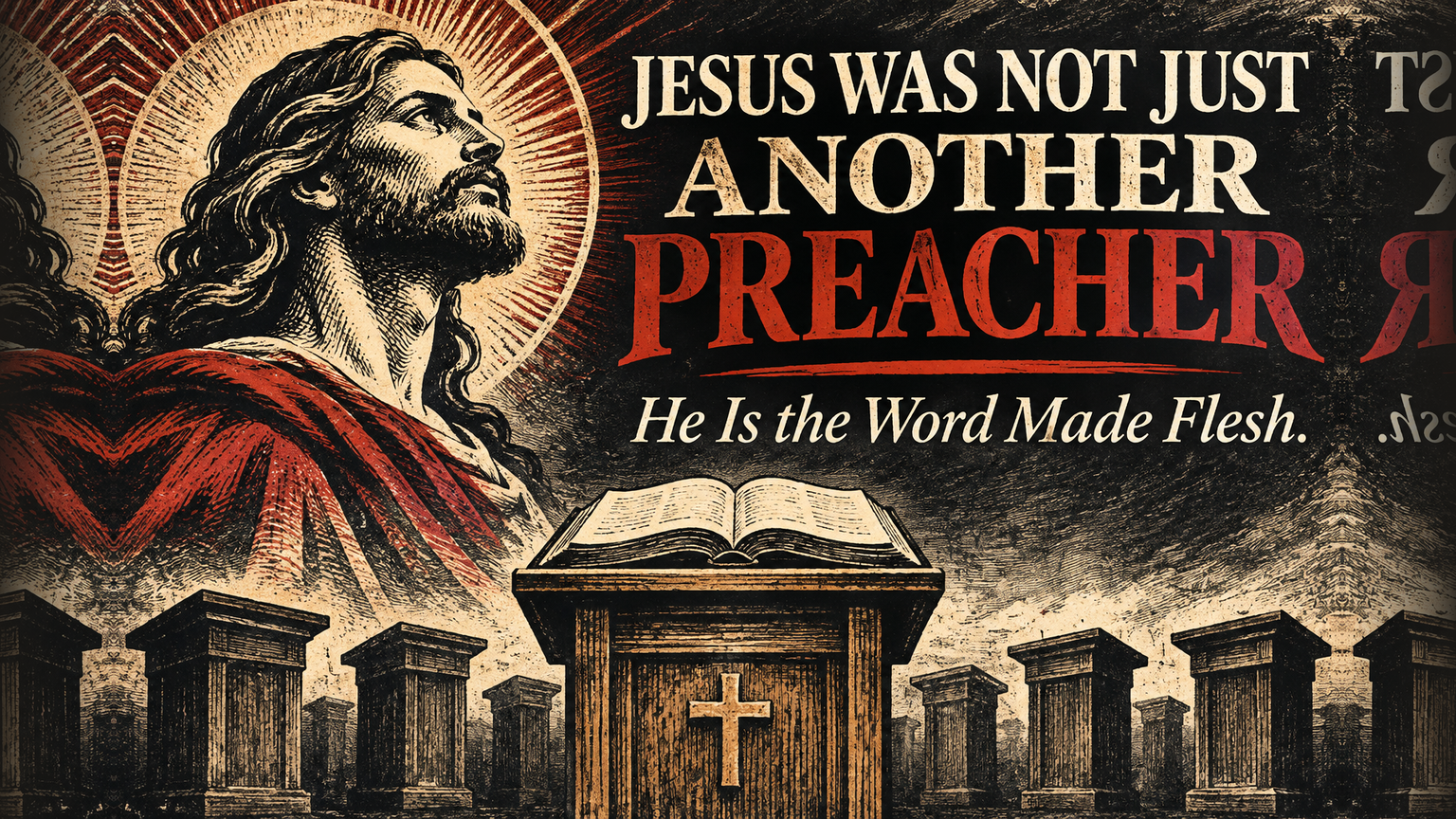
Jesus Was Not Just Another Preacher
A Critical Examination of Christ’s Two Natures, Divine Revelation, and the Authority of Preaching
By Theology Central
I was listening to a message on SermonAudio today, and what began as a fairly straightforward discussion about the importance of preaching and studying the Bible suddenly took a turn into Christology.
And that is where things became very interesting.
The message is entitled “The Bible Must Be Studied” by Gregory N. Barkman, from the Beacon Broadcast, dated November 12, 2026. The primary text is Mark 1:38.
You can listen to the entire message here:
Listen to The Bible Must Be Studied – Gregory N. Barkman on SermonAudio
I encourage you to listen to the message for yourself. Do not simply accept my analysis of it. Listen to what is said, examine the Scriptures, consider the theological implications, and wrestle with the questions being raised.
The importance of preaching is not something I am interested in denying. I spent over two decades preaching and teaching in a local church, and I have produced thousands of podcast episodes devoted to examining Scripture, theology, and the preaching of others.
I understand the importance of preaching. I understand the importance of studying the Bible. I understand the responsibility that comes with standing before people and attempting to explain the Word of God.
But I also understand something else.
We must never elevate the importance of preaching by diminishing the uniqueness of the one who came to preach.
And that is the concern I have with this message.
What Is Barkman Actually Saying?
Barkman begins with Mark 1:38:
“And he said unto them, Let us go into the next towns, that I may preach there also: for therefore came I forth.”
His argument is that Jesus came not only to die but also to preach. Therefore, preaching occupies a position of extraordinary importance in the Christian faith.
There is certainly truth in that observation.
But as Barkman develops his argument, he begins to explore the relationship between Jesus’ preaching and his divine and human natures.
Here are his actual words:
“Now, when Jesus preached, everything he said was the word of God because he was God.”
He then continues:
“But I don’t know that he in his earthly ministry was communicating new divine truth when he was preaching, though that may be true. I’m not real sure about that, even as I say it. That could be what was taking place.”
And then comes the statement that immediately caught my attention:
“But if he was carrying out this preaching ministry in his human nature rather than in his divine nature, and he was both, He had two natures.”
He continues:
“He was 100% God and 100% man. But if he was doing this preaching in the arena of his human nature, then he was doing the same thing that every faithful preacher does, namely, preaches the Word of God that has already been given, but he proclaims it, he explains it, he helps people understand it, he applies it.”
And finally:
“The only difference is, when Jesus did that, because of his sinless nature, he never erred.”
There is a lot to examine in those few statements.
Before we proceed, I want to acknowledge something important. Barkman explicitly affirms the full deity and full humanity of Christ. He also presents his suggestion tentatively. He uses the word if, and he openly admits that he is uncertain.
I am not interested in taking a speculative statement, stripping away its qualifications, and declaring someone a heretic.
But theological speculation is not exempt from theological examination. Particularly when that speculation is being used to establish a doctrine of preaching and pastoral authority.
So let’s examine it.
1. Mark 1:38 Must Be Understood in Its Context
The first issue is hermeneutical.
What exactly is Jesus saying in Mark 1:38?
In the preceding verses, Jesus has been teaching in the synagogue at Capernaum. He has cast out an unclean spirit, healed Simon’s mother-in-law, and ministered to many who were sick and possessed by demons.
Early the following morning, Jesus withdraws to a solitary place to pray. Simon and those with him search for Jesus and eventually find him.
They tell him:
“All men seek for thee.” — Mark 1:37
Jesus responds that they must go to other towns so that he may preach there also.
The immediate issue is not the modern pastor’s job description. The immediate issue is the geographical extension of Jesus’ ministry. Jesus will not allow the demands of one community to prevent him from proclaiming his message elsewhere.
And what is that message?
Mark has already told us:
“Now after that John was put in prison, Jesus came into Galilee, preaching the gospel of the kingdom of God, And saying, The time is fulfilled, and the kingdom of God is at hand: repent ye, and believe the gospel.” — Mark 1:14–15
Jesus is announcing the arrival of God’s kingdom. He is proclaiming that the appointed time has been fulfilled.
This is not merely a general statement about the importance of delivering religious sermons.
This is the Messiah announcing the arrival of the kingdom in connection with his own mission.
There is also an interesting interpretive question concerning the phrase “for therefore came I forth.” Does Jesus mean that he came from heaven for this purpose, or that he went out from Capernaum to carry out his wider preaching ministry?
The wording in Mark permits discussion of that question. Luke’s parallel provides additional clarity:
“And he said unto them, I must preach the kingdom of God to other cities also: for therefore am I sent.” — Luke 4:43
Luke explicitly connects Jesus’ preaching with his divine commission.
So I have no objection to recognizing preaching as an essential component of Jesus’ earthly mission.
But we must not overlook the specific nature of that mission. Jesus is not simply demonstrating how future pastors should prepare and deliver sermons.
He is announcing the kingdom of God as the one sent by the Father.
Before we turn Jesus into an example for the modern preacher, we must understand Jesus in his own historical, messianic, and redemptive context.
2. Who Is Actually Preaching?
Now we come to the Christological question.
Barkman raises the possibility that Jesus was carrying out his preaching ministry in his human nature rather than in his divine nature.
What exactly does that mean?
The historic Christian confession concerning Jesus Christ is that he is one person possessing two distinct natures: a fully divine nature and a fully human nature.
The Council of Chalcedon in AD 451 articulated this understanding by affirming that Christ exists in two natures without confusion, change, division, or separation.
These distinctions matter.
Jesus is not a divine person and a human person sharing a body. He is not two individuals cooperating with one another. He is not God on certain occasions and man on other occasions.
He is the eternal Son of God who assumed a genuine human nature.
The Word became flesh.
“And the Word was made flesh, and dwelt among us.” — John 1:14
The divine nature did not become a human nature. The human nature did not cease to be genuinely human. The two natures remain distinct, but they belong to the one person of Jesus Christ.
Now, does that mean we cannot distinguish between actions or experiences according to his two natures?
Of course not.
Jesus experienced hunger according to his human nature. He experienced fatigue according to his human nature. He suffered and died according to his human nature.
The divine nature did not become hungry, exhausted, or mortal.
But who experienced hunger? Who became exhausted? Who suffered? Who died?
The person of Jesus Christ.
The distinction between the natures must never become a division of the person.
And that brings us directly to the issue of preaching.
Jesus certainly preached using the faculties of his human nature. He possessed a genuine human mind. He spoke with a human voice. He communicated through human language.
There is nothing theologically problematic about acknowledging those realities.
The problem arises if we suggest that because Jesus preached through his human faculties, he was therefore functioning as an ordinary human preacher, merely explaining revelation that had already been given.
That conclusion does not follow.
The human voice speaking was the human voice of the eternal Son of God.
The person preaching was not a merely human religious teacher. The person preaching was God the Son incarnate.
We can distinguish the natures without dividing the person. We can recognize the genuine humanity of Jesus without reducing the unique authority of his preaching.
Barkman’s wording does not necessarily establish that he is denying the unity of Christ’s person. But his proposed distinction is insufficiently defined, and the conclusion he draws from it creates a serious problem.
3. The Logical Problem: Humanity Does Not Exclude Revelation
Let’s examine the argument logically.
Barkman suggests that if Jesus preached in the arena of his human nature, then he was doing what every faithful preacher does: proclaiming, explaining, and applying the Word of God that had already been given.
But why?
Why would preaching through human faculties necessarily mean that no new divine revelation was being communicated?
Consider the prophets.
Isaiah was a human being. Jeremiah was a human being. Ezekiel was a human being.
They communicated through human language, using human faculties. Yet they communicated divine revelation that had not previously been given.
Peter writes:
“For the prophecy came not in old time by the will of man: but holy men of God spake as they were moved by the Holy Ghost.” — 2 Peter 1:21
Human beings can communicate new divine revelation when God authorizes and enables them to do so.
That is precisely what happened through the prophets and apostles.
Therefore, even if we grant Barkman’s premise that Jesus exercised his preaching ministry through his human faculties, his conclusion does not follow.
Human faculties do not exclude divine revelation.
Genuine humanity does not exclude divine revelation.
Speaking through human language does not exclude divine revelation.
And if God communicated new revelation through ordinary human prophets, why would the genuine humanity of the incarnate Son prevent him from communicating new revelation?
The argument fails at the level of basic logic.
The proposed alternatives are not mutually exclusive. Jesus could preach through his genuine human faculties while communicating divine revelation.
The humanity of the instrument does not determine the limitations of the message.
4. Did Jesus Communicate New Divine Revelation?
This is perhaps the most surprising part of the entire message.
Barkman says:
“I don’t know that he in his earthly ministry was communicating new divine truth when he was preaching.”
He acknowledges that he may be mistaken. But I think the New Testament gives us ample reason to move beyond that uncertainty.
First, we need to define what we mean by new divine truth.
We do not mean that God discovered something he previously did not know. We do not mean that truth itself changed. We do not mean that the Old Testament was false and needed to be replaced by something true.
We mean that God disclosed things to humanity that had not previously been revealed, or revealed them with a specificity, clarity, and fullness not previously given.
With that distinction in mind, consider the following passages.
John 1:18 — The Son Reveals the Father
“No man hath seen God at any time; the only begotten Son, which is in the bosom of the Father, he hath declared him.”
Jesus does not merely explain a collection of previously revealed statements about God.
He makes the Father known through his unique relationship with the Father.
This is the eternal Son revealing the Father.
Matthew 11:27 — The Unique Knowledge of the Son
“All things are delivered unto me of my Father: and no man knoweth the Son, but the Father; neither knoweth any man the Father, save the Son, and he to whomsoever the Son will reveal him.”
Notice what Jesus claims.
He possesses a unique knowledge of the Father, and he reveals the Father to others.
This is not a claim that an ordinary preacher can make.
John 8:26 — Jesus Speaks What He Has Heard from the Father
“I have many things to say and to judge of you: but he that sent me is true; and I speak to the world those things which I have heard of him.”
Jesus describes his teaching in relation to his commission from the Father.
His message cannot be reduced to the work of a biblical commentator.
John 14:10 — The Father and the Son
“The words that I speak unto you I speak not of myself: but the Father that dwelleth in me, he doeth the works.”
Jesus’ teaching is inseparable from his unique relationship with the Father.
We must not confuse his submission to the Father in his incarnate mission with the absence of divine authority.
John 16:12–13 — Revelation Still to Come
“I have yet many things to say unto you, but ye cannot bear them now. Howbeit when he, the Spirit of truth, is come, he will guide you into all truth.”
Jesus explicitly acknowledges that there are things still to be communicated to his disciples.
The unfolding of divine revelation did not stop with the Old Testament. The Son came, taught, accomplished redemption, and promised the Spirit’s ministry of revelation to his disciples.
Hebrews 1:1–2 — God Has Spoken in His Son
“God, who at sundry times and in divers manners spake in time past unto the fathers by the prophets, Hath in these last days spoken unto us by his Son.”
This passage is devastating to any attempt to reduce Jesus to another expositor of previously revealed Scripture.
The author of Hebrews establishes a distinction between God’s former revelation through the prophets and his climactic revelation in the Son.
Jesus is not simply the latest preacher in a long succession of preachers.
He is the Son.
He is the heir of all things.
He is the one through whom God made the worlds.
He is the brightness of God’s glory and the express image of his person.
The identity of the one speaking is central to the argument.
And that is precisely what we must not lose in our theology of preaching.
5. Jesus Revealed Specific Truths About His Own Mission
We can go beyond general statements about revelation and examine the actual content of Jesus’ teaching.
Consider Mark 8:31:
“And he began to teach them, that the Son of man must suffer many things, and be rejected of the elders, and of the chief priests, and scribes, and be killed, and after three days rise again.”
Jesus announces specific details concerning his coming rejection, death, and resurrection.
Were the suffering and vindication of the Messiah anticipated in the Old Testament? Certainly.
But Jesus identifies himself as the one who will fulfill those promises and announces the events with extraordinary specificity.
Consider Luke 22:20:
“This cup is the new testament in my blood, which is shed for you.”
The Old Testament anticipated a new covenant, particularly in Jeremiah 31.
But Jesus identifies his own blood as the blood of that covenant.
He is not merely explaining Jeremiah 31. He is revealing how the promised covenant is being established through his own sacrificial death.
Consider John 14–16 and Jesus’ teaching concerning the coming of the Holy Spirit, the Spirit’s relationship to the Father and the Son, and the Spirit’s future ministry among the disciples.
These teachings bring a fullness of revelation that cannot be reduced to an ordinary exposition of an Old Testament passage.
We must recognize the continuity between the Old and New Testaments without denying the progression of revelation.
Jesus fulfills the Scriptures. Jesus explains the Scriptures. Jesus appeals to the Scriptures.
But Jesus also reveals.
Those realities are not in conflict.
6. The Sermon on the Mount: Who Has the Authority?
Consider Matthew 5:21–22:
“Ye have heard that it was said by them of old time, Thou shalt not kill … But I say unto you, That whosoever is angry with his brother without a cause shall be in danger of the judgment.”
Throughout this section of the Sermon on the Mount, Jesus repeatedly uses the expression:
“But I say unto you.”
There are important interpretive debates concerning these passages. Is Jesus correcting traditional interpretations of the law? Is he exposing the deeper demands of the law? Is he authoritatively teaching the implications of the law in relation to the kingdom?
We should not simplistically assume that every one of these statements represents the introduction of an entirely new moral command.
But one point is unmistakable: Jesus speaks with extraordinary authority.
Matthew explicitly tells us this at the conclusion of the sermon:
“And it came to pass, when Jesus had ended these sayings, the people were astonished at his doctrine: For he taught them as one having authority, and not as the scribes.” — Matthew 7:28–29
Notice the distinction.
Jesus does not teach merely as another scribe.
Matthew draws our attention to the difference between Jesus and the religious teachers of his day.
Jesus possesses an authority that sets him apart.
We must be extremely careful when developing a theology of preaching that emphasizes the similarity between Jesus and ordinary preachers without adequately accounting for this fundamental difference.
7. “The Only Difference” Is Not the Only Difference
Barkman says that if Jesus was preaching through his human nature, then he was doing what every faithful preacher does.
He then adds:
“The only difference is, when Jesus did that, because of his sinless nature, he never erred.”
I understand what he is attempting to communicate.
He wants preachers to study diligently, recognize their fallibility, and strive to communicate Scripture accurately.
But the difference between Jesus and every other preacher cannot be reduced to the fact that Jesus never made a mistake.
Jesus is the eternal Son of God. Every other preacher is a created human being.
Jesus possesses divine authority. Every other preacher possesses authority that is derived and dependent.
Jesus reveals the Father. Every other preacher communicates what God has revealed.
Jesus is the Word made flesh. Every other preacher is a servant of the Word.
Jesus is the object of saving faith. Every other preacher is responsible for pointing people to the object of saving faith.
Jesus is the fulfillment of Scripture. Every other preacher is responsible for faithfully interpreting Scripture.
These are not minor distinctions.
They are fundamental.
And there is another issue with the explanation that Jesus never erred because of his sinlessness.
Sinlessness and omniscience are not identical concepts.
A finite human being could lack knowledge of a particular fact without committing a sin. Limited knowledge is not inherently a moral failure.
Luke 2:52 tells us:
“And Jesus increased in wisdom and stature, and in favour with God and man.”
Mark 13:32 presents us with the challenging statement that the Son does not know the day or hour.
These passages require us to take the genuine humanity of Christ seriously.
Historic Christian theology has wrestled with how we understand Christ’s human knowledge in relation to his divine omniscience. We should acknowledge the complexity of that discussion rather than pretend that we can resolve it with a simple statement about sinlessness.
The fact that Jesus was sinless is essential to Christian theology.
But we must not assume that sinlessness, by itself, provides a complete explanation of the authority and infallibility of Jesus’ teaching.
The identity of the one teaching matters.
He is the incarnate Son of God, carrying out the mission given to him by the Father.
8. Jesus Is Not Merely the Preacher. He Is the Message.
This is the distinction that I believe must be central to our understanding of Christian preaching.
Jesus certainly preached.
Jesus certainly taught.
Jesus certainly explained Scripture.
But Jesus is also the very substance of the message Christian preachers are called to proclaim.
Consider Luke 24:27:
“And beginning at Moses and all the prophets, he expounded unto them in all the scriptures the things concerning himself.”
Yes, Jesus expounded the Scriptures.
But what did he explain?
The things concerning himself.
Consider Luke 4:21, following Jesus’ reading from Isaiah in the synagogue:
“This day is this scripture fulfilled in your ears.”
Jesus does not simply tell his listeners what Isaiah meant in its historical context.
He announces that the Scripture is being fulfilled in connection with his own presence and ministry.
Consider John 5:39:
“Search the scriptures; for in them ye think ye have eternal life: and they are they which testify of me.”
The Scriptures testify of him.
And consider John 14:6:
“I am the way, the truth, and the life: no man cometh unto the Father, but by me.”
No faithful Christian preacher can stand before a congregation and make that claim about himself.
Jesus does not merely announce the way.
He is the way.
Jesus does not merely explain the truth.
He is the truth.
Jesus does not merely describe eternal life.
He is the life.
The Christian preacher proclaims Christ crucified and risen.
Jesus is the Christ who was crucified and rose again.
The Christian preacher announces the forgiveness of sins through Christ.
Jesus is the one whose blood was shed for the forgiveness of sins.
The Christian preacher points people to the righteousness of Christ.
Jesus is the righteous one in whom our salvation is found.
Jesus is not simply the greatest preacher in the history of Christianity. He is the reason Christianity has anything to preach.
9. What Is the Authority of the Modern Preacher?
The final section of Barkman’s broadcast raises another important question.
He says:
“What I’m preaching to you is not my opinion.”
He acknowledges that occasionally he gives his opinion and tries to identify it as such.
Then he says:
“In essence, what I’m saying to folks is when I’m preaching, this is God’s word to you.”
I understand the legitimate concern behind this statement.
A preacher should not stand before a congregation and simply offer personal opinions, cultural commentary, motivational speeches, or whatever happens to be occupying his mind that morning.
The Christian preacher is called to preach the Word.
Paul tells Timothy:
“Preach the word; be instant in season, out of season; reprove, rebuke, exhort with all longsuffering and doctrine.” — 2 Timothy 4:2
But there is a distinction that must be maintained.
The authority of the preacher is not identical to the authority of the Scripture being preached.
Scripture is inspired.
The preacher’s interpretation is not inspired.
Scripture is infallible.
The preacher’s interpretation is not infallible.
Scripture possesses divine authority.
The preacher’s authority is derivative and extends only as far as he faithfully communicates what God has revealed.
This does not mean that faithful preaching cannot properly be described as the proclamation of God’s Word. When the preacher faithfully announces what God has revealed, it is God’s message that is being communicated.
But the preacher’s confidence does not establish that he has communicated it faithfully.
His theological education does not establish it.
His ordination does not establish it.
His years of experience do not establish it.
His sincerity does not establish it.
His claim to have prayed and studied does not establish it.
The interpretation must be examined.
The argument must be examined.
The context must be examined.
The theological conclusions must be examined.
Acts 17:11 commends the Bereans because they received the message eagerly and searched the Scriptures daily to determine whether the things they were hearing were true.
They did not assume that the authority of the speaker guaranteed the accuracy of everything being said.
And neither should we.
There is a profound irony in this particular broadcast.
Barkman emphasizes the importance of accurately communicating God’s Word, but in the process, he introduces a speculative Christological argument and openly acknowledges:
“I’m not real sure about that, even as I say it.”
I appreciate that admission. I would rather hear a preacher acknowledge uncertainty than disguise speculation as certainty.
But that moment illustrates precisely why we must maintain a distinction between the Word of God and the words of the preacher.
The fact that a statement is made during a sermon does not make it divine revelation.
The fact that a preacher is explaining a biblical text does not make every conclusion he reaches the teaching of that text.
And the fact that a preacher rarely identifies something as his opinion does not mean that the remainder of his sermon is free from human judgment, interpretation, inference, and error.
Conclusion: Do Not Elevate the Pulpit by Reducing Christ
I agree that the Bible must be studied.
I agree that preaching is important.
I agree that those who teach Scripture bear a tremendous responsibility.
I agree that preachers should strive for accuracy and should never use human fallibility as an excuse for carelessness.
But I reject the idea that we need to reduce the uniqueness of Jesus’ preaching in order to establish the importance of our own.
Jesus is not simply a model of careful biblical exposition.
Jesus is not simply a sinless version of the modern pastor.
Jesus is not simply another religious teacher who happened to get every interpretation right.
Jesus is the eternal Son of God incarnate.
He is truly God and truly man.
He is one person in two distinct, inseparably united natures.
He reveals the Father.
He announces the kingdom.
He fulfills the Scriptures.
He accomplishes redemption.
He is the Word made flesh.
And he is the very heart of the message we have been given to proclaim.
There is an enormous difference between the authority of Jesus Christ and the authority of every Christian preacher who has ever lived.
Jesus can say:
“But I say unto you.”
The preacher must demonstrate:
This is what the Scriptures actually teach.
Jesus can say:
“I am the way, the truth, and the life.”
The preacher must point away from himself and say:
There is your Savior.
Jesus can say:
“He that hath seen me hath seen the Father.”
The preacher must recognize that he is a fallible servant attempting to communicate the truth about the one who reveals the Father.
I believe in the importance of preaching. But the importance of preaching is not found in the greatness of the preacher.
It is found in the greatness of the Christ being proclaimed.
And perhaps that is the most important lesson we can take away from this entire discussion.
The preacher is not the Word.
The sermon is not the Savior.
The pulpit is not the throne.
Jesus Christ is Lord.
And every sermon, every theological argument, every interpretation, and every preacher—including the one writing this article—must remain subject to the authority of the Word of God.
Theology Central is dedicated to the ongoing examination of Scripture, theology, church history, and the preaching and teaching of the Christian church. The goal is not to discourage the examination of difficult questions, but to encourage it. Listen to the original message, open your Bible, examine the arguments, and continue the journey.

Forty Years Later, I Am Still That Broken Boy