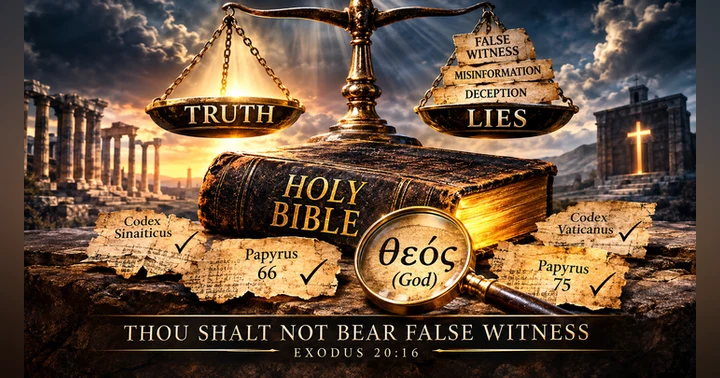
AI Slop? Have You Listened to a Sermon Lately?
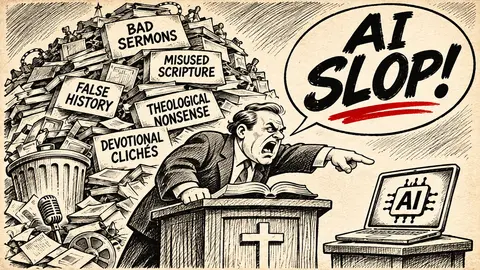
AI Slop? Have You Listened to a Sermon Lately?
I am getting tired of hearing the phrase AI slop.
I hear it in discussions about journalism, art, music, literature, social media, and increasingly in the Christian world. Artificial intelligence is producing slop. Artificial intelligence is flooding the internet with garbage. Artificial intelligence is destroying creativity, intellectual integrity, and meaningful communication.
I have a question.
Have you listened to a sermon lately?
Have you read a Christian devotional lately? Have you walked through a Christian bookstore? Have you listened to some of the theological arguments being made by people who have supposedly spent years studying Scripture?
Humans have been producing slop for as long as humans have been walking across the earth!
We did not need artificial intelligence to produce misinformation. We did not need artificial intelligence to fabricate historical claims, misrepresent opposing viewpoints, twist biblical texts, construct terrible arguments, or publish books that should never have been published.
We have been doing all of that quite successfully on our own.
And yet, suddenly, because a machine can generate words, we have developed this newfound concern about the quality of the content being produced.
Where was all of this concern before?
The Article That Got Me Thinking
I recently came across an article on SermonAudio titled AI Slop May Be Here to Stay by J.R. Dickens.
To be fair, the article is not simply another attack on artificial intelligence. It acknowledges the usefulness of AI and explores some of the author’s experiences with the technology. I appreciate that willingness to engage with AI rather than simply condemn it.
But the title and the larger discussion surrounding AI brought me back to something that has increasingly frustrated me.
Why have we become so comfortable using the term AI slop while seemingly ignoring the enormous amount of slop human beings have been producing for generations?
And why, particularly in the Christian world, do we seem far more concerned about whether something was written by AI than whether something is actually true?
The Church Has Been Producing Slop for Centuries
Let’s stop pretending that the Christian world has some great history of intellectual excellence that artificial intelligence has suddenly arrived to threaten.
Yes, Christianity has produced extraordinary thinkers, brilliant scholars, remarkable works of theology, and generations of people who have devoted their lives to the serious study of Scripture.
But Christianity has also produced an enormous amount of intellectual garbage.
We have sermons that completely ignore the historical context of biblical passages. We have devotionals that take verses out of context and make them say whatever the author wants them to say. We have theological books that misrepresent other theological systems. We have pastors repeating historical claims that could be disproven with a few minutes of research.
We have sermons built around illustrations that never happened, quotations that were never spoken, and interpretations that cannot be defended from the text.
We have entire theological traditions that have developed elaborate systems for explaining away biblical passages that do not fit their predetermined conclusions.
We have preachers who will confidently stand behind a pulpit and tell people what the Greek or Hebrew supposedly means when they have clearly not done the necessary work to establish their claims.
And every Sunday, across the world, people sit in churches listening to human-generated content that may be inaccurate, misleading, logically incoherent, or hermeneutically indefensible.
But nobody stands up and says, “Excuse me, I think we are being subjected to human slop.”
No. We call it preaching.
We call it teaching.
We call it ministry.
Sometimes we even call it anointed.
The Slop I Have Been Listening To
I spend an enormous amount of time listening to sermons, examining theological claims, reading Christian articles, and reviewing biblical interpretations.
This is not some abstract discussion for me.
Recently, I listened to a sermon containing claims about the history of biblical manuscripts that were demonstrably false. I have listened to pastors describe the Trinity in ways that amount to practical modalism. I have listened to sermons that take biblical narratives and transform them into motivational messages with little regard for what the biblical text actually communicates.
I recently spent hours reviewing a sermon involving Joshua 6. The preacher indicated that he had delivered the message 206 times.
Two hundred and six times!
Think about that. If the interpretation of Joshua 6 is fundamentally flawed, then the problem is not merely that someone mishandled a biblical passage. The problem is that the same mishandling of Scripture has potentially been repeated before congregation after congregation, year after year.
No artificial intelligence was necessary.
A human being was perfectly capable of developing an interpretation, becoming convinced of it, and repeating it over and over again.
And this is what makes the current discussion so frustrating.
We are supposedly terrified that artificial intelligence will generate inaccurate information and distribute it to large numbers of people.
What exactly do you think human beings have been doing?
The Most Ridiculous Double Standard
Imagine a pastor stands behind a pulpit and makes a false statement about the history of the Bible.
He is confident. He is passionate. He speaks with authority. He may even pound the pulpit to emphasize the importance of what he is saying.
The congregation responds with an enthusiastic “Amen!”
Now imagine that someone takes that statement, examines the historical evidence, uses AI to assist in researching the issue, checks the relevant sources, and publishes an article demonstrating that the pastor’s statement was false.
What happens?
Someone dismisses the article because it was written with AI.
Think about the intellectual absurdity of that situation.
The human-generated statement is false.
The AI-assisted correction is accurate.
But the false statement is somehow granted greater credibility because a human being produced it.
Since when did the origin of a statement determine whether the statement was true?
If a human being tells me that two plus two equals five, the statement is false.
If artificial intelligence tells me that two plus two equals four, the statement is true.
The humanity of the first speaker does not make the statement true. The artificial nature of the second speaker does not make the statement false.
This should be so obvious that it does not even require discussion.
And yet, here we are.
Slop Is Slop
Let me make something perfectly clear.
I am not arguing that everything AI produces is good.
AI can produce absolute garbage. It can fabricate quotations. It can invent historical events. It can misrepresent scholarly sources. It can generate biblical interpretations that are embarrassingly bad. It can produce an argument that sounds sophisticated while being completely incoherent.
AI can be wrong.
AI can be very wrong.
AI can be confidently wrong.
But have you ever met a human being?
Have you ever attended a theological conference?
Have you ever listened to two pastors confidently proclaiming contradictory interpretations of the same passage, both insisting that the Holy Spirit has illuminated their understanding of the text?
The problem is not unique to artificial intelligence.
If AI produces inaccurate information, call it inaccurate.
If a pastor produces inaccurate information, call it inaccurate.
If AI produces a terrible interpretation of Scripture, expose it.
If a pastor produces a terrible interpretation of Scripture, expose it.
If AI fabricates a quotation, correct it.
If a Christian author fabricates or carelessly repeats a false quotation, correct it.
Apply the same standard!
I am not interested in giving artificial intelligence a pass.
I am interested in ending the pass we have been giving human intelligence.
We Have Confused Human Authorship With Intellectual Integrity
Somewhere along the way, we seem to have developed the idea that human-generated content possesses some inherent intellectual superiority simply because a human being produced it.
But human beings have egos. Human beings have biases. Human beings have financial interests. Human beings have reputations to protect. Human beings have theological systems they are desperate to defend.
Human beings can be dishonest.
Human beings can deliberately misrepresent evidence.
Human beings can ignore facts because those facts threaten their worldview.
Human beings can spend decades defending an interpretation of Scripture, not because the interpretation is correct, but because admitting they were wrong would be personally, professionally, or institutionally devastating.
AI has its own limitations and biases. It can reproduce human prejudices, reflect weaknesses in its training data, and generate answers designed to satisfy the expectations of the person asking the question.
But that should lead us to scrutinize both human and artificial intelligence.
It should not lead us to romanticize human intelligence.
I do not automatically trust a statement because a pastor made it. I do not automatically trust a statement because a scholar made it. I do not automatically trust a statement because it appeared in a book published by a respected Christian publisher.
And I do not automatically trust a statement because AI generated it.
I want to know whether it is true.
The Church’s Content Factory
Here is something else that needs to be said.
The church has been mass-producing content for generations.
Another sermon series. Another devotional. Another Christian living book. Another Bible study curriculum. Another conference. Another theological podcast. Another video series. Another study Bible.
We have an almost endless supply of Christian content.
And what do we continually hear?
Christians are biblically illiterate.
Christians do not understand theology.
Christians cannot defend their faith.
Christians do not know how to interpret Scripture.
We hear this over and over again.
And what is the proposed solution?
Another book. Another sermon series. Another curriculum. Another conference.
More content!
At what point do we stop and ask whether the problem might be the content we have already been producing?
At what point do we examine the quality of the teaching?
At what point do we ask whether our sermons have actually taught people how to read and interpret Scripture or merely taught them how to listen to someone else tell them what Scripture means?
We have spent generations producing enormous amounts of human-generated Christian content while simultaneously lamenting the intellectual and biblical condition of the church.
Now artificial intelligence arrives, and suddenly we are concerned that there might be too much low-quality content.
Where have you been?
Yes, AI Can Make the Problem Worse
There is a legitimate concern about artificial intelligence that should not be dismissed.
AI makes it possible to generate enormous quantities of content in an incredibly short period of time. Someone can produce dozens of articles, hundreds of social media posts, or an entire collection of devotionals without engaging in any serious research or reflection.
That is a real problem.
The speed is different. The scale is different. The cost of producing the material is different.
Artificial intelligence can make existing problems considerably worse.
But that is not an argument against artificial intelligence itself. It is an argument against irresponsible production, irresponsible publishing, and irresponsible consumption of information.
The printing press made it possible to distribute bad theology on a scale previously unimaginable.
Radio made it possible for a false teacher to reach millions of people.
Television gave religious charlatans access to living rooms across the country.
The internet gave virtually everyone the ability to publish theological material.
Podcasting gave someone with a microphone the ability to produce thousands of episodes.
I know a little something about that last one!
Every advancement in communication technology has increased our ability to distribute both truth and error.
Artificial intelligence is no exception.
The answer is not to pretend that the previous technologies produced only good content. The answer is to demand intellectual responsibility regardless of the technology being used.
What If AI Helps Expose Human Slop?
Here is where things become particularly interesting.
Artificial intelligence can help people examine the claims being made by human authorities.
Someone hears a pastor make a claim about church history. They can use AI to identify relevant historical sources, investigate the claim, and discover that the pastor may have misrepresented the evidence.
Someone hears a sermon based on a biblical passage. They can use AI to explore the historical context, examine the literary structure, compare interpretations, and identify assumptions the preacher never addressed.
Someone reads a theological article. They can use AI to identify logical fallacies, examine the argument, and investigate whether the author’s conclusions actually follow from the evidence.
None of this means the AI’s answers should be accepted uncritically. They must be examined, verified, and corrected when necessary.
But the potential is extraordinary.
The very technology being dismissed as slop can help people identify the slop that human beings have been feeding them for years.
And perhaps that is one of the most interesting possibilities AI presents to the Christian world.
Not that it can help pastors produce sermons faster.
Not that it can help Christian publishers generate more books.
Not that it can help churches produce more social media content.
But that it can help ordinary Christians ask better questions.
Questions about Scripture.
Questions about theology.
Questions about church history.
Questions about the claims being made by the people standing behind their pulpits.
What happens when someone sitting in a congregation can immediately begin investigating a historical claim made by the pastor?
What happens when a Christian can explore interpretations of a biblical passage that their denomination has never presented to them?
What happens when people have greater access to the tools necessary to examine the arguments of those who have traditionally been treated as the authorities?
I think those are far more interesting questions than whether an article was written with AI.
The Biblical Standard Has Not Changed
Acts 17:11 describes the Bereans as more noble because they received the word with readiness and searched the Scriptures daily to determine whether the things they were hearing were true.
Think about who was teaching them.
The apostle Paul!
They were not listening to some random individual on the internet. They were listening to an apostle.
And yet, the Scriptures commend them for examining what they were being taught.
First Thessalonians 5:21 tells us to prove all things and hold fast to that which is good. In its immediate context, the instruction concerns prophetic utterances, but it reflects an important principle: claims are not exempt from examination simply because they come from a religious source.
Proverbs 18:17 reminds us that the first person to present a case can appear right until another comes and examines it.
James 3:1 warns of the greater accountability associated with teaching.
None of these passages is directly addressing artificial intelligence. We should not pretend otherwise.
But the principles of truthfulness, examination, discernment, and accountability remain relevant.
The Christian should not be asking whether the information came from a human being or a machine as the ultimate test of its validity.
The Christian should be asking:
Is it true?
Can it be demonstrated?
Does the evidence support it?
Does the interpretation accurately reflect the biblical text?
Have opposing arguments been fairly represented?
Are we willing to acknowledge when we are wrong?
These questions apply to artificial intelligence.
And they apply to the pastor standing behind the pulpit.
I Used AI to Help Produce This Article
And now, for the part that some people may find particularly amusing.
I used artificial intelligence to help produce this article.
The frustration is mine. The experiences are mine. The questions are mine. The theological concerns are mine.
I have spent countless hours listening to sermons, examining biblical texts, studying theology, and wrestling with the issues discussed here.
Artificial intelligence helped me organize those thoughts, develop the argument, and communicate it in written form.
Does that automatically make this article slop?
If you believe something in this article is inaccurate, demonstrate it.
If you believe the argument is logically flawed, identify the flaw.
If you believe I have misrepresented Scripture, show me where.
If you believe my criticism of the church is unfair, make your case.
I welcome that discussion.
But if your entire response is that artificial intelligence was involved in producing the article, then you have not addressed a single argument I have made.
You have merely demonstrated the very problem this article is attempting to expose.
Stop Asking the Wrong Question
I am not interested in defending artificial intelligence at all costs.
I am not interested in attacking human intelligence simply because human beings are capable of error.
I am interested in truth.
And I think the Christian world needs to rediscover an uncompromising commitment to truth that transcends our loyalty to particular pastors, denominations, theological systems, institutions, and technologies.
Stop asking whether something was produced by AI as though that settles the matter.
Start asking whether it is accurate.
Start asking whether it is logical.
Start asking whether it is historically defensible.
Start asking whether it represents Scripture faithfully.
Start asking whether the person publishing it has exercised intellectual responsibility.
And while we are doing all of that, perhaps we could finally start applying those same questions to the sermons being preached in our churches every Sunday.
Artificial intelligence did not invent slop.
Artificial intelligence did not introduce misinformation into the church.
Artificial intelligence did not create biblical illiteracy.
Artificial intelligence did not invent bad hermeneutics.
Artificial intelligence did not teach pastors how to twist Scripture.
We were doing all of that long before artificial intelligence arrived.
So the next time someone complains about AI slop, I have one question:
Have you listened to a sermon lately?
Theology Central — A journey of wrestling with Scripture, theology, and the Christian life.
Does Jesus Command Infant Baptism?