Forty Years Later, I Am Still That Broken Boy
Today, I drove past a building.
Thousands of people have probably driven past that building without giving it a second thought. To them, it is just another building on another street in another city. But to me, it is something entirely different.
It is the psychiatric hospital where I was admitted after attempting to take my own life.
Forty years ago.
My mother died on October 20, 1986. She was forty-one years old. I was a teenager. And sometime around this very day in November of 1986, I decided I no longer wanted to live.
Today, as I drove past that hospital, something happened that I wasn’t prepared for.
It was almost as if I could look over and see him.
That teenage boy.
Broken. Battered. Emotionally destroyed. Walking into a hospital because he had reached a point in his young life where he could no longer imagine continuing to live it.
I could almost see him walking through those doors.
And I had tears in my eyes.
Forty years have passed, but for a moment, it felt as if forty years had disappeared.
There he was.
There I was.
And I don’t know how to explain the emotions that come with looking at a place and realizing that a younger version of yourself once walked through those doors carrying a pain he didn’t know how to survive.
The Story I Am Supposed to Tell
I know how this kind of story is supposed to go.
I am supposed to tell you about all the lessons I have learned. I am supposed to tell you how far I have come, how much I have grown, how much stronger I have become.
I am supposed to look back at that broken teenage boy and celebrate the distance between who he was and who I am today.
I am supposed to tell you that everything happens for a reason, that God had a plan, that my pain had a purpose, and that all those difficult experiences made me the person I am today.
Perhaps I am supposed to tell you that the boy who once wanted to die grew up to become a pastor, spent more than two decades preaching and teaching, and went on to create a podcast with thousands of episodes that have been listened to by people around the world.
What a testimony!
What a story of victory!
What an incredible journey from brokenness to triumph!
But there is a problem.
I don’t know how much I even believe that narrative.
Not because those things didn’t happen. They did. Not because there haven’t been good things in my life. There have been many.
But because I am not convinced that the distance between that teenage boy and the man writing these words is nearly as great as we would like to imagine.
Forty Years Later
I am older.
I have experienced more of life. I have read more books. I have studied more theology. I have preached thousands of sermons and recorded thousands of podcast episodes. I have experienced things that teenage boy could never have imagined.
But deep down?
I am still that broken, battered human being.
I still desire love.
I still desire intimacy and companionship. I still want to be wanted. I still want to be desired. I still want to be important to someone. I still want to feel that I am number one in someone’s life.
I want to be praised. I want to be recognized. I want to feel strong and powerful. I want to feel that I have accomplished something significant. I want to feel that I am better than others, stronger than others, more successful than others.
I want people to think my podcast is the best.
And yes, I know how that sounds.
But I am not writing this to sound spiritual. I am not writing this to impress you with my humility. I am not writing this to create a carefully constructed image of a man who has somehow risen above the struggles of ordinary human existence.
I am writing this because I drove past a building today and saw something that I have spent forty years carrying with me.
My own humanity.
The longing to be loved. The fear of being forgotten. The desire to be significant. The insecurity that comes with wondering whether I matter. The endless temptation to measure my worth by what I accomplish, what people think of me, or how I compare to everyone else.
Some of those desires are deeply human. Some are expressions of selfishness, pride, and sin. And sometimes they are so intertwined that I cannot even tell where one ends and the other begins.
Forty years later, I am still trying to untangle them.
Forty years later, I am just as human, just as fallen, just as sinful, just as scared, and just as needy.
What If We Stripped Away All the Pretense?
We become very good at hiding ourselves.
We learn how to present the right image. We learn how to speak the right language. We learn how to dress up our insecurities in respectable clothing.
We call our desire for recognition a desire to make a difference. We call our need for praise a desire to encourage others. We call our ambition a calling. We call our need to feel superior a commitment to excellence.
And sometimes those things really are good and noble desires.
But sometimes they are simply the old, broken, frightened human being trying desperately to find a reason to feel significant.
What would happen if we stripped away all the pretense?
What if we stripped away the titles, the accomplishments, the degrees, the ministries, the platforms, the numbers, the carefully constructed public images?
What if we stripped away the religious language and the spiritual bravado?
What would we find?
I suspect we would find a lot of frightened human beings.
People who desperately want to be loved. People who are terrified of being rejected. People who want to believe their lives mean something. People who want someone to look at them and say, “You matter to me.”
People who want to feel strong because they know how weak they really are.
People who want to be admired because they are not sure they can bear being truly known.
People who want to be successful because they are afraid of what failure might say about them.
People who have spent decades learning how to look like they have everything together while privately wondering how much longer they can hold everything together.
Perhaps that broken teenage boy never really disappeared.
Perhaps he simply learned how to wear different clothes.
The Christian Version of the Story
Christianity has its own version of the triumphant narrative.
We love the testimony that begins with brokenness and ends with victory. We love the story of the person who was once lost, struggling, addicted, depressed, frightened, or emotionally destroyed, but then everything changed.
And sometimes people experience remarkable changes in their lives. I am not denying that.
But what about the Christian whose story doesn’t follow that pattern?
What about the Christian who has believed for decades and still struggles with loneliness?
What about the Christian who still battles insecurity, still longs for affection, still struggles with pride, still fears rejection, still wants to be noticed, still wants to be loved?
What about the Christian who can preach about the grace of God and then sit alone wondering why he feels so insignificant?
What about the Christian who knows the Scriptures, understands theology, can articulate the doctrine of justification, and still finds himself emotionally overwhelmed by driving past a building?
What do we do with him?
Do we tell him he hasn’t grown enough? That he hasn’t surrendered enough? That he hasn’t trusted enough? That he hasn’t experienced enough of God’s transforming power?
Do we tell him that forty years should have been enough time to become someone else?
Or do we finally allow him to be what he is?
A human being. A fallen human being. A suffering human being. A sinner who needs Christ.
I Have Not Outgrown My Need for Grace
There is something about that teenage boy that I cannot escape.
He needed grace.
And forty years later, so do I.
Not less grace. Not a smaller amount of grace because I have become more mature, more knowledgeable, more disciplined, or more spiritual.
I need grace.
The same grace. The same Christ. The same mercy. The same forgiveness. The same righteousness that is not my own.
My hope is not that forty years have transformed me into someone worthy of standing before God.
My hope is that Christ is worthy.
My hope is not that I have finally conquered all the things that make me weak, sinful, frightened, insecure, and needy.
My hope is that Jesus Christ has accomplished everything necessary for my salvation.
My hope is not found in the distance between the teenage boy who walked into that hospital and the man who drove past it today.
My hope is found in the righteousness of Jesus Christ.
Perhaps that is the only thing I can say with any real confidence after forty years.
I have not outgrown my need for Him.
And I never will.
There Is a Grave
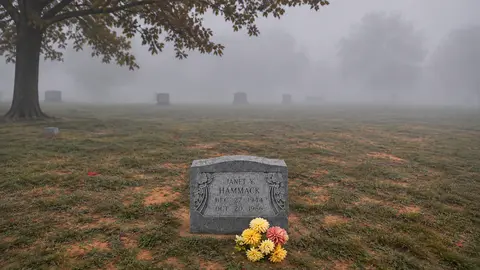
My mother’s grave bears two dates.
December 27, 1944.
October 20, 1986.
Two dates carved into stone.
For most people, those dates mean nothing. For me, the second date marks a dividing line in my life. There was life before October 20, 1986, and there was life after it.
My mother was forty-one years old when she died.
I have now lived forty years since her death.
There is something almost impossible to comprehend about that.
I have lived nearly as many years without her as she lived in total.
And today, forty years after the death of my mother, I drove past the hospital where her teenage son ended up after deciding he could no longer bear the pain of living.
And I cried.
Not because I have learned nothing.
Not because nothing good has happened.
Not because my life has been meaningless.
But because forty years do not erase everything.
Time passes. We grow older. Our faces change. Our bodies change. Our circumstances change. We accumulate experiences, accomplishments, failures, memories, and regrets.
But some things remain.
Some losses are carried, not conquered.
Some wounds become part of the story we live, not simply chapters we finish.
And sometimes a building on the side of the road can bring forty years crashing down upon you in a matter of seconds.
The Story of Reality
I know this is not the triumphant story of victory that people want to hear.
I know this is not the inspirational story that ends with a list of lessons about overcoming adversity and becoming the best version of yourself.
I know this is not the kind of testimony that makes everyone stand up and applaud.
But it is my story.
And I think it may be closer to the story of humanity than we are willing to admit.
We are all carrying things.
We are all longing for things.
We are all trying to find our place in a world that can be beautiful one moment and unbearably cruel the next.
We are all capable of tremendous selfishness and tremendous kindness. We can love and hate, believe and doubt, celebrate and despair, sometimes within the same day.
We want to be known, but we are afraid of being known. We want to be loved, but we fear that if people truly knew us, they would stop loving us.
We want to believe we have become something extraordinary, but underneath it all, we are still human.
And Christianity, at its heart, is not the announcement that we have finally managed to escape our humanity.
It is the announcement that God the Son entered into our humanity.
That Christ came into a world of suffering, grief, sin, loneliness, and death.
That He came not for those who had successfully put themselves back together, but for sinners.
For people like me.
For people like you.
Forty Years
I wish I could go back and sit beside that teenage boy.
I wish I could tell him about some of the beautiful things he would experience. I wish I could tell him about his daughters. About the people he would meet. About the places he would go. About the countless hours he would spend behind a microphone talking about Scripture, theology, and life.
I wish I could tell him that there would be laughter again.
But I would not tell him that everything would be easy. I would not tell him that the pain would disappear. I would not tell him that one day he would become so strong that nothing could ever hurt him again.
I know better.
I think I would just sit beside him.
I would want him to know that he didn’t have to pretend. That he didn’t have to impress me. That he didn’t have to prove his worth. That he didn’t have to manufacture a triumphant ending to justify his continued existence.
And perhaps I would tell him something that I still need to hear forty years later.
You do not have to become extraordinary for your life to be worth living.
You do not have to conquer every weakness to deserve compassion.
You do not have to become someone else to be loved.
And you do not have to manufacture your own righteousness to stand before God.
Christ is enough.
Today, I drove past a building.
I saw a broken teenage boy walking through the doors.
And I had tears in my eyes.
Forty years have passed.
I am still that broken boy.
But I am still here.
And today, perhaps that is enough.
Jesus Was Not Just Another Preacher