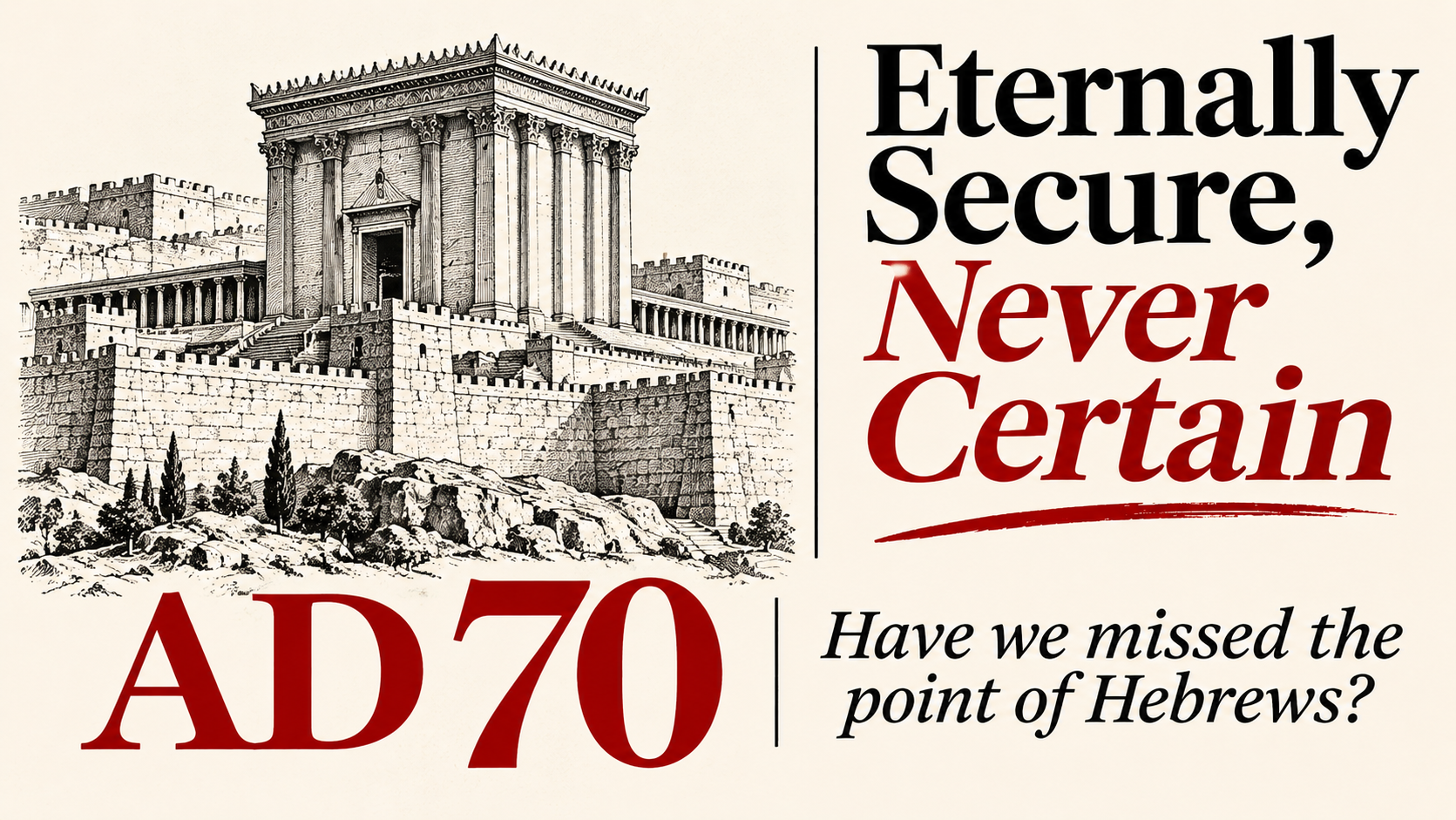
Eternally Secure, Never Certain
This morning, an episode appeared in my SermonAudio feed entitled “Can You Fall Away from Christ and Still Be Saved?” featuring Richard Caldwell Jr. on the Straight Truth Podcast.
Listen to the episode on SermonAudio
The timing was remarkable. Just days ago, I received an email from a listener who has struggled with assurance of salvation for over thirty years. The struggle has been so severe that it has produced panic attacks.
And now, here is another discussion of eternal security that may leave the struggling Christian more insecure than ever.
But there is another problem with this episode, one that I believe is even more fundamental. It involves how we interpret the book of Hebrews.
I want to address both problems.
Eternal Security That Creates Insecurity
Caldwell affirms that a genuinely regenerate person cannot lose their salvation. That sounds encouraging. But the discussion quickly shifts to how a person can determine whether they were ever genuinely saved.
Consider these statements:
“If you really are a believer, the warning lands. If you really are a believer, the warning is heeded. If you really are a believer, you move forward in the Christian life.”
Later, he states:
“And it’s the pattern of your life that’ll tell the truth about the genuineness of your faith.”
And there it is.
You cannot lose your salvation, but you must examine the pattern of your life to determine whether you ever possessed salvation.
Caldwell acknowledges that an unregenerate person can profess faith, attend church, experience moral improvement, and appear to be growing spiritually. He also acknowledges that a genuinely regenerate person can experience serious moral failure, cowardice, and even deny Christ, as Peter did.
So the unregenerate can look regenerate, and the regenerate can look unregenerate.
How, then, do I know which one I am?
Apparently, the answer is the pattern of my life.
But my life isn’t over yet!
What constitutes a sufficient pattern? How many years of faithfulness are enough? How much failure is too much? How long can a period of spiritual struggle last before it becomes evidence that I was never saved?
And if someone can appear faithful for forty years and then fall away, revealing that those forty years were merely the appearance of genuine conversion, how could that person have possessed definitive assurance during those forty years?
We have not eliminated the uncertainty. We have simply relocated it.
Instead of fearing that I might lose my salvation, I now fear that I might discover I never had salvation.
Imagine the listener who wrote to me. Thirty years of uncertainty. Thirty years of examining themselves. Thirty years of wondering whether they will ultimately stand before God and discover that everything they believed about their salvation was wrong.
What does this approach offer them?
Another examination. Another investigation. Another opportunity to scrutinize their spiritual performance.
Perhaps another thirty years of questions.
The Bigger Problem: What Happened to the Context of Hebrews?
As serious as the problem of assurance is, I believe there is an even more fundamental problem with this discussion.
How did we get from the book of Hebrews to a modern Christian trying to determine whether their struggle with sin proves they were never genuinely regenerated?
Where is the hermeneutical bridge?
When I preached through Hebrews, I had the congregation participate in an investigation. I asked people to grab Bible encyclopedias, dictionaries, handbooks, and study Bibles and find the proposed date of the book.
The overwhelming majority of the resources we consulted placed Hebrews somewhere in the 60s, before the destruction of Jerusalem in AD 70.
I believe the cumulative historical and textual evidence strongly supports that dating. While later dates have been proposed, a pre-AD 70 date is a widely held scholarly position.
And that date matters enormously.
The Jewish–Roman War began in AD 66. Roman forces had already advanced against Jerusalem that year. Vespasian began his campaign in Galilee in AD 67, and by AD 68 the Roman conquest was well underway.
In AD 70, Jerusalem fell, the temple was destroyed, and the sacrificial system ceased.
This is the historical world in which I believe Hebrews must be interpreted.
A Religious World About to End
Consider the original audience of Hebrews. The book addresses people deeply immersed in the Scriptures, institutions, and religious categories of the Mosaic Covenant.
The temple is still standing. The priests are still ministering. Sacrifices are still being offered.
Yet Christ has come.
He has offered the final sacrifice. He has entered the heavenly sanctuary. He is the eternal High Priest. He is the mediator of the New Covenant.
And the old religious order is approaching its historical destruction.
Hebrews 8:13 declares:
“In that he saith, A new covenant, he hath made the first old. Now that which decayeth and waxeth old is ready to vanish away.”
Notice the distinction. The Old Covenant has already been rendered obsolete through Christ, but its visible religious institutions are still standing.
They will not stand much longer.
Imagine someone rejecting Christ and returning to Judaism as their means of approaching God. What are they returning to?
- A temple that is about to be destroyed.
- An altar that is about to disappear.
- Sacrifices that are about to cease.
- A high priest who will no longer have a sanctuary in which to minister.
- A priestly system dependent upon physical descent and genealogical records, many of which would be lost or disrupted.
Judaism would survive and develop into rabbinic Judaism, but the temple-centered Mosaic system could no longer function as prescribed in the Torah.
Now consider what Hebrews offers its readers in Christ.
An eternal High Priest. A heavenly sanctuary. One sufficient sacrifice forever. A better covenant. A heavenly Jerusalem. A kingdom that cannot be shaken.
Everything the readers have in Christ will survive the destruction that is coming.
The Romans cannot destroy their High Priest. They cannot burn their heavenly sanctuary. They cannot interrupt the effectiveness of Christ’s sacrifice. They cannot overthrow the kingdom they have received.
This is not incidental historical background. I believe it is essential to understanding the entire theological argument of Hebrews.
What Does It Mean to Fall Away?
Caldwell approaches Hebrews 6 as a discussion of false conversion. He repeatedly describes the experiences mentioned in the passage as superficial.
But the text speaks of people who have been enlightened, tasted the heavenly gift, shared in the Holy Spirit, and tasted the powers of the coming age.
Where does the text establish that these experiences were superficial?
The word tasted certainly does not establish it. Hebrews 2:9 tells us that Jesus tasted death. Did Jesus merely experience death superficially?
Before importing our theological categories into Hebrews 6, we should ask what falling away would mean within the historical, literary, and theological argument of the book.
What would it mean for someone who had encountered Christ as the fulfillment of the Mosaic system to reject him and return to that system?
They would be rejecting the final sacrifice for sacrifices that could never take away sins.
They would be rejecting the eternal High Priest for a priesthood that could never accomplish eternal redemption.
They would be rejecting the mediator of the New Covenant for a covenant that had been rendered obsolete.
And they would be returning to a religious order whose visible institutions were approaching catastrophic destruction.
This also illuminates Hebrews 10:26:
“For if we sin wilfully after that we have received the knowledge of the truth, there remaineth no more sacrifice for sins.”
Christians have been terrified by this verse for centuries.
A Christian watches pornography, knowing it is wrong, and begins wondering whether there remains any sacrifice for their sins.
But read the chapter!
Hebrews 10 is about the finality and sufficiency of Christ’s sacrifice. The blood of bulls and goats cannot take away sins. Christ has offered one sacrifice forever. By one offering, he has perfected forever those who are sanctified.
Verse 18 has already declared that there is no more offering for sin.
Why does there remain no more sacrifice?
Because Christ is the final sacrifice!
If you reject Christ, there is no alternative sacrifice to which you can turn.
And notice how Hebrews 10:29 describes the offense: trampling the Son of God underfoot, treating the blood of the covenant as unholy, and insulting the Spirit of grace.
There is an enormous difference between a Christian who struggles with pornography while believing that the blood of Christ is their only hope of forgiveness and someone who repudiates the blood of Christ and turns elsewhere for salvation.
Yet we regularly take warnings describing the latter and use them to terrify the former.
A Hermeneutical Failure
I am not arguing that Hebrews has no soteriological content. Of course it does!
I am arguing that the soteriological content of Hebrews must be interpreted in light of its historical, literary, and theological context, including the approaching destruction of Jerusalem and the temple-centered Mosaic system.
We must establish what the author was communicating to the original audience before turning the book into a battleground for Calvinism, Arminianism, eternal security, perseverance, and false conversion.
This does not mean that every reference to judgment must automatically be identified exclusively with AD 70. Those connections require careful exegesis.
But how can we responsibly discuss the warnings of Hebrews while virtually ignoring the historical catastrophe that was approaching and the covenantal transition that dominates the entire book?
Caldwell may have a theological argument for his understanding of regeneration and perseverance. But he must demonstrate that Hebrews 6 is actually addressing that argument.
Otherwise, we are allowing our theological systems to determine the meaning of the text.
And that is a fundamental hermeneutical failure.
Look Unto Jesus
Perhaps the greatest irony in all of this is that Hebrews contains some of the most powerful statements of assurance in the entire New Testament.
Hebrews 7:25:
“Wherefore he is able also to save them to the uttermost that come unto God by him, seeing he ever liveth to make intercession for them.”
Hebrews 10:14:
“For by one offering he hath perfected for ever them that are sanctified.”
Hebrews 10:19:
“Having therefore, brethren, boldness to enter into the holiest by the blood of Jesus.”
What is the basis of that boldness?
The pattern of my life?
The quality of my repentance?
The degree of my moral transformation?
The blood of Jesus.
Even Peter, whom Caldwell uses as an example of someone whose subsequent faithfulness demonstrated genuine conversion, points us toward a different emphasis.
Jesus told Peter:
“But I have prayed for thee, that thy faith fail not.” — Luke 22:32
Peter’s preservation rested in the intercession of Christ, not in Peter’s ability to demonstrate sufficient loyalty.
Peter failed. Christ did not.
And that brings us back to the message of Hebrews.
The temple would fall. The altar would be destroyed. The sacrifices would cease. The earthly priesthood would lose its sanctuary. Jerusalem would be devastated.
But Christ would remain.
The original audience was being told that everything they needed was found in Christ.
How tragic that we have taken a book proclaiming the permanence, superiority, and sufficiency of Christ and turned it into one of the greatest sources of Christian insecurity.
Hebrews tells us to look unto Jesus.
Our theological systems keep telling us to look at ourselves.
Perhaps it is time we listened to Hebrews.
Hell Is 1,800 Miles Below Us?