The Meme Is Dead, but the Sermons Live On
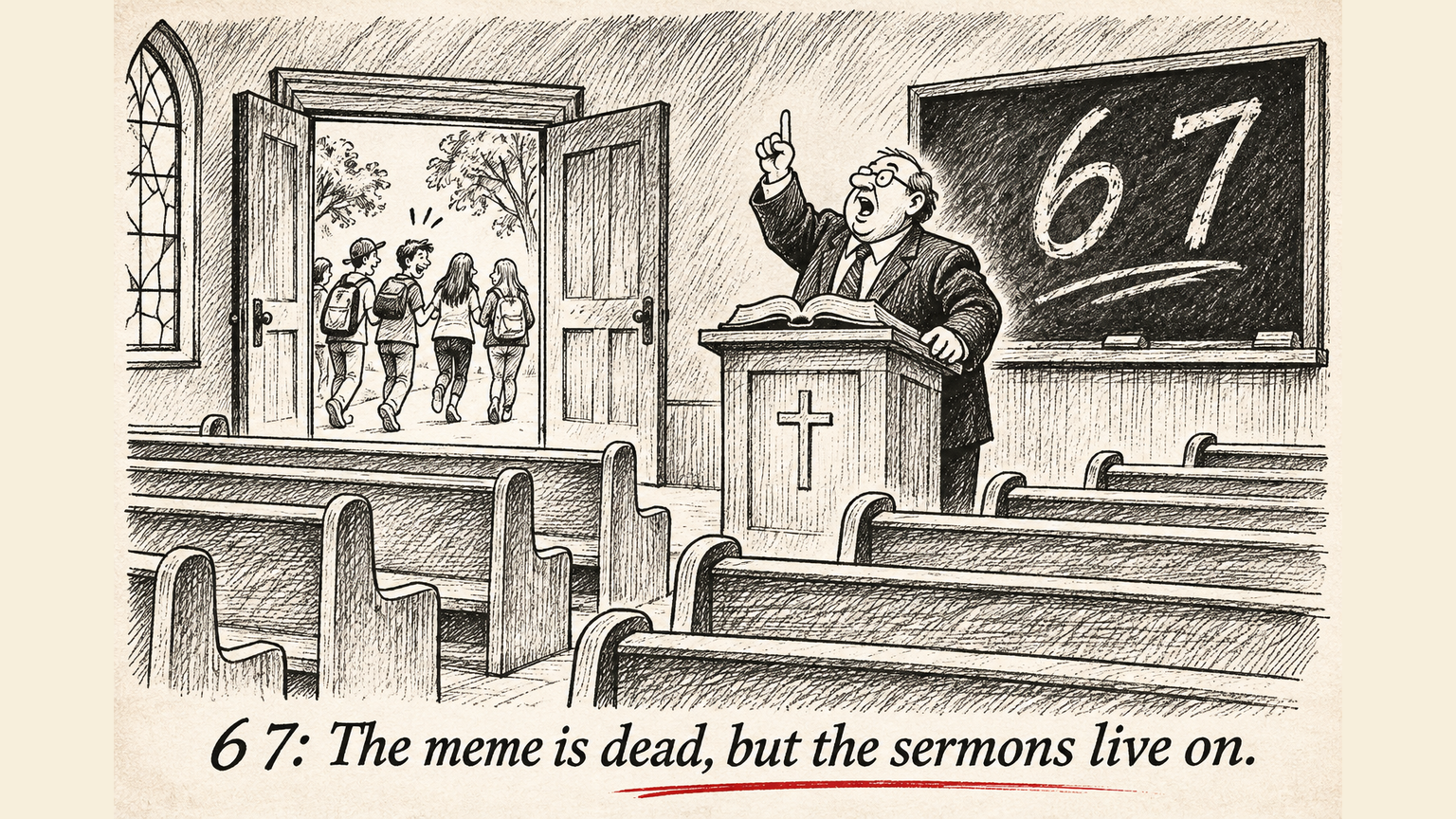
It is almost 1 a.m. on Friday, November 13, 2026. I am lying in bed, listening to sermons, when I encounter something that makes me wonder if I have finally lost my mind.
The sermon is entitled “What Does ‘6 7’ Mean? The Bible Got There First,” preached by Jimmy Fortunato on October 27, 2026.
You can listen to the sermon here:
https://www.sermonaudio.com/sermons/11526129348069
Yes, you read that correctly. There is a sermon about 6 7.
I am lying in bed in the middle of the night listening to a preacher address a viral internet meme that young people have largely abandoned, and somehow we are going to turn this into a biblical, theological, hermeneutical discussion.
I cannot even type that without laughing.
But here we are.
First, What Was 6 7?
For those who somehow missed this incredibly important chapter in human civilization, “6 7” was a viral internet trend that became enormously popular among children and teenagers in 2025.
The phrase originated in a song by Philadelphia rapper Skrilla called “Doot Doot (6 7).” The song initially circulated in late 2024 and became part of a growing internet phenomenon in 2025.
The phrase gained popularity through basketball videos, particularly videos featuring NBA player LaMelo Ball, who happens to be six feet, seven inches tall. Other videos, basketball personalities, children, and an accompanying hand gesture helped turn the phrase into a widespread cultural phenomenon.
Children would say “six seven,” move their hands up and down, and laugh.
Sometimes they would say it when the numbers appeared in a classroom. Sometimes they would say it in response to a question. Sometimes they would say it for absolutely no discernible reason.
That was largely the point.
Dictionary.com selected “67” as its 2025 Word of the Year, despite the expression having no stable, agreed-upon definition.
The Associated Press, NPR, and numerous other news organizations attempted to explain the phenomenon to increasingly confused adults.
Skrilla himself indicated that he had not assigned the expression a definitive meaning. Whatever significance the numbers might have had within the original song, the viral expression developed a cultural life of its own.
It became an inside joke. It became a shared experience. It became something young people said because other young people said it, because it was funny, and because adults were increasingly irritated by it.
And then something happened that should shock absolutely no one.
Young people moved on.
By March 3, 2026, Yahoo News had published an article entitled:
”‘It was never cool, but now it’s dead.’ How ‘6-7’ lost its grip on Gen Alpha.”
The article documented how the older children and teenagers who had helped popularize the expression were largely abandoning it.
Some younger children continued using it, and I am sure someone somewhere is still saying it. But the cultural moment had passed its peak.
The sermon I am listening to was preached almost eight months after that article appeared.
The young people have moved on.
Apparently, the adults are still holding meetings about it.
Have We Forgotten What It Was Like to Be Young?
Every generation has had its expressions, jokes, trends, and cultural phenomena that made absolutely no sense to the adults around them.
Young people have always developed their own language.
They have repeated television catchphrases, movie lines, song lyrics, commercial slogans, and absurd expressions that drove their parents and teachers crazy.
Some of us grew up saying things like “Nanu Nanu,” “Where’s the beef?” or “Don’t have a cow, man.”
There was Pig Latin. There were ridiculous schoolyard rhymes. There were jokes that made no sense outside a particular group of friends. There were words and phrases that became hilarious simply because adults did not understand them.
Some of these things lasted years. Others lasted a few weeks.
The internet has accelerated the process, but it did not invent it.
Young people doing something silly that older people do not understand is not a new development in human history.
It is called being young.
And sometimes, perhaps the most entertaining part of a trend is watching adults try to figure out what it means.
Imagine being a teenager, saying two numbers to make your friends laugh, and discovering that a preacher has constructed an entire sermon about it.
You might have just discovered the funniest part of the entire meme.
The Bible Got There First?
The preacher introduces his sermon by saying:
“I came to open up the Bible to some places where it says 6-7. And to show you who was already standing there.”
He then says:
“The number is not holy, but the book is holy. 6-7 has no power. God never needed a number to speak, but God did speak, and He wrote it down.”
That sounds like an important qualification.
Unfortunately, it introduces the central problem with the entire sermon.
God did not write down the chapter and verse numbers.
The biblical authors did not write their books using our modern chapter and verse numbering system.
Moses did not write Exodus 6:7 as Exodus 6:7.
Isaiah did not write Isaiah 6:7 as Isaiah 6:7.
Paul did not write Galatians 6:7 as Galatians 6:7.
The modern chapter divisions are generally associated with Stephen Langton in the early thirteenth century. The Hebrew Scriptures had earlier traditions of textual and verse division, but our familiar numbering systems developed over time. The modern New Testament verse numbering was introduced by Robert Estienne in his 1551 Greek New Testament.
These numbers are useful editorial tools. They help us locate passages, compare texts, and communicate about Scripture.
They are not inspired connections between passages.
The words of Exodus existed long before the internet meme. Of course they did. But the fact that a particular sentence in Exodus is now identified as chapter six, verse seven has absolutely nothing to do with a rapper, a basketball player’s height, or a child making a hand gesture in a school hallway.
The Bible did not anticipate the meme.
The preacher found a numerical coincidence.
And then he built a sermon around it.
Seven Stops, One Hermeneutical Problem
The preacher takes his listeners through seven passages:
- Exodus 6:7
- Deuteronomy 6:7
- Matthew 6:7
- Galatians 6:7
- Genesis 6:7
- Isaiah 6:7
- Mark 6:7
At the conclusion, he declares:
“Seven stops, one truth.”
But what actually connects these seven passages?
Exodus 6:7 concerns God’s covenant promise to deliver Israel from Egyptian bondage.
Deuteronomy 6:7 concerns Israel’s responsibility to teach God’s commandments to its children.
Matthew 6:7 concerns the nature of prayer.
Galatians 6:7 concerns sowing and reaping within Paul’s discussion of life according to the flesh and the Spirit.
Genesis 6:7 concerns God’s judgment upon humanity in the flood narrative.
Isaiah 6:7 concerns Isaiah’s cleansing within his prophetic commissioning.
Mark 6:7 concerns Jesus sending out the Twelve and granting them authority over unclean spirits.
These are seven different passages, written in different historical circumstances, addressing different subjects, within different literary contexts.
Their shared numerical address establishes no exegetical relationship between them.
Could someone develop a legitimate biblical theology of redemption, judgment, grace, and mission using some of these passages? Certainly.
But the legitimacy of that theological construction would depend upon the actual meaning of the texts and the demonstrable relationships between them.
It would not depend upon the fact that they are all numbered 6:7.
Change the numbering system, and the entire organizing principle of the sermon disappears without changing a single inspired word.
That should tell us something.
There is nothing inherently wrong with using a cultural reference as a sermon introduction. There is nothing wrong with using a mnemonic device to help people remember passages of Scripture.
But when a cultural phenomenon supplies the numbers, those numbers determine which passages will be selected, and those passages are subsequently assembled into a spiritual message, we have allowed something other than the biblical text to establish the structure of our interpretation.
The culture supplied the numbers.
The editors supplied the addresses.
The preacher supplied the connections.
And somehow, the Bible got there first.
From a Rap Song to Mount Carmel
This is where the sermon moves from being a somewhat amusing gimmick to something considerably more troubling.
The preacher discusses Skrilla and his reported involvement in Santería and Palo, religious traditions that he regards as spiritually dangerous.
He says:
“Look, in that chant that all these kids are saying, that chant came out of that world. A world where words are repeated and chanted to call on spirits. You know what that is? That’s Mount Carmel all over again.”
He then asks:
“The same two syllables that came from a man calling on spirits came out of your mouth in the lunchroom just because it was funny?”
Wait a minute.
We have several entirely different claims here.
A musician has particular religious beliefs.
That musician produces a song.
A phrase from that song becomes a viral internet trend.
Children repeat the phrase.
And now, somehow, we are standing on Mount Carmel with the prophets of Baal?
How did we get there?
There is an enormous logical leap between establishing that a musician participates in certain religious practices and establishing that a particular phrase from one of his songs is a religious invocation.
There is another enormous logical leap between establishing that a phrase has some religious origin and establishing that children repeating it as a basketball joke are participating in that religious practice.
The sermon does not establish either of those connections.
It simply moves from the musician’s reported religious beliefs to the phrase, from the phrase to the children, and from the children to Mount Carmel.
That is not biblical discernment.
That is guilt by association.
Furthermore, the fact that a phrase originated in a song containing objectionable lyrics does not establish that every subsequent use of that phrase communicates those lyrics, endorses the musician’s beliefs, or participates in the musician’s religious practices.
Language does not work that way.
If a child says “six seven” because LaMelo Ball is six feet, seven inches tall, the child’s words do not become an invocation of spirits because a rapper once used those same numbers.
Where is the evidence?
Where is the biblical argument?
Where is the logical connection?
And perhaps most importantly, why are we placing a spiritual burden on children without establishing that the burden comes from Scripture?
The Sermon Contradicts Its Own Argument
One of the central themes of the sermon is that identical words can have different meanings depending upon who says them, why they say them, and what they intend.
The preacher discusses prayer, the use of God’s name, the sons of Sceva in Acts 19, and Satan quoting Scripture during the temptation of Jesus.
His argument is that the words themselves do not necessarily establish the nature of the act.
There is actually an important truth there.
Context matters.
Intention matters.
Meaning matters.
But if that is true, why does it suddenly stop being true when a child says “6 7”?
If the same words can function differently in different contexts, then the phrase used in a song and the phrase used by a child in a school hallway must be evaluated according to their respective contexts.
The preacher’s own argument undermines the spiritual warning he is attempting to deliver.
He acknowledges that the same words can have different meanings, but then treats the origin of the meme as though it determines the spiritual significance of every subsequent use.
Which is it?
Do context and meaning determine what someone is communicating?
Or does a phrase carry the religious identity of everyone who has ever used it?
You cannot have it both ways.
The Bible, the GOAT, and the Goat
And then we get this:
“Goat. Everybody wants to be the goat. The greatest of all time. You know the one time Jesus talks about goats? He separates them. Heaven don’t have no goats in it. Heaven’s full of sheep! What are you?”
I am not making this up.
The modern expression GOAT is an acronym for Greatest of All Time.
The goats in Matthew 25 are animals used in Jesus’ illustration of judgment.
There is no linguistic relationship between the acronym and the animals in the passage.
Calling someone the GOAT does not mean that you are identifying that person with the goats in Matthew 25.
If someone calls Michael Jordan the GOAT, that person is not making a theological statement about Michael Jordan’s eternal destiny.
What makes this even more extraordinary is that the preacher immediately goes on to say:
“Look, the point is, what I’m trying to make is there’s context to chapters. You can’t just throw sheep and goats out there and make it just mean anything.”
Exactly!
That is precisely the problem!
He has just used the goats in Matthew 25 to make a point about a modern acronym that has absolutely nothing to do with the passage.
And then he warns his listeners not to make the sheep and goats mean whatever they want.
At this point, I am lying in bed wondering if anyone else is hearing what I am hearing.
Exodus 6:7 and the Problem of Personal Application
The sermon also contains a more familiar form of biblical misuse.
Discussing Exodus 6:7, the preacher focuses on the word “bringeth” in the King James Version.
He says:
“That’s present tense. He’s still bringing. Now He brought them out of Egypt, but God has never stopped bringing His people out.”
He then applies the passage to young people experiencing pressures, habits, secrets, and burdens.
But the English present tense does not establish the theological conclusion he draws.
The Hebrew expression identifies God as the one bringing Israel out from under the burdens of Egypt. It belongs to a specific covenant declaration concerning a specific historical deliverance.
The fact that the King James Version uses “bringeth” does not establish an ongoing promise that God will remove whatever burden a Christian happens to be experiencing.
Can the exodus contribute to a broader biblical theology of redemption? Absolutely.
The New Testament itself provides grounds for such connections.
But that is different from taking an English verb tense and using it to transform a promise to Israel into an assurance of deliverance from personal struggles.
The distinction matters because Christians often remain under tremendous burdens.
Christians experience chronic illness, grief, loneliness, persecution, and suffering. Some struggle with the same sins and weaknesses throughout their lives.
Paul prayed for the removal of his thorn in the flesh, and the answer he received was not the removal of the burden but the sufficiency of God’s grace in the midst of weakness.
We need to be careful about what we promise people in the name of God.
Even in a sermon about an internet meme.
What Does the Bible Actually Say About Christian Liberty?
There is a biblical discussion that could have been developed from this cultural phenomenon.
It concerns Christian liberty, conscience, wisdom, and the distinction between what Scripture actually prohibits and what Christians personally find objectionable.
Romans 14 addresses disputes over practices that believers evaluated differently.
Paul warns Christians against judging one another over matters that are not inherently sinful. He also recognizes the importance of conscience and the responsibility not to cause another believer to stumble.
In 1 Corinthians 8–10, Paul addresses food associated with idols.
Think about that.
Food associated with actual pagan worship.
Paul distinguishes between participation in idolatrous worship, which he explicitly prohibits, and the ordinary consumption of food that may have had an association with idolatry.
In 1 Corinthians 10:25, he writes:
“Whatsoever is sold in the shambles, that eat, asking no question for conscience sake.”
Paul does not establish a system in which everything that has ever been associated with pagan religion becomes permanently contaminated.
He distinguishes the object, its use, the context, the conscience, and the nature of the act.
Actual participation in idolatry is forbidden. Ordinary use is not automatically equivalent to participation in idolatry.
That distinction is enormously relevant here.
If a child were knowingly participating in a religious invocation, that would be one discussion.
If a child is repeating two numbers from a viral basketball meme, that is an entirely different discussion.
Christians can evaluate the original song. Parents can make decisions about the music their children consume. Teachers can address classroom disruption. Children can be taught consideration for others.
None of that requires us to invent a spiritual danger inherent in saying two numbers.
And none of it requires us to drag the prophets of Baal into a middle school cafeteria.
There Is Actually Some Good Material in This Sermon
I want to be fair.
There are portions of this sermon that contain worthwhile biblical observations.
The preacher correctly recognizes that Matthew 6:7 does not prohibit all repetition in prayer. Jesus himself repeated his prayer in Gethsemane.
The preacher also makes an important observation in Isaiah 6: Isaiah does not cleanse himself before coming into the presence of God. God provides the cleansing.
He even criticizes excessive pastoral authority and the endless rules imposed upon people within his own religious circles.
He says:
“Because parents, you cannot legislate righteousness.”
That is a significant statement.
He criticizes the assumption that conformity to external rules can accomplish what only God can accomplish.
And that makes the rest of the sermon all the more frustrating.
There is material here for a powerful message about sin, grace, forgiveness, and the inability of human beings to make themselves righteous.
Why not preach that?
Why do we need a viral internet meme?
Why do we need to construct a chain of passages based on editorial numbering?
Why do we need to introduce an unsubstantiated association between children repeating a phrase and the prophets of Baal?
Why not simply open Isaiah 6 and preach Isaiah 6?
The Church’s Endless Search for Something to Be Against
There is a larger issue here.
Christianity has often developed a reputation for discovering spiritual dangers in whatever happens to be popular among young people.
A new form of music appears. A new television program appears. A new game appears. A new fashion appears. A new expression appears.
And almost inevitably, someone begins explaining why Christians should be concerned.
Sometimes there are legitimate concerns. Cultural products can communicate ideas and values that deserve careful evaluation.
But not every cultural phenomenon is a spiritual crisis.
Not every joke requires a sermon.
Not every expression requires a theological investigation.
Not every meaningless thing needs to be assigned a meaning so that Christians can subsequently condemn it.
And not every connection between a cultural phenomenon and a religious practice is a connection that actually exists.
Sometimes a child is just being silly.
Sometimes a teenager is just trying to make a friend laugh.
Sometimes a meme is just a meme.
I wonder how many young people have grown up hearing Christians warn them about things that they themselves knew were harmless, absurd, or meaningless.
What happens when those same Christians later attempt to communicate something of genuine theological significance?
What happens when the young person has learned that spiritual warnings are often built upon exaggeration, speculation, and a fundamental misunderstanding of the world in which they live?
We should be concerned about that.
When we manufacture spiritual dangers, we risk undermining our credibility when addressing actual ones.
The Real Danger
It is now well past midnight, and I have spent part of my night listening to a sermon about two numbers.
The meme has largely faded.
The young people have moved on to whatever the next thing happens to be.
And the church is still explaining why the last thing might have been spiritually dangerous.
But perhaps there really is a danger worth discussing here.
It is not the danger of a child saying “six seven.”
It is the danger of Christians using Scripture to give divine authority to conclusions that Scripture does not establish.
It is the danger of allowing our cultural anxieties to determine what biblical passages we select and how we connect them.
It is the danger of placing burdens upon people’s consciences that God has not placed there.
It is the danger of confusing an entertaining sermon structure with sound biblical interpretation.
And it is the danger of spending so much time trying to find something wrong with the culture that we fail to examine what is wrong with our own handling of the Word of God.
The children were saying two numbers.
The preacher turned those numbers into seven biblical passages, a spiritual warning, a discussion of pagan religious practices, and a trip to Mount Carmel.
I am not sure the children were the ones who took the meme too far.
6 7.
The meme is dead.
Unfortunately, the hermeneutics live on.
Sources and further reading:
- Sermon under review: Jimmy Fortunato, “What Does ‘6 7’ Mean? The Bible Got There First,” October 27, 2026. https://www.sermonaudio.com/sermons/11526129348069
- Dictionary.com: Explanation of the slang expression “67,” September 15, 2025. https://www.dictionary.com/culture/slang/67
- Associated Press: “Dictionary.com’s word of the year is ‘6-7.’ But is it even a word and what does it mean?” https://apnews.com/article/f905630f251cc8969100853d7e64ca79
- NPR: “What does ‘67’ mean? Dictionary.com’s 2025 word of the year has no definition,” November 1, 2025. https://www.opb.org/article/2025/11/01/67-is-dictionary-coms-word-of-the-year-what-is-it/
- Yahoo News: “‘It was never cool, but now it’s dead.’ How ‘6-7’ lost its grip on Gen Alpha,” March 3, 2026. https://www.yahoo.com/lifestyle/article/it-was-never-cool-but-now-its-dead-how-6-7-lost-its-grip-on-gen-alpha-120058416.html
Theology Central — An ongoing journey through Scripture, theology, and life.
https://www.theologycentral.net
https://www.theologycentral.org
When Christian History Disappears