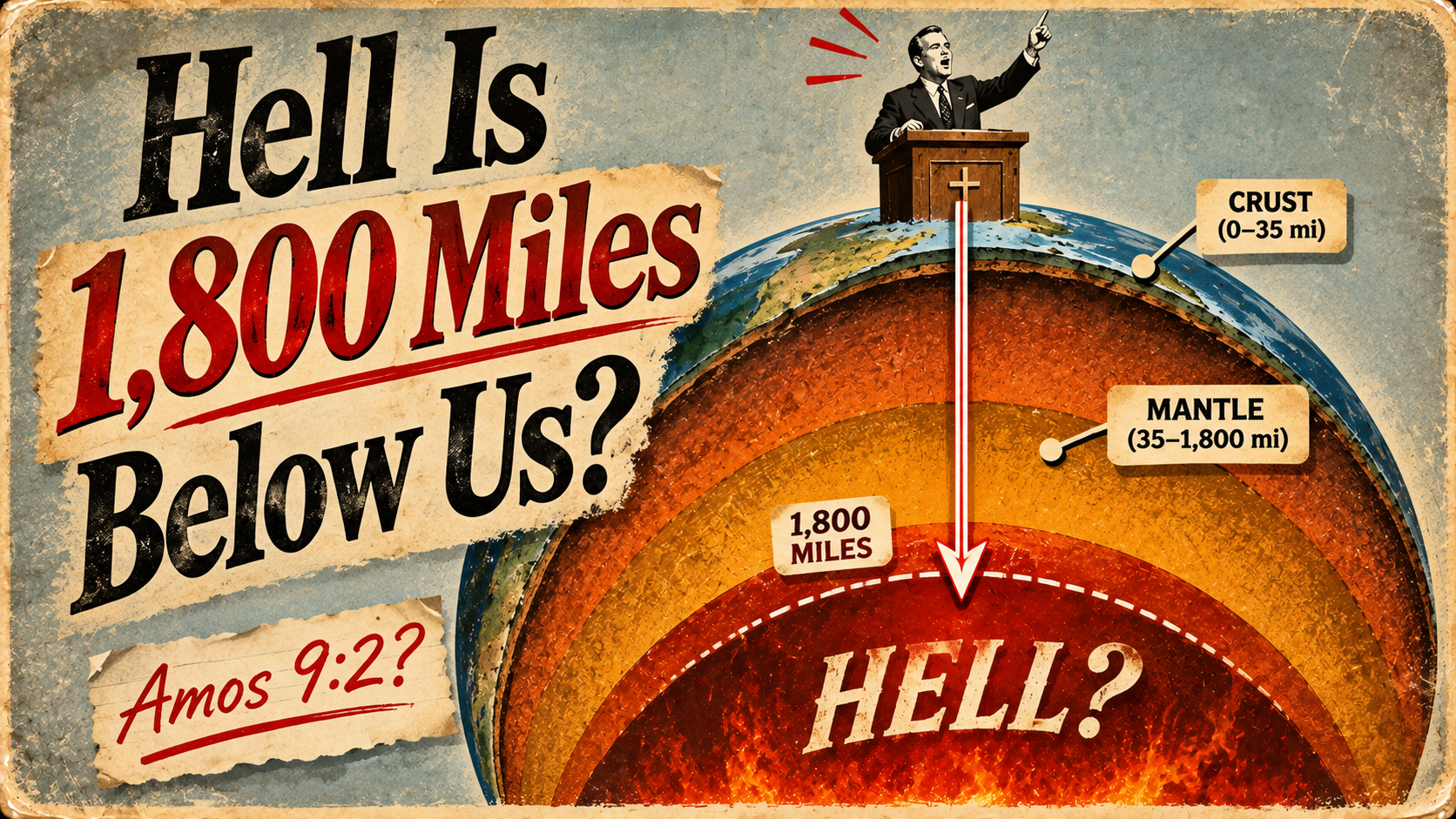
Hell Is 1,800 Miles Below Us?
It is Friday morning, November 13, 2026. I am scrolling through the SermonAudio app when I encounter a newly uploaded chapel message from Ambassador Baptist College.
The title? The Names of Hell.
The speaker is Mike Pelletier, and the text is Revelation 20:11–15.
I start listening.
Before long, I discover that hell is approximately 1,800 miles beneath my feet, that temperatures may reach 13,000 degrees, that miners have reportedly heard screaming deep within the earth, that liquid metal may produce pounding sounds that increase the anxiety of those in hell, and that people may be continually falling while being burned, bitten, and stung by demonic creatures.
And no, I am not making this up.
This is being preached at a Bible college.
Listen to the message here:
The Names of Hell — Mike Pelletier | Ambassador Baptist College | November 13, 2026
I encourage you to listen to the message for yourself. What follows is not a rejection of divine judgment, the seriousness of sin, or the necessity of proclaiming the gospel. It is a rejection of a methodology that takes biblical words, removes them from their contexts, combines them with historical legends and scientific misunderstandings, and then presents the resulting picture as biblical truth.
We need to talk about this.
The Hermeneutical Problem Begins Immediately
The preacher explains how he arrived at the approach for his sermon:
“I wondered why did God give hell so many different names? And my conclusion was each name describes an aspect of hell that we might not give from any other name.”
There it is.
Before we have examined a single Hebrew or Greek word, the controlling assumption has already been established: all these different words are names for hell, and each one reveals a different feature of that place.
But that is precisely what must be demonstrated, not assumed.
Sheol, Hades, Gehenna, Tophet, Tartarus, the abyss, and the lake of fire do not automatically refer to the same reality simply because English-speaking Christians frequently associate them with the word hell.
Each term must be examined within its own linguistic, historical, literary, and theological context.
Instead, the sermon treats these terms as pieces of a puzzle. Each supposedly provides another detail, and by putting them together, the preacher believes he can construct a comprehensive picture of what hell is like.
The result is extraordinary.
Hell Is 1,800 Miles Below Your Feet
The first word examined is the Hebrew word Sheol.
The preacher turns to Amos 9:2:
“Though they dig into hell, thence shall mine hand take them; though they climb up to heaven, thence will I bring them down.”
His conclusion?
“Now, the idea is if you dug deeply enough, you could dig into hell.”
He proceeds to locate what he calls the present hell in the core of the earth.
We are then given a discussion of the earth’s outer core, inner core, temperature, density, and depth.
At one point, he asks his audience to imagine burning in temperatures of 13,000 degrees without ever dying.
He even introduces the testimony of two miners from West Virginia who reportedly heard sounds resembling people screaming deep underground.
Let us examine the actual text.
Amos 9:1–4 describes the impossibility of escaping divine judgment. Whether people dig into Sheol, ascend to heaven, hide on Mount Carmel, descend into the sea, or go into captivity, God will find them.
The point is not the physical location of Sheol.
The point is that there is nowhere to escape God.
The passage uses dramatic spatial imagery to communicate the inescapability of divine judgment. It is not providing a geological map of the afterlife.
Furthermore, Sheol is not exclusively the destination of the wicked in the Old Testament. In Genesis 37:35, Jacob expects to go down to Sheol in mourning for his son Joseph. In Job 14:13, Job wishes that God would hide him in Sheol.
The word has a broader range of usage associated with death, the grave, and the realm of the dead.
That should have been explored before anyone started calculating how many miles a person would have to dig to reach hell.
And scientifically, the earth’s outer core does begin approximately 1,800 miles below the surface. But establishing that the earth has a hot interior does absolutely nothing to establish that deceased human beings are being punished there.
Volcanic lava, incidentally, does not originate in the earth’s core. Magma generally forms through melting processes in the mantle or crust.
The existence of a hot planetary interior is not evidence for the geographical location of hell.
As for miners hearing screaming?
What are we supposed to do with that?
Even the preacher acknowledges that he does not know what they heard. Yet the story is introduced in a way that encourages the audience to associate those sounds with the suffering of people in hell.
That is not evidence. It is speculation.
Tophet and the Sounds of Hell
Next, we move to Isaiah 30:33 and the word Tophet.
The preacher describes an elaborate idol associated with Molech, with flames emerging from its fingers, eyes, nose, and mouth. Children are sacrificed, drums are beaten to drown out their screams, and the preacher concludes that Tophet may reveal another feature of hell.
Pounding sounds.
He then brings in a conversation with a geologist who supposedly explained how liquid metal moving within the earth could produce strange sounds.
The preacher imagines these sounds increasing the anxiety of those suffering in hell.
Where does one even begin?
First, Tophet was a place associated with the horrific practice of child sacrifice in the Valley of Hinnom. The biblical text does not identify Tophet as the name of a brass statue.
Second, the elaborate description of the statue and the drums goes beyond what Scripture establishes. Such details appear in later traditions and historical reconstructions, but they should not be presented as though we possess a straightforward biblical description of the entire ceremony.
Third, Isaiah 30:33 appears within a prophecy concerning divine judgment against Assyria. Read Isaiah 30:27–33. The passage describes God’s judgment against an earthly enemy through powerful imagery of fire, destruction, and divine wrath.
Where does the passage teach that people in the afterlife will hear pounding sounds generated by the movement of molten metal?
It doesn’t.
And then there is the scientific problem.
The sermon refers to the earth’s core spinning at approximately 68,000 miles per hour. That figure is approximately the speed at which the earth orbits the sun, not the rotational speed of the earth’s core.
These are entirely different things.
Even if geological processes generate sounds or seismic waves, that would not establish that those sounds are part of divine punishment.
We have moved from a biblical passage about judgment against Assyria to ancient child sacrifice, to drums, to liquid metal, to the supposed acoustics of hell.
At what point did we stop interpreting Scripture and start writing our own account of the afterlife?
Gehenna: The Garbage Dump That Won’t Go Away
The next word is Gehenna.
Here we encounter one of the most frequently repeated claims in Christian preaching: the Valley of Hinnom was a garbage dump where fires burned continuously, refuse rotted, worms multiplied, and the bodies of executed criminals were discarded.
The preacher claims King Josiah established this arrangement.
He also states:
“Gehenna means the place of refuse, the place of garbage.”
No, it doesn’t.
Gehenna derives from the name of the Valley of Hinnom.
Read 2 Kings 23:10:
“And he defiled Topheth, which is in the valley of the children of Hinnom, that no man might make his son or his daughter to pass through the fire to Molech.”
The text tells us that Josiah defiled Topheth to prevent child sacrifice.
It does not tell us that he established a perpetually burning garbage dump.
It does not tell us that he established a disposal site for executed criminals.
The familiar story of Gehenna as a continuously burning municipal garbage dump in the time of Jesus lacks secure ancient historical evidence. Its repetition in sermons does not transform it into an established historical fact.
There is another issue.
When Jesus speaks of the worm that does not die and the fire that is not quenched in Mark 9, he is drawing upon Isaiah 66:24.
In Isaiah, the imagery concerns the dead bodies of those who rebelled against God.
That Old Testament context deserves serious examination. Instead, we are given a garbage dump, rotting refuse, an imagined stench, and the additional claim that the undying worm represents the human soul.
Where does the text identify the worm as the human soul?
Again, we are being given conclusions that the passage itself does not establish.
Tartarus and Turning Up the Temperature
The preacher next turns to 2 Peter 2:4:
“For if God spared not the angels that sinned, but cast them down to hell…”
The Greek verb used here is tartaroō, associated with Tartarus. It occurs only once in the New Testament.
The passage concerns angels who sinned and are being held for judgment.
The preacher constructs an explanation involving different categories of fallen angels and different degrees of punishment, eventually moving to Romans 2:5 and the idea that human beings accumulate wrath.
He then declares:
“Every time somebody’s talked to about God and they say, I’m okay, God says, turn up the temperature.”
And:
“The hottest place in hell is for the person who thinks that they’re so good that they do not need a savior.”
There are legitimate biblical questions concerning degrees of judgment. Jesus speaks of greater and lesser accountability in passages such as Matthew 11:20–24 and Luke 12:47–48.
But that does not establish different temperatures in the afterlife.
Romans 2:5 speaks of accumulating wrath in anticipation of the day of judgment. It does not describe God adjusting a thermostat.
The claim that the hottest location in hell is reserved for self-righteous people is not a conclusion established by 2 Peter 2 or Romans 2.
A preacher can communicate the seriousness of self-righteousness without inventing a temperature-based system of divine punishment.
Falling, Burning, Screaming, and Being Stung
We now arrive at Revelation 9 and the bottomless pit.
The preacher interprets the abyss as a place where people continually fall without ever reaching the bottom.
He then discusses the terrifying creatures that emerge from the abyss during the fifth trumpet judgment. These creatures possess the power to torment people like scorpions.
His reasoning is that if these creatures emerge from the abyss, they must already be there. Therefore, he imagines people in hell being tormented by them.
Listen to the picture he constructs:
“Just imagine falling and falling and burning and burning, the screaming. On top of that, you’re stinging and the scorpion and the biting and the burning.”
But read Revelation 9.
The creatures emerge from the abyss and torment people on the earth.
Their activity is restricted.
Their victims are specified.
Their period of torment is five months.
The passage never states that deceased human beings are falling through the abyss while these creatures sting and bite them.
The abyss appears elsewhere in Scripture as a place associated with the confinement of demonic powers. In Luke 8:31, the demons beg Jesus not to command them to depart into the abyss. In Revelation 20:1–3, Satan is confined in the abyss for a thousand years.
None of these passages describes deceased human beings endlessly falling while being tortured by demonic creatures.
And Revelation is apocalyptic literature. Its visions demand careful attention to symbolism, Old Testament backgrounds, literary structure, and theological purpose.
Instead, the preacher has taken a vision of judgment occurring on earth and transferred its creatures into his composite picture of the afterlife.
That is not exegesis.
The Passage That Undermines the Entire Sermon
The sermon begins and ends with Revelation 20:11–15.
And ironically, this passage exposes the fundamental problem with the sermon’s methodology.
Revelation 20:14 states:
“And death and hell were cast into the lake of fire. This is the second death.”
The Greek word translated hell in the King James Version is Hades.
Hades is cast into the lake of fire.
The text distinguishes them.
The preacher recognizes this distinction and describes what he calls two hells. But this recognition should have forced him to reconsider the entire approach he had taken throughout the sermon.
If Scripture distinguishes Hades from the lake of fire, and if the abyss is described as a place of confinement for demonic powers, and if Tophet is a historical location associated with judgment and child sacrifice, then why have we spent the sermon gathering all these terms together as though they supply interchangeable details about one place?
The Bible’s distinctions matter.
Consider what we actually have:
- Sheol: Hebrew terminology associated with death and the realm of the dead.
- Hades: Greek terminology associated with the realm of the dead, distinguished from the lake of fire in Revelation 20.
- Gehenna: A term derived from the Valley of Hinnom, used by Jesus in warnings of judgment.
- Tophet: A historical location associated with child sacrifice and imagery of divine judgment.
- Tartarus: The background of a Greek verb used in 2 Peter 2:4 concerning sinful angels held for judgment.
- The abyss: A place associated with confinement and demonic powers.
- The lake of fire: The image of final judgment and the second death in Revelation.
These concepts have relationships that deserve careful theological study.
But they are not simply seven different names for the same place, each revealing another detail about its geography, temperature, sounds, smells, and inhabitants.
The Most Troubling Statement
After constructing this elaborate picture of hell, the preacher anticipates an objection:
“You say, okay, you’re overdoing it. Uh-uh. It’s all there.”
That statement is perhaps the most troubling moment in the entire message.
Because it is not all there.
The biblical words are there.
The passages are there.
The imagery is there.
But the connections the preacher has constructed between them are frequently not there.
The 1,800-mile depth is not there.
The 13,000-degree temperature is not there.
The geological pounding sounds are not there.
The miners hearing the screams of the damned are not there.
The people continually falling through the abyss are not there.
The demonic creatures torturing deceased human beings with scorpion-like stings are not there.
And yet, after assembling all of this, the preacher assures his audience that it is all in the Bible.
This is precisely why hermeneutics matters.
It is possible to quote numerous biblical passages, pronounce Hebrew and Greek words, turn from book to book, and still fail to demonstrate that your conclusions are actually taught by Scripture.
The number of Bible verses you quote does not determine whether your sermon is biblical. How you interpret those verses does.
And This Is a Bible College
I cannot get away from that fact.
This message was delivered at Ambassador Baptist College during a chapel service.
Think about what that means.
Students preparing for Christian ministry are hearing a demonstration of biblical interpretation in which:
Biblical words are treated as interchangeable without sufficient lexical examination. Historical traditions are presented as established facts. Scientific claims are misunderstood. Prophetic and apocalyptic imagery is removed from its literary context. Speculation is transformed into doctrine.
And the resulting construction is declared to be what the Bible teaches.
A Bible college should be a place where students learn to recognize these problems.
It should be a place where future pastors are taught to distinguish between what the text says, what the text may imply, what remains uncertain, and what the preacher has simply imagined.
To be fair, one chapel message does not establish what every professor at Ambassador Baptist College teaches or what the institution’s entire curriculum contains.
But this particular message was delivered to its students, and it deserves to be examined on that basis.
Because some of those students may eventually stand behind pulpits and teach congregations.
What methodology will they take with them?
We Do Not Need to Invent a More Terrifying Hell
The preacher’s stated motivation is evangelism. He wants students to remain committed to Christian ministry because he believes people face eternal judgment apart from Christ.
I understand that concern.
But the seriousness of divine judgment does not justify exaggeration, speculation, historical inaccuracies, or irresponsible interpretation.
We do not need to invent a more terrifying hell to make the gospel more urgent.
We do not need to tell people that miners have heard screaming underground.
We do not need to assign temperatures to different degrees of punishment.
We do not need to imagine people falling endlessly while demonic creatures bite and sting them.
And we certainly do not need to tell people that all these things are in the Bible when we cannot demonstrate that they are.
The law exposes our sin. The gospel announces what Christ has accomplished for sinners through his death and resurrection.
The power of that message does not depend on our ability to frighten people with increasingly elaborate descriptions of the afterlife.
The preacher’s responsibility is to proclaim what God has revealed, not to supplement divine revelation with whatever might produce a stronger emotional response.
A Final Thought
I began listening to this message on an ordinary Friday morning.
I expected a sermon examining the biblical terminology associated with hell.
Instead, I received a geological tour of the earth’s interior, complete with temperatures, pounding sounds, screaming miners, perpetually falling people, and demonic scorpions.
And yes, some of this is so extraordinary that it is difficult not to laugh.
But underneath the laughter is a serious concern.
If this is how we are teaching the Bible to those preparing to teach the Bible, what should we expect to hear from the pulpits of the next generation?
Perhaps the most urgent lesson from this chapel message is not a lesson about the location of hell.
Perhaps it is a lesson about the location of our authority.
Is our authority found in what Scripture actually teaches?
Or is it found in what a preacher can imagine, assemble, and confidently declare from behind a pulpit?
Those are not the same thing.
And the difference matters.
Theology Central — A continuing exploration of Scripture, theology, hermeneutics, and the things we hear from the pulpit.
I Lived. Caleb Died.