Christians: Just Don’t Watch It.
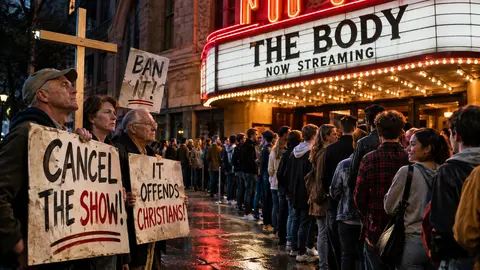
Will Christians ever learn?
I find myself asking that question once again after reading about the Christian campaign to have the Netflix series The Body canceled. Another television show. Another controversy. Another petition. Another group of Christians convinced that because they find something offensive, nobody else should be allowed to watch it.
And once again, Christians have managed to accomplish something absolutely remarkable: they have provided free advertising for the very thing they want to disappear.
Read the article: Why the Petition to Cancel ‘The Body’ Just Made It More Popular
How many people had never heard of this show until Christians started complaining about it? How many people who would have scrolled right past it on Netflix are now curious? How many people are going to watch it for no other reason than to find out what has Christians so upset?
Congratulations, Christians. You just became the marketing department for the television show you wanted canceled.
We have been watching this same ridiculous cycle for decades. Christians attack a movie. Christians attack a television show. Christians attack a musician. Christians attack a book. Christians organize protests, circulate petitions, issue warnings, preach sermons, and generate headlines. The object of their outrage suddenly receives an enormous amount of publicity that it might never have received otherwise.
And somehow, Christians never seem to learn.
From The Last Temptation of Christ to Harry Potter to The Da Vinci Code, we have seen this pattern play out repeatedly. I remember the Christian outrage over rock music, heavy metal, album covers, song lyrics, and alleged satanic messages. Christians would spend an extraordinary amount of time telling everyone about the music they should never listen to.
And what do you think many young people wanted to do after hearing all of that?
Listen to the music!
There is even a psychological explanation for this. It is called psychological reactance. When people perceive that their freedom is being threatened, they can become more motivated to exercise that freedom. Tell someone they cannot have something, and you may have just made them want it.
Of course, not every controversy makes a movie successful, and not every censorship campaign backfires commercially. But how many times do we need to watch Christians generate publicity for something they want suppressed before someone recognizes the absurdity of the strategy?
Christians, of all people, should understand that prohibitions do not necessarily eliminate desire. Read Romans 7. Paul describes sin taking occasion by the commandment. The commandment itself is not sinful, but the prohibition does not eradicate the sinful desires of the human heart.
Yet Christians repeatedly seem convinced that if they can just get enough signatures, generate enough outrage, or exert enough pressure, they can eliminate the things they don’t want people to desire.
But the far bigger issue is not the stupidity of the strategy. It is the arrogance behind it.
What makes Christians think they possess the authority to determine what other people are allowed to watch?
Seriously. Where does this come from?
You don’t like a television show? Don’t watch it.
You don’t like a movie? Don’t buy a ticket.
You don’t like a musician? Don’t listen to the music.
You don’t like a book? Don’t read it.
You don’t like what Netflix produces? Cancel your subscription.
Why is that not enough?
Why does your decision about what you will or will not watch have to become a decision about what everyone else will or will not watch?
There is something profoundly disturbing about the mentality that says, “I find this offensive, therefore you should not have access to it.”
It is arrogant. It is controlling. It reflects an almost narcissistic understanding of one’s place in the world. It begins to resemble a religious God complex in which Christians apparently believe they have been appointed to sit on a throne and determine what everyone else is permitted to see, hear, read, and think.
You are not God.
Your church is not God.
Your pastor is not God.
Your Christian organization is not God.
And your personal offense does not establish your authority over the rest of humanity.
You have every right to criticize a television show. You have every right to explain why you believe its message is wrong. You have every right to produce an article, record a podcast, preach a sermon, or engage in a public discussion about its content.
I spend a considerable amount of my life criticizing things. If you listen to the Theology Central podcast or read the articles I publish, you know that I have no objection to criticism. I believe ideas should be examined, questioned, challenged, and subjected to serious scrutiny.
But there is an enormous difference between challenging an idea and trying to ensure nobody else can encounter that idea.
I criticize sermons. I do not demand that SermonAudio remove every sermon with which I disagree. I criticize theological books. I do not demand that publishers stop selling them. I criticize Christian teaching that I believe is demonstrably false. I do not demand that everyone who teaches it be silenced.
In fact, I frequently provide links to the very material I am criticizing because I want people to hear it for themselves. I want them to examine it, think about it, and determine whether my criticism is valid.
That is what meaningful engagement looks like.
It is not my responsibility to protect everyone from encountering an idea I believe is wrong. It is my responsibility, when I choose to address that idea, to offer a compelling argument explaining why I believe it is wrong.
Apparently, some Christians would rather eliminate the thing they disagree with than engage it.
And here is where the hypocrisy becomes almost unbearable.
Christians demand religious freedom. Christians demand freedom of speech. Christians demand the freedom to publish books, produce movies, broadcast sermons, establish television networks, distribute Bibles, and express their religious convictions in the public square.
And they should have those freedoms.
But what happens when someone finds Christian content offensive?
What happens when someone argues that the Bible contains disturbing material? What happens when someone finds Christian teaching on sexuality offensive? What happens when someone argues that Christian preaching about hell is psychologically damaging? What happens when someone believes a Christian movie promotes harmful religious beliefs?
Should those people organize campaigns to have Christian content removed?
Should they demand that Christian books be taken off the shelves? Should they demand that Christian films be removed from streaming platforms? Should they pressure Apple Podcasts, Spotify, SiriusXM, and other platforms to remove Christian podcasts?
Imagine someone starts a petition demanding that Theology Central be removed from every podcast platform because they believe the content is offensive or harmful.
Would Christians celebrate that petition?
Would they defend the right of those individuals to determine what everyone else should be allowed to hear?
Or would Christians immediately start screaming about persecution, censorship, freedom of speech, and religious liberty?
We know exactly what would happen.
And that is the problem.
Christians want the freedom to produce material that others find offensive, while simultaneously demanding that material Christians find offensive be removed.
That is not a commitment to freedom.
That is a commitment to religious privilege.
Freedom wanted and demanded must be freedom granted and given.
If you want the freedom to express your beliefs, you must recognize the freedom of others to express beliefs you reject. If you want the freedom to produce Christian movies, you must recognize the freedom of others to produce movies that criticize Christianity. If you want the freedom to publish Christian books, you must recognize the freedom of others to publish books that challenge, ridicule, or reject Christianity.
Freedom does not mean you only encounter ideas you approve of. Freedom does not mean you get to live in a society where everyone respects your religion. Freedom does not mean your religious sensitivities become the standard by which everyone else’s expression is judged.
Freedom means other people possess the same freedom you demand for yourself.
And yes, that includes the freedom to offend you.
To be clear, a petition asking Netflix to cancel a show is not the same thing as government censorship. Christians have the freedom to organize petitions, protest, boycott companies, and express their displeasure. Netflix is a private company, not the government.
But having the freedom to demand something does not make the demand wise, morally justified, or consistent with the principles you claim to believe.
The issue is not whether Christians should be legally prohibited from organizing a campaign against a television show. Of course they shouldn’t.
The issue is whether Christians should recognize the hypocrisy and danger of demanding that other people’s access to expression be restricted simply because Christians find that expression offensive.
There is also a biblical question that Christians involved in these campaigns might want to consider.
In 1 Corinthians 5:12–13, Paul writes:
For what have I to do to judge them also that are without? do not ye judge them that are within? But them that are without God judgeth.
The context is church discipline. Paul is distinguishing between the church’s responsibility toward those within its own community and those outside it.
But what a fascinating distinction.
Paul does not appear to envision the church as an institution responsible for policing the behavior of everyone in the surrounding culture. He is not telling the Corinthian Christians to organize a campaign to eliminate every offensive aspect of Corinthian society.
And Corinth certainly had plenty of things Christians could have found offensive.
Perhaps Christians should spend a little less time trying to regulate what the world watches on television and a little more time examining what is being preached in their own churches.
I listen to sermons every day. I hear biblical texts ripped out of context. I hear false historical claims. I hear theological contradictions. I hear manipulative teaching, fear-based preaching, and claims that cannot withstand even the most basic examination of Scripture.
There is more than enough material within Christianity itself to keep Christians occupied for the rest of their lives.
But apparently, it is easier to organize a petition against a Netflix show.
And perhaps that is part of the attraction. It allows Christians to feel like they are standing for righteousness without having to confront the problems within their own religious communities. It gives them an enemy, a cause, a sense of moral superiority, and the satisfaction of believing they are fighting for God.
Does God need you to get a television show canceled?
Is Christianity so fragile that its survival depends on what Netflix does or does not include in its streaming library?
Is your faith so weak that other people watching a television show threatens it?
And what exactly do you think you have accomplished if you succeed?
Have you changed anyone’s heart? Have you convinced anyone that Christianity is true? Have you demonstrated the truth of the gospel? Have you provided a compelling argument against the ideas presented in the show?
Or have you simply demonstrated that Christians want to control what other people are allowed to experience?
Christianity does not need a society in which competing ideas are eliminated. If Christianity is true, it is true whether Netflix produces a television show that respects it or a television show that ridicules it. The resurrection of Christ does not become less historically true because a filmmaker produces something offensive. The gospel does not become less powerful because someone writes a book attacking Christianity.
Truth does not require the elimination of every competing voice.
And Christians need to understand something else. The mechanisms you celebrate when they are used against material you dislike can eventually be used against material you love.
The culture changes. Political power changes. Public opinion changes. Corporate leadership changes. What society considers offensive changes.
You may be part of the group demanding that something be removed today. Tomorrow, you may be the group whose material others demand be removed.
And when that day comes, what principle will you appeal to?
Will you argue that people should have the freedom to encounter ideas for themselves? Will you argue that offense is not sufficient justification for suppressing expression? Will you argue that nobody should be able to determine what everyone else is permitted to watch, read, or hear?
Those are wonderful principles.
Perhaps you should start practicing them now.
Freedoms you seek to take away will be freedoms you yourself lose.
That is the danger of establishing a culture in which the solution to encountering offensive ideas is to demand their disappearance. Eventually, someone will find your ideas offensive enough to demand your disappearance.
So here we are again. Another television show. Another Christian outrage campaign. Another petition. Another opportunity for Christians to provide free publicity for something they want nobody to see.
Will Christians ever learn?
I don’t know.
But I do know that there is a remarkably simple solution for the Christian who finds a television show offensive.
It requires no petition. No protest. No campaign. No headlines. No attempt to control the lives of other people.
It requires nothing more than exercising the very freedom you claim to value.
Christians, just don’t watch it.
And extend to everyone else the freedom to make a different decision.

Standing Before an Ocean