Christians and the Myth of the 25,000 New Testament Manuscripts
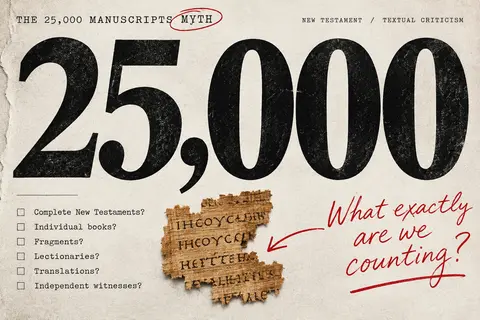
Christians and the Myth of the 25,000 New Testament Manuscripts
When defending the Bible becomes an exercise in misrepresenting the evidence.
Spend enough time listening to Christian sermons, attending apologetics conferences, reading books defending the reliability of Scripture, or scrolling through Christian social media, and eventually you will encounter a familiar claim:
We possess approximately 25,000 manuscripts of the New Testament, making it the best-attested document in ancient history.
The statistic is frequently accompanied by a chart comparing the New Testament with the writings of Plato, Aristotle, Homer, Tacitus, and other ancient authors.
The numbers are impressive. The comparisons appear overwhelming. Christians walk away convinced that they have been given powerful evidence for the reliability of their Bible.
But how many Christians have ever stopped to investigate what that number actually represents?
How many pastors repeating the statistic have examined its origins?
How many apologists have explained the differences between a manuscript fragment, a complete biblical book, a lectionary, a medieval copy, and a translation?
And perhaps most importantly, how many Christians have considered whether the evidence actually establishes what they are claiming it establishes?
The problem is not simply that the number of 25,000 is questionable. The problem is that the number is frequently presented without the qualifications necessary to understand it and then used to support conclusions that manuscript evidence cannot establish.
What makes this particularly troubling is that textual scholars, including Christian scholars, have already challenged many of these claims.
Yet the statistic continues to circulate.
1. Where Does the Number Come From?
The commonly repeated figure of approximately 25,000 manuscripts is generally constructed by combining several categories:
- Approximately 5,700–5,800 Greek manuscripts.
- An estimated 10,000 Latin manuscripts.
- Several thousand additional manuscripts in Syriac, Coptic, Armenian, Ethiopic, Georgian, and other languages.
The resulting total is frequently presented as though it were an established, carefully verified inventory.
But it is not.
The numbers associated with the various ancient translations are estimates, and some of those estimates have been seriously challenged by scholars.
In 2019, IVP Academic published an important book titled Myths and Mistakes in New Testament Textual Criticism, edited by Elijah Hixson and Peter J. Gurry.
In chapter 14, “Myths About Early Translations: Their Number, Importance, and Limitations,” Jeremiah Coogan examines the exaggerated claims concerning manuscript evidence in languages other than Greek.
Coogan challenges the frequently repeated estimate of 10,000 Latin manuscripts.
A review published in the Journal of Biblical and Theological Studies summarizes his discussion as suggesting a figure closer to 1,000 rather than 10,000.
That should immediately get our attention.
The traditional estimate of 10,000 Latin manuscripts constitutes approximately 40 percent of the entire 25,000 figure regularly presented in Christian apologetics.
If one of the largest components of the statistic is seriously questionable, what does that tell us about the reliability of the overall number?
Coogan does not attempt to replace the traditional figures with another supposedly definitive total. Instead, he offers a much more cautious conclusion on page 303 of the book:
“It is better to say that there are a few thousand versional manuscripts and leave it at that.”
There is a considerable difference between acknowledging the existence of several thousand manuscript witnesses in other languages and declaring that we possess 25,000 New Testament manuscripts as though the matter has been definitively settled.
Somewhere between the academic discussion and the Sunday morning sermon, the qualifications disappear.
The statistic remains.
2. How Many Greek Manuscripts Do We Actually Have?
The Institute for New Testament Textual Research (INTF), located at the University of Münster in Germany, maintains the official scholarly register of Greek New Testament manuscripts.
On September 29, 2023, Katie Leggett and Greg Paulson published an article examining the complexities involved in counting these manuscripts.
The following figures represent the catalogue totals discussed by textual critic Peter J. Gurry in November 2023:
| Manuscript category | Number |
| Papyri | 135 |
| Majuscules | 283 |
| Minuscules | 2,860 |
| Lectionaries | 2,422 |
| Total | 5,700 |
These figures provide a dated snapshot of the Greek manuscript catalogue rather than a permanent or definitive count of surviving physical manuscripts.
Even counting Greek manuscripts is considerably more complicated than many Christians realize.
Some manuscripts have been assigned multiple catalogue numbers because separate fragments were originally believed to belong to different manuscripts. Others have been removed from the register after further examination. Some manuscripts have been lost, destroyed, or are currently of unknown whereabouts.
Scholars must also determine what qualifies for inclusion in the catalogue.
In chapter 3 of Myths and Mistakes in New Testament Textual Criticism, Jacob W. Peterson offered an estimate of approximately 5,100–5,300 surviving Greek manuscripts.
Peter Gurry subsequently addressed the differences between Peterson’s earlier estimate and the 2023 catalogue figures, explaining that different counting methods and assumptions account for some of the discrepancy.
The significance of this discussion is not that one particular number must replace every other number. It is that the question itself is considerably more complicated than popular apologetics suggests.
If specialists must carefully explain their methodology when counting Greek manuscripts, why are Christians confidently repeating an aggregate figure of 25,000 across multiple languages without similar qualifications?
3. What Exactly Is a Manuscript?
When the average Christian hears that we possess 25,000 manuscripts of the New Testament, what picture forms in their mind?
Do they imagine thousands of ancient handwritten copies containing Matthew through Revelation?
Do they imagine thousands of documents dating from the first few centuries of Christianity?
Do they imagine thousands of independent witnesses confirming the precise wording of the original documents?
The reality is considerably more complicated.
Consider three examples.
Papyrus 52
A small fragment containing portions of five verses from John 18. It is commonly assigned to the second century, although its precise dating remains a matter of scholarly discussion.
Papyrus 46
A substantial but incomplete collection of Pauline epistles, commonly dated to around AD 200, though its precise date is also debated.
Codex Sinaiticus
A fourth-century manuscript containing the entire 27-book New Testament, along with additional early Christian writings.
Each represents a manuscript witness, but each provides a dramatically different amount of textual evidence.
A fragment containing portions of five verses is not equivalent in content to a manuscript containing all 27 books.
Yet both can contribute one manuscript to a numerical total.
Only a small fraction of the approximately 5,700 catalogued Greek manuscripts contain the entire New Testament.
Most contain individual books, collections of books, selected readings, or fragments.
That does not mean these manuscripts are worthless. A small fragment may provide extraordinarily important evidence concerning a particular passage.
But possessing thousands of manuscript witnesses to portions of the New Testament is not the same thing as possessing thousands of complete New Testaments.
That distinction should be explained every time the statistic is presented.
4. Over 42 Percent Are Lectionaries
One of the most interesting details in the 2023 Greek manuscript statistics is the number of lectionaries.
Of the 5,700 catalogue entries, 2,422 were classified as lectionaries.
That represents approximately 42.5 percent of the total.
Lectionaries contain selections of Scripture arranged for public reading according to the worship practices and liturgical calendar of the church.
They are valuable witnesses to the transmission, interpretation, and historical use of biblical texts. However, they are not ordinary sequential copies of the New Testament.
The distinction does not diminish their importance. It simply explains what they are.
How often have you heard a Christian apologist explain that more than two-fifths of the Greek manuscript catalogue consists of lectionaries?
How often are Christians told what proportion of the manuscripts contain entire books, collections of books, selected readings, or the complete New Testament?
Imagine an apologetics presentation in which the speaker announces:
“We have approximately 5,700 Greek manuscript catalogue entries, over 2,400 of which are lectionaries, with the remaining entries representing everything from small fragments to substantial collections and complete New Testaments.”
That would be a much more informative statement.
It would also create a considerably different impression from simply announcing that we possess thousands of manuscripts of the New Testament.
5. How Ancient Are These Ancient Manuscripts?
Another misleading impression concerns the age of the manuscripts.
The overwhelming majority of surviving Greek New Testament manuscripts are medieval rather than originating in the earliest centuries of Christianity.
A manuscript produced in AD 1300 may preserve a reading that originated centuries earlier. A later manuscript is not necessarily inferior simply because it is later.
Nevertheless, possessing a manuscript from AD 1300 is not the same thing as possessing a manuscript from AD 130.
The distinction is historically significant.
When Christians are presented with a massive manuscript count in a discussion about the reliability of ancient documents, they may understandably assume that these manuscripts are concentrated in the earliest centuries of Christianity.
They are not.
The impressive total represents a manuscript tradition extending across many centuries of Christian history.
That is worth appreciating as a historical phenomenon, but it must be accurately represented.
Furthermore, scholars often date undated manuscripts by examining handwriting styles and comparing them with other surviving documents.
This process typically produces an estimated range of dates rather than an exact year.
Even the dates commonly assigned to our earliest New Testament manuscripts must be understood within those limitations.
A responsible discussion of manuscript evidence must distinguish between what we know, what we reasonably estimate, and what remains uncertain.
6. Twenty-Five Thousand Manuscripts Are Not Twenty-Five Thousand Independent Witnesses
Imagine that an original document is copied twice.
The first copy introduces an error. The second copy preserves the original wording.
Over the following centuries, the first copy becomes the basis for another thousand manuscripts. The second copy becomes the basis for only ten manuscripts.
We now possess a thousand manuscripts containing the error and ten manuscripts preserving the original reading.
Which reading is correct?
If manuscript quantity alone determined textual accuracy, the incorrect reading would win overwhelmingly.
But the thousand manuscripts are not a thousand independent confirmations of the original wording. They are descendants of a common textual ancestor.
This is why textual criticism is considerably more complicated than counting manuscripts.
Scholars must investigate relationships between manuscripts, patterns of transmission, scribal habits, geographical distribution, textual variations, and numerous other factors.
The number of surviving manuscripts is relevant, but the number alone cannot settle the question.
More manuscripts can provide more evidence. They do not automatically provide more independent evidence.
This also explains why scholars may sometimes conclude that a reading preserved in relatively few manuscripts is more likely to represent the earlier text than a reading preserved in hundreds or thousands of manuscripts.
An impressive numerical majority is not necessarily a demonstration of textual originality.
7. Translations Are Not Identical to Original-Language Witnesses
Another complication involves combining Greek manuscripts with manuscripts of translations into other languages.
Ancient translations are enormously valuable to textual criticism. They can provide evidence concerning Greek texts that existed at the time those translations were produced.
But a translation introduces another stage into the transmission process.
The translator must make decisions concerning vocabulary, grammar, syntax, and meaning.
Different Greek expressions may be translated using the same word in another language. Certain grammatical distinctions in Greek may be difficult or impossible to reproduce precisely in the language of the translation.
Consequently, reconstructing the Greek wording behind an ancient translation can involve considerable uncertainty.
Furthermore, hundreds of manuscripts preserving one translation may ultimately descend from a much smaller number of underlying Greek textual sources.
This does not make the translations insignificant.
It does mean that combining thousands of Greek and non-Greek manuscripts into one impressive numerical total conceals important methodological differences between those witnesses.
A manuscript of a Latin translation and a Greek manuscript are not automatically equivalent forms of evidence for determining the precise wording of the Greek New Testament.
Responsible textual criticism recognizes these distinctions.
Popular apologetics frequently fails to explain them.
8. Comparing the New Testament With Other Ancient Literature
Christians frequently encounter charts comparing the manuscript evidence for the New Testament with the evidence for various works of classical literature.
The New Testament appears alongside Plato, Aristotle, Homer, Caesar, and Tacitus.
The Christian conclusion is usually obvious: if historians accept these ancient writings with comparatively few surviving manuscripts, how could anyone possibly question the New Testament?
But what exactly is being compared?
The New Testament is a collection of 27 separate literary works. Christianity developed institutions dedicated to preserving, copying, translating, studying, and publicly reading those writings.
For centuries, churches and monasteries had powerful religious motivations to reproduce biblical manuscripts.
The historical circumstances surrounding the preservation of other ancient literature were often quite different.
Furthermore, popular apologetic comparisons sometimes include manuscripts of translations when calculating the New Testament total without applying equivalent criteria consistently to other ancient works.
Some of the manuscript counts used for classical literature are themselves outdated.
James B. Prothro addresses these problems in chapter 4 of Myths and Mistakes in New Testament Textual Criticism, titled “Myths about Classical Literature: Responsibly Comparing the New Testament to Ancient Works.”
Before such comparisons can be considered meaningful, we need to establish consistent criteria.
Are we counting complete works or fragments?
Original-language manuscripts or translations?
Individual literary works or collections?
Manuscripts from comparable historical periods?
Independent textual witnesses or descendants of the same manuscript tradition?
The New Testament genuinely possesses a rich manuscript tradition in comparison with many ancient works.
However, acknowledging that reality does not require accepting every popular apologetic comparison.
Another problem is that historians do not simply accept everything written by ancient authors because manuscripts of their works have survived.
Historians investigate their claims, examine their biases, compare their accounts with other evidence, and distinguish between what an author wrote and whether what the author wrote is historically accurate.
That same distinction must be maintained when discussing the New Testament.
9. Christian Scholars Have Already Challenged These Claims
This criticism is not something Christians must dismiss as an attack originating from atheists, skeptics, or enemies of Scripture.
As previously mentioned, in 2019, IVP Academic published Myths and Mistakes in New Testament Textual Criticism, edited by Elijah Hixson and Peter J. Gurry.
Several chapters are particularly relevant:
- Jacob W. Peterson, “Math Myths: How Many Manuscripts We Have and Why More Isn’t Always Better.”
- James B. Prothro, “Myths about Classical Literature: Responsibly Comparing the New Testament to Ancient Works.”
- Elijah Hixson, “Dating Myths, Part One: How We Determine the Ages of Manuscripts.”
- Gregory R. Lanier, “Dating Myths, Part Two: How Later Manuscripts Can Be Better Manuscripts.”
- Jeremiah Coogan, “Myths About Early Translations: Their Number, Importance, and Limitations.”
The book’s foreword was written by Daniel B. Wallace, one of the most recognizable evangelical textual critics and the founder of the Center for the Study of New Testament Manuscripts.
This is not a book designed to undermine Christianity by attacking the manuscript evidence for the New Testament.
It is a scholarly attempt to correct misunderstandings, exaggerations, and methodological errors that have circulated in discussions of New Testament textual criticism, including Christian apologetics.
Christians do not need to wait for skeptics to expose the weaknesses in Christian apologetics.
Christian scholars have already been doing that work.
The question is whether pastors, apologists, and ordinary Christians are willing to listen.
10. The Greatest Logical Fallacy
Even if we could establish beyond all reasonable doubt that exactly 25,000 New Testament manuscripts exist, what would that prove?
Suppose tomorrow archaeologists discovered another 100,000 manuscripts.
Suppose we eventually possessed one million manuscripts of the Gospel of John, and every single one agreed perfectly with every other manuscript.
Would that prove Jesus rose from the dead?
No.
It would provide extraordinary evidence concerning the wording of the Gospel of John.
It would not, by itself, establish the historical truthfulness of what John recorded.
There are several fundamentally different questions:
- What did the original author write?
- Who was the original author?
- Did the events described actually occur?
- Was the author divinely inspired?
- What does the author mean?
These are not interchangeable questions.
Textual criticism investigates the wording and transmission of a text.
Historical and literary criticism examine matters such as authorship, historical circumstances, and the composition of documents.
Historical investigation evaluates the events described.
Theology addresses questions concerning divine inspiration and authority.
Hermeneutics concerns interpretation.
These disciplines may overlap and inform one another, but they address distinct questions.
Establishing the wording of a document is not the same thing as establishing the truthfulness of its contents.
Imagine two ancient documents.
One makes historically accurate claims but survives in only a single manuscript.
The other makes historically inaccurate claims but survives in 25,000 manuscripts.
Which document contains the truth?
The answer cannot be determined by counting the manuscripts.
A false statement copied one million times remains a false statement.
A true statement preserved in a single manuscript remains a true statement.
Truth is not determined by the number of surviving copies.
Yet Christian apologetics sometimes moves from manuscript abundance to textual reliability, from textual reliability to historical reliability, and from historical reliability to divine inspiration without adequately demonstrating the logical connections between those conclusions.
The impressive statistic is made to carry a weight it cannot bear.
11. The Theological Problem Christians Rarely Consider
If manuscript abundance is evidence of divine inspiration or supernatural preservation, what happens when we apply that standard consistently?
Do biblical books with fewer surviving manuscripts possess less evidence of divine inspiration?
Was the Bible less trustworthy before the discovery of significant ancient manuscripts?
Did the authority of Scripture increase when Codex Sinaiticus became known to modern Western scholarship?
Does the discovery of another papyrus fragment increase the probability that God inspired Scripture?
If thousands of manuscripts were destroyed tomorrow, would the New Testament become less inspired?
What happens when we apply the same argument to the Old Testament, whose manuscript history differs considerably from that of the New Testament?
Does the Old Testament possess less evidence of divine inspiration because its surviving manuscript tradition developed under different historical circumstances?
These questions expose the theological difficulties created when Christians attempt to make manuscript quantity a foundation for the authority of Scripture.
Consider 2 Timothy 3:16:
All scripture is given by inspiration of God, and is profitable for doctrine, for reproof, for correction, for instruction in righteousness.
The theological assertion concerns the origin of Scripture.
It does not establish a relationship between divine inspiration and the number of manuscripts that will survive over the subsequent centuries.
If Scripture is divinely inspired, it is divinely inspired because of what God did in its production, not because of how many copies survived the subsequent centuries of human history.
The discovery of another manuscript may increase our knowledge of textual transmission. It does not increase the inspiration of Scripture.
The destruction of a manuscript may diminish the available textual evidence. It does not diminish the inspiration of Scripture.
Christians must distinguish between the theological status of Scripture and the historical evidence available for reconstructing its text.
They are not the same thing.
12. Why Do Christians Keep Repeating It?
Perhaps the most troubling aspect of this entire discussion is not the manuscript statistic itself.
It is the apparent willingness of Christians to repeat information without investigating it simply because it appears to support Christianity.
A statistic is heard in a sermon.
It appears in an apologetics book.
It is repeated at a conference.
It becomes a social media graphic.
Another pastor sees the graphic and incorporates it into another sermon.
Eventually, the claim becomes so familiar that questioning it is perceived as questioning the Bible itself.
But familiarity is not verification.
Repetition is not research.
And a claim does not become true simply because it is useful in defending something we believe to be true.
Christians should be particularly concerned about this tendency.
We claim to believe in the importance of truth. We condemn falsehood. We warn people about deception. We insist that the world must submit to the truth of God’s Word.
Should we not demonstrate that same commitment to truth when examining the arguments we use to defend it?
There is something deeply problematic about Christians demanding that the world critically investigate its assumptions while refusing to critically investigate their own apologetic arguments.
We cannot demand intellectual honesty from everyone else while exempting ourselves from the same obligation.
The fact that an argument supports Christianity does not make that argument historically accurate, logically valid, or intellectually responsible.
Sometimes Christians need to be protected not from the arguments being made against Christianity but from the arguments being made in its defense.
13. What Christians Should Be Saying
The New Testament possesses a remarkably extensive and historically significant manuscript tradition.
That tradition provides scholars with substantial evidence for investigating the transmission of the text and reconstructing its earliest recoverable wording.
There are ancient fragments, substantial collections, complete manuscripts, lectionaries, translations, and numerous other witnesses that deserve careful study.
There is no need to diminish the significance of that evidence.
But neither is there any need to exaggerate it.
A more responsible apologetic statement would be something like this:
The New Testament is preserved in thousands of Greek manuscript witnesses, along with thousands of additional witnesses in ancient translations. These manuscripts vary considerably in date, completeness, textual relationships, and usefulness for textual criticism. Together, they provide substantial evidence for investigating the transmission of the New Testament and reconstructing its earliest recoverable text. However, the precise total depends on how manuscripts are defined and counted, and manuscript abundance does not independently establish the historical truthfulness or divine inspiration of the writings.
Is that statement as impressive as declaring that we possess 25,000 manuscripts?
Perhaps not.
Is it as easy to memorize or place on a PowerPoint slide?
Probably not.
But it is more responsible.
And if Christians are genuinely committed to truth, that should matter far more than the rhetorical effectiveness of the argument.
Conclusion: Does Truth Matter When We Are Defending the Truth?
The next time someone declares that we possess 25,000 manuscripts of the New Testament, ask a few questions.
Where did that number come from?
What exactly is being counted?
Has the overall estimate ever been established through a comprehensive and consistently applied manuscript census?
How many contain the entire New Testament?
How many are lectionaries?
How many are translations?
When were they produced?
How many represent independent lines of textual transmission?
How do scholars determine which manuscripts are most useful for reconstructing a particular passage?
And what, precisely, does the number prove?
These are not hostile questions.
They are necessary questions.
Christians should not be afraid of investigating the evidence behind Christian claims.
We should not be afraid of discovering that an argument we have used for decades is flawed.
We should not be afraid of admitting that a statistic is uncertain, that a comparison is misleading, or that a conclusion does not logically follow from the evidence.
The authority of Scripture does not depend upon our ability to produce impressive apologetic statistics.
The New Testament does not become more inspired because another manuscript is discovered or less inspired because a popular apologetic statistic turns out to be unreliable.
What we believe about Scripture cannot excuse us from being honest about the evidence.
The real tragedy surrounding the myth of the 25,000 New Testament manuscripts is not simply that Christians have been repeating a questionable statistic.
It is that Christian scholars have already identified many of the problems, published their findings, and made the information available, yet the same misleading arguments continue to circulate.
At some point, we must ask whether our commitment is to discovering the truth or merely to collecting arguments that reinforce what we already believe.
If Christianity is committed to truth, that commitment must extend to the arguments Christians use to defend Christianity.
We cannot defend the truth by becoming careless with it.
Sources and Further Research
1. Elijah Hixson and Peter J. Gurry, editors. Myths and Mistakes in New Testament Textual Criticism. IVP Academic, 2019. ISBN: 9780830852574.
https://www.ivpress.com/myths-and-mistakes-in-new-testament-textual-criticism
Particularly relevant chapters:
- Chapter 3: Jacob W. Peterson, “Math Myths: How Many Manuscripts We Have and Why More Isn’t Always Better,” beginning on page 48.
- Chapter 4: James B. Prothro, “Myths about Classical Literature: Responsibly Comparing the New Testament to Ancient Works,” beginning on page 70.
- Chapter 5: Elijah Hixson, “Dating Myths, Part One: How We Determine the Ages of Manuscripts,” beginning on page 90.
- Chapter 6: Gregory R. Lanier, “Dating Myths, Part Two: How Later Manuscripts Can Be Better Manuscripts,” beginning on page 110.
- Chapter 14: Jeremiah Coogan, “Myths About Early Translations: Their Number, Importance, and Limitations.”
2. Katie Leggett and Greg Paulson. “How Many Greek New Testament Manuscripts Are There REALLY? The Latest Numbers.” Institute for New Testament Textual Research, September 29, 2023.
https://ntvmr.uni-muenster.de/intfblog
3. Peter J. Gurry. “Explaining a Discrepancy in the Number of Greek NT Manuscripts.” Evangelical Textual Criticism, November 2, 2023.
https://evangelicaltextualcriticism.blogspot.com/2023/11/explaining-discrepancy-in-number-of.html
4. Journal of Biblical and Theological Studies. Review of Myths and Mistakes in New Testament Textual Criticism.
https://jbtsonline.org/2021/10/review-of-myths-and-mistakes-in-new-testament-textual-criticism-edited-by-elijah-hixson-and-peter-gurry/
5. Reading Religion. Academic review of Myths and Mistakes in New Testament Textual Criticism.
https://readingreligion.org/9780830852574/myths-and-mistakes-in-new-testament-textual-criticism/
6. Tommy Wasserman. “Manuscripts and the Making of the New Testament.” In The Cambridge History of Ancient Christianity, Cambridge University Press, 2023, pp. 419–442.
https://doi.org/10.1017/9781108620420.023
Additional research resources:
Institute for New Testament Textual Research:
https://www.uni-muenster.de/INTF/
New Testament Virtual Manuscript Room:
https://ntvmr.uni-muenster.de/
Center for the Study of New Testament Manuscripts:
https://www.csntm.org/
Codex Sinaiticus Project:
https://www.codexsinaiticus.org/
Research note: The Greek manuscript statistics presented in this article represent a dated 2023 catalogue snapshot, not a definitive count of surviving manuscripts as of publication. Catalogue totals change as manuscripts are discovered, identified, reclassified, or consolidated. The discussion of Coogan’s alternative Latin manuscript estimate draws on a published academic review of his work and should not be understood as establishing a definitive replacement count. The term “myth” in the title refers to the presentation of the 25,000 figure as an established fact and the misleading conclusions frequently associated with it.
THEOLOGY CENTRAL
Examining theology, Scripture, Christianity, and the assumptions we rarely question.
https://www.theologycentral.net

Award-Winning Podcast? That Will Be $199, Please.