You See AI. You Don’t See Me.
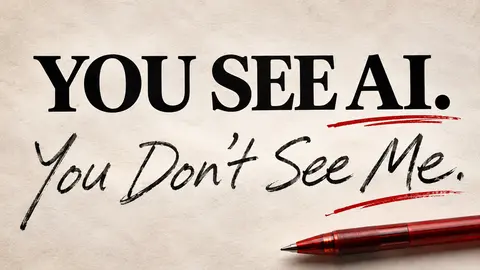
If you have been following Theology Central over the last several days, you may have noticed something: there have been a lot of articles. A LOT of articles.
Some of you may be wondering what is going on. Some may be wondering how I am producing so many articles. And some of you who have known me for any length of time probably have another question: When did he learn to use punctuation?
Let’s be honest. If you have ever received a long email from me, you know I am capable of writing 6,233 words, throwing a period at the end, and calling it good.
So, yes, artificial intelligence is involved in the production of the Theology Central articles.
There. I said it.
For some people, that admission will be enough to dismiss everything that follows. AI-generated content. AI slop. Garbage. Artificial. Manufactured. Worthless.
Others may read the articles and dislike the writing style. They may recognize certain patterns associated with AI-assisted writing. They may find the structure, the phrasing, or the presentation irritating. Those are criticisms people are certainly entitled to make.
But the reality of how these articles come into existence is far more complicated, and far more human, than many people may realize.
So let me take you behind the scenes of Theology Central.
Over the last several days, I have been unable to get behind the microphone. I told the audience that I would not be able to broadcast for a while, but that I would continue posting articles. That is exactly what I have been doing.
But I have not been sitting in front of a computer telling artificial intelligence to generate five Christian articles a day. I have not been looking for trending theological topics to exploit. I have not established a publishing schedule or a content quota. I have not suddenly decided to transform Theology Central into some kind of Christian content factory.
I have been doing what I have always done.
I listen to sermons. I read articles. I study Scripture. I encounter theological arguments. I ask questions. I get frustrated. I laugh. Sometimes I get angry. Sometimes I find myself wrestling with questions that have no easy answers. Sometimes I encounter something that brings tears to my eyes.
The only difference is that, at the moment, I cannot turn on the microphone and talk about those things.
So I start writing.
Sometimes I write a few paragraphs. Sometimes I write a considerable amount. Sometimes I send a sermon transcript along with my initial observations. Sometimes I begin with a question, an objection, or a theological argument. Sometimes I write about an experience from my own life.
Then I begin a conversation with AI.
And I do mean a conversation.
There are times when we go back and forth for quite a while before an article is ever produced. I challenge an argument. I question an interpretation. I offer another Scripture. I explain why I think a particular conclusion is wrong. I reject a suggestion. I clarify what I am trying to communicate. Sometimes the discussion takes us in a direction I had not anticipated.
Eventually, I say something like, “We need to turn this into an article.”
By that point, there may already be hundreds or thousands of words of discussion. There may be an entire theological argument that has been developed. There may be a collection of biblical passages, historical considerations, logical problems, and personal observations.
AI then helps take all of that material and turn it into an article.
It organizes the material. It develops the arguments. It helps with clarity, structure, transitions, grammar, and, yes, punctuation. It may introduce additional arguments or observations that I had not considered. It may suggest a title or a more effective way of communicating something.
And then I may ask for changes. Sometimes I want something stronger. Sometimes I want something more emotional. Sometimes I want more theological precision. Sometimes I want fewer headings because I want the article to feel like an article rather than a series of talking points.
And sometimes I look at what has been produced and think, “No, that isn’t what I am trying to say.”
The process continues.
Even the artwork involves a similar process. Anyone who could see some of our conversations about artwork would probably find them hilarious.
“That looks like typical AI artwork.”
“Try something different.”
“Remove that.”
“Change the dimensions.”
“Do you really think that works?”
“Try it again.”
There are times when the discussion about the artwork seems to take longer than the production of the article itself.
But let me give you some specific examples of what has been happening.
Recently, I was lying in bed at almost one in the morning when I encountered a sermon about the viral expression “6 7.” I listened in disbelief as a meaningless cultural phenomenon became the subject of a sermon offering biblical warnings and spiritual implications.
AI did not discover that sermon. AI did not decide to listen to it. AI did not experience the absurdity of lying in bed at one in the morning listening to a preacher discuss “6 7.”
That was me.
I wrote my reaction. I explained why I thought the entire premise was ridiculous. I discussed the cultural phenomenon and the hermeneutical problems involved in attempting to turn it into a biblical warning.
And then we produced an article.
Another article emerged from a sermon that dealt with eternal security. I found myself frustrated by what I believe is a recurring problem in evangelical theology: an attempt to defend eternal security while simultaneously creating enormous insecurity in the minds of Christians.
But the discussion went much further than that. I began explaining my argument concerning the book of Hebrews. I argued that the soteriological content of Hebrews must be examined in light of the coming destruction of Jerusalem in AD 70. I discussed the original Jewish audience, the temple, the sacrificial system, the priesthood, and the implications of returning to Judaism when that entire religious system was facing destruction.
That argument did not originate with AI. It is an argument I have been developing and discussing in my teaching.
We went back and forth. We examined the implications. We discussed the historical, literary, and theological context. Eventually, that conversation became an article.
But perhaps the most important examples have nothing to do with the more technical aspects of biblical interpretation.
Recently, I drove past the psychiatric hospital where I was admitted after attempting to end my life as a teenager, following the death of my mother in 1986.
Forty years had passed.
As I drove by that building, I found myself thinking about the emotionally destroyed teenager who had walked through those doors. For a moment, it almost felt as though I could see him. I had tears in my eyes.
I began writing about that experience.
I wrote about what it felt like. I wrote about the memories. I wrote about the difference between the kind of testimony Christians often want to hear and the reality of what life has been like for me.
AI helped me turn those thoughts into an article.
Now, someone can read that article and dismiss it as AI-generated content if they want.
But AI did not lose its mother.
AI did not walk into that hospital.
AI did not live the forty years that followed.
AI did not drive past that building and find itself overwhelmed by the memories.
I did.
And then there was the story of Caleb, a fifteen-year-old boy who was killed. Reading about what happened to him brought back memories of the extreme bullying I experienced during parts of my childhood.
I began writing about an incident in which another boy attacked me while his mother watched and threatened me not to fight back. I wrote about the injuries. I wrote about the theological questions that arise when we consider an omnipotent and omnipresent God in the face of such suffering.
I expressed my frustration with the way Christians speak so confidently about God intervening to provide a parking place, help a car start, or give a pastor a sermon, while we struggle to explain the silence of God in the face of unimaginable human suffering.
And in the middle of that conversation, I wrote something that captured the emotional weight of the entire discussion.
“But I lived. Caleb is dead.”
Those words were mine.
That pain was mine.
Those memories were mine.
The theological struggle was mine.
AI helped me communicate it.
And here is where I think the discussion about artificial intelligence often becomes terribly simplistic.
We have become so obsessed with identifying whether something was produced with AI that we sometimes stop asking whether it contains anything worth reading.
Is the argument sound? Are the facts accurate? Has the Scripture been interpreted correctly? Is the theological reasoning consistent? Does the article raise important questions? Does it challenge assumptions that need to be challenged? Does it communicate something meaningful?
Or have we decided that none of those questions matter once we discover that artificial intelligence was involved?
Now, let me be clear. AI can produce absolute garbage. It can generate inaccurate information. It can invent facts. It can misrepresent arguments. It can produce writing that sounds impressive while saying very little. It can generate repetitive, predictable, formulaic content. It can allow people to flood the internet with material they have barely read and never seriously considered.
Those are legitimate concerns.
And I am not suggesting that every Theology Central article is immune from criticism. Far from it. Challenge the arguments. Examine the facts. Question the interpretations. Point out the errors. Criticize the writing style. Disagree with the conclusions.
AI involvement does not remove my responsibility for what I publish. If an article contains a factual error, a bad argument, or a misrepresentation of someone’s position, that is something I need to address. I cannot simply blame AI.
But neither should we assume that the involvement of AI tells us everything we need to know about the quality, substance, or origin of an article.
There is a difference between asking AI to generate an opinion for you and using AI to help communicate an opinion you have already developed.
There is a difference between manufacturing content and developing something that arose from your own experiences, study, reading, listening, and thinking.
There is a difference between using artificial intelligence to avoid thinking and using artificial intelligence as part of the process of thinking.
And that last distinction is particularly important to me.
I do not simply use AI as a machine into which I insert an idea and out of which comes an article. I use it as a discussion partner. I want to examine arguments. I want to explore possibilities. I want to identify weaknesses. I want to ask whether something actually makes sense. I want to consider the biblical, historical, theological, and logical implications of what I am encountering.
That does not mean the AI is always right. It isn’t. It does not mean I am always right. I am not.
It means there is a process of discussion and examination that occurs before many of these articles are ever published.
The finished article is only the part of that process you get to see.
And yes, the sheer volume of articles demonstrates something remarkable about the capabilities of artificial intelligence. It has dramatically reduced the amount of time required to turn my thoughts, arguments, observations, and discussions into something that can be published.
But the speed at which an article can be produced should not be confused with the amount of time spent thinking about the subject.
Some of the theological arguments appearing in these articles are arguments I have been wrestling with for years. Some of the personal experiences go back decades. Some of the articles emerged from hours of listening, reading, and discussion.
You may see an article that was produced relatively quickly.
You do not necessarily see everything that came before it.
When things return to normal and I can get behind the microphone again, the volume of articles will probably decrease. The podcast remains the heart of Theology Central. I love turning on the microphone, opening the Bible, listening to a sermon, wrestling with a theological question, and seeing where the discussion takes us.
But I have discovered something valuable during this period.
The article section gives me another way to do what I have always done. It allows me to continue communicating when I cannot broadcast. It allows me to develop arguments in written form. It allows me to share things that might never become podcast episodes. It allows me to take advantage of a feature that SermonAudio has made available to broadcasters.
And I intend to continue using it.
There is one final thing I should tell you about this particular article.
It was not planned.
I was looking at the Theology Central article page and thinking about everything that had been published. I began discussing the volume of articles with AI. I explained why I thought the volume made sense, given that I could not get behind the microphone and that the articles were arising organically from what I was listening to and reading.
The conversation moved toward the role of artificial intelligence. I pointed out that people often miss the human element in what we have been doing. I explained that I had written a considerable amount of material for the articles and that, in many cases, there had been substantial discussion before the articles were produced.
And then I realized what was happening.
We were doing it again.
An observation had become a conversation. The conversation had become an examination of an issue. The examination of that issue had become the foundation for another article.
So I wrote my thoughts, explained what I wanted to communicate, and said, “Let’s make it an article, lol.”
And here it is.
You can call it AI-generated. You can call it AI-assisted. You can criticize it. You can dismiss it. You can disagree with it.
But I hope you now have a better understanding of what actually happens behind the scenes at Theology Central.
Because when you see the finished article, you may see the influence of artificial intelligence.
What you may not see is the human being who had something he wanted to say.
And apparently, even when I can’t get behind the microphone, I still have a lot to say.
— Theology Central

Saved by Grace, Judged by Transformation