Saved by Grace, Judged by Transformation
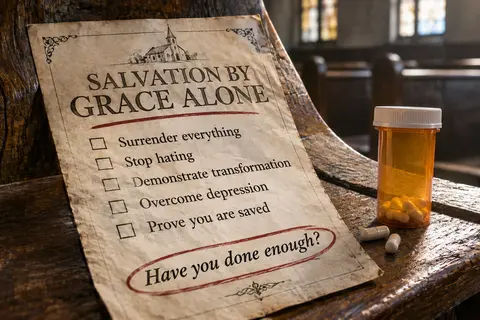
There are moments when I listen to a sermon and genuinely wonder how we arrived at this point in Christianity. How did people who claim to believe in salvation by grace alone, through faith alone, in Christ alone, end up preaching a message that sounds so remarkably like the very works-based system they claim to reject? And how did we move beyond that into a theology that apparently promises to eliminate sinful dispositions and even cure depression?
On November 8, 2026, Phil Seely of Grace Bible Independent Baptist Church preached a sermon entitled O Worship the King. The sermon is available on SermonAudio, and I encourage everyone to listen to it for themselves.
Listen to the original sermon:
https://www.sermonaudio.com/sermons/1113261550426371
The sermon opens with a discussion of the conversion of Fanny Crosby. According to the account presented, Crosby had gone forward at religious meetings, crying out to God, weeping, and seeking salvation, only to leave without being saved night after night. Finally, the preacher explains what the problem was:
“The Lord showed her very clearly that she was trying to hold on to the world in one hand and to God in another. You cannot come to God like that.”
Stop and think about what is being communicated.
Here is a woman crying out to God for salvation, but according to this account, she cannot receive salvation because she has not yet let go of the world. She is holding on to her own will while attempting to embrace God’s will. Something must change before she can be saved.
And what must change?
HER.
Apparently, Christ has already accomplished His saving work. The cross is already a historical reality. The resurrection has already occurred. But this woman cannot be saved until something changes within her. Until she surrenders. Until she relinquishes her attachment to the world. Until she stops holding on to her own will.
How is this salvation by grace alone?
I can already hear the objections. We are not talking about works! We are talking about repentance! We are talking about surrender! We are talking about genuine faith!
Fine. Call it whatever you want. But changing the terminology does not eliminate the theological problem.
If a sinner cannot receive salvation until that sinner accomplishes a particular moral or spiritual change, then that change has become a condition for receiving salvation. If I cannot be justified until I surrender enough, let go of enough, or demonstrate sufficient devotion, then I am no longer being directed exclusively to the finished work of Jesus Christ. I am being directed to something that must happen within me before Christ’s saving work can be applied to me.
And how much surrender is enough?
That is the question these systems never seem capable of answering.
Later in the sermon, Seely declares:
“God requires it absolute, full devotion. It’s what God requires.”
Yes! Absolutely! God requires that we love Him with all our heart, all our soul, all our mind, and all our strength. God requires perfect obedience. God requires perfect righteousness. God requires holiness.
That is precisely why we need the Gospel!
The Law demands what we have failed to accomplish. The Gospel announces what Jesus Christ has accomplished on our behalf.
But if you take the demands of the Law and turn them into conditions that must be satisfied before a sinner can receive the Gospel, you have destroyed the very distinction that makes the Gospel good news.
Romans 4:5 could not be clearer:
“But to him that worketh not, but believeth on him that justifieth the ungodly, his faith is counted for righteousness.”
Who does God justify?
The ungodly.
Not the sufficiently surrendered. Not the adequately devoted. Not the people who have finally relinquished every competing desire. Not those who have successfully achieved some acceptable degree of spiritual transformation.
The ungodly.
The entire point of justification is that sinners who possess no righteousness sufficient to stand before God receive a righteousness that is not their own. The righteousness of Jesus Christ is credited to them. Their standing before God rests on His obedience, His death, His resurrection, and His finished work.
This is where I find the great irony of so much contemporary Protestant preaching.
There are preachers who will passionately denounce Roman Catholicism for its understanding of justification, grace, works, and human cooperation. They will insist that salvation is not based on what we do. They will proclaim the five solas. They will tell us that we cannot earn our way to heaven.
Then they will turn around and preach that you cannot get saved until you surrender your life, that you cannot have assurance unless your life demonstrates sufficient transformation, and that your continued struggles may reveal that you were never saved in the first place.
What exactly have we accomplished?
We have condemned one theological system for directing people toward their own spiritual condition while constructing another theological system that directs people toward their own spiritual condition.
To be fair, Roman Catholic theology does not teach that people can save themselves independently of God’s grace. It teaches the necessity of grace while understanding justification, inward renewal, cooperation with grace, and merit differently from classical Protestant theology. Those distinctions matter, and we should represent them accurately.
But that makes the Protestant contradiction even more striking.
Some Protestants reject the Catholic understanding of justification because they insist that righteousness is imputed rather than achieved through inward transformation. Yet in their actual preaching, inward transformation becomes the decisive evidence by which people must determine whether they possess that imputed righteousness.
You may insist that works do not save you. But if the ultimate answer to whether you are saved is found by examining your works, you have created a system in which the sinner’s confidence rests on the sinner’s performance.
You have not necessarily changed the formal doctrine of justification. You have, however, fundamentally changed where people are told to look for assurance.
And this particular sermon goes even further.
Seely begins discussing hatred, drawing upon the language of 1 John. He argues that a person who continues to hate without cause is damned and needs to be born again. He then explains what God supposedly does when a person is saved:
“Because God takes the hate. Takes it from you. Just, it’s gone.”
And then comes this extraordinary personal declaration:
“I am incapable of hatred now. God has taken those things.”
I want everyone to appreciate the significance of that statement.
He is not saying that God has helped him recognize hatred as sinful. He is not saying that he struggles against hatred. He is not saying that he has grown in his understanding of forgiveness or that he is learning to love his enemies.
He is claiming that he is incapable of hatred.
What an astonishing theological claim.
If God has made this man incapable of hatred, why has God not made him incapable of pride? Why has God not made him incapable of selfishness, lust, envy, impatience, arrogance, or every other sinful disposition?
If an omnipotent God can remove one sinful disposition entirely, what prevents Him from removing all of them?
And if God has chosen to remove hatred completely but leave other sins intact, where exactly is that doctrine taught in Scripture?
First John is the very book that tells us:
“If we say that we have no sin, we deceive ourselves, and the truth is not in us.” — 1 John 1:8
John writes to believers about the ongoing reality of sin. He tells them to confess their sins. He reminds them that if anyone sins, we have an advocate with the Father, Jesus Christ the righteous.
Yet the same book contains statements about those born of God not sinning and being unable to sin. Those statements must be interpreted in light of the entire epistle, not isolated and turned into claims of personal sinlessness or selective moral perfection.
You cannot simply take the strongest possible language from one passage and ignore everything else the author says.
And there is a particularly revealing contradiction within the sermon itself. Earlier, Seely acknowledges his own ongoing need to yield himself to God, suggesting that he may need to do so every two and a half minutes. He recognizes the continuing problem of carnality and the need for forgiveness.
But when it comes to hatred, he has apparently reached a state of absolute moral inability. He cannot do it anymore.
Why this sin? Why not the others? Where does Scripture establish such a distinction?
The preacher does not claim to have attained complete sinless perfection, and we should not accuse him of making a claim he did not make. But his assertion that salvation has rendered him incapable of a particular sin raises precisely the theological problems that accompany perfectionist teaching.
And then, as if all of this were not enough, we arrive at depression.
The preacher asks whether it would be possible to be depressed in the presence of God. His conclusion is that depression is possible only if a person is contrary to God.
He then declares:
“If anybody’s depressed, they just need to get right with God. Here’s a good proof verse for that. Just get right with God. You don’t need pills. You need to get right with God.”
And he continues:
“Remember, God created that body and all the chemicals that are in it. And that chemical imbalance is to show you that you’re not right with God.”
I genuinely do not know how anyone can stand behind a pulpit and make such a sweeping, irresponsible, and potentially devastating declaration.
Where is the biblical text that teaches that depression is evidence that someone is not right with God?
Where is the biblical text that teaches that a person suffering from depression does not need medication?
Where is the biblical text that teaches that whatever biological processes contribute to a person’s depression are God’s way of communicating that the person is spiritually rebellious?
Where is it?
And why stop at depression?
God created my pancreas. If I develop diabetes, does that mean I am not right with God?
God created my brain. If I develop a seizure disorder, does that mean I am not right with God?
God created my spine. If I develop chronic back problems, does that mean I am not right with God?
God created the cells in my body. If those cells become cancerous, does that mean I am not right with God?
Should I tell the cancer patient to stop taking medication and simply get right with God? Should I tell the diabetic to abandon insulin? Should I tell the person with epilepsy that anticonvulsant medication is unnecessary because the real problem is a lack of spiritual devotion?
Of course, the preacher does not make those claims about cancer, diabetes, or epilepsy. But that is precisely the point. His reasoning about depression would seem to apply to every other medical condition as well.
Why is depression different?
In fact, earlier in this very sermon, Seely encourages people to thank God for their eye problems, ear problems, back problems, and heart problems. He presents those physical difficulties as things God can use for good.
So apparently, a person can be right with God and suffer from heart problems. A person can be right with God and suffer from back problems. A person can be right with God and suffer from eye problems.
But depression?
That means you need to get right with God.
This is not biblical reasoning. This is an arbitrary distinction imposed upon suffering people without adequate theological or medical justification.
Depression is a complex condition that can involve biological, psychological, social, environmental, and other contributing factors. It cannot be reduced to a simplistic theory about chemical imbalance, much less to a spiritual diagnosis delivered from a pulpit.
And let me be absolutely clear: telling people that they do not need medication because they need to get right with God is dangerous. No one should discontinue prescribed psychiatric medication because a preacher tells them that their illness is evidence of spiritual failure. Decisions about treatment belong in consultation with qualified healthcare professionals.
There is a difference between preaching the Word of God and pretending that the Word of God has given you the ability to diagnose every suffering person in the congregation.
Have we forgotten the Bible we claim to believe?
Have we forgotten Job, a man described as upright and God-fearing, who experienced such overwhelming suffering that he cursed the day of his birth?
Have we forgotten Elijah, who sat under a juniper tree and asked God to take his life?
Have we forgotten Psalm 88, which ends not with a triumphant declaration of emotional victory, but with darkness?
Have we forgotten Paul’s description of being pressed beyond measure, above strength, to the point that he despaired even of life in 2 Corinthians 1:8?
We should not attempt to retroactively diagnose biblical figures with modern psychiatric conditions. But these passages absolutely destroy the simplistic notion that profound emotional suffering is incompatible with faithfulness to God.
And what did God do for Elijah?
He provided rest. He provided food. He allowed him to sleep. He cared for him in his physical exhaustion before addressing the larger circumstances of his life.
Perhaps some preachers could learn something from that.
Sometimes the person sitting in front of you does not need another accusation. Sometimes they do not need to be told that their suffering proves something is wrong with their relationship with God. Sometimes they need someone to listen. Someone to care. Someone to help them obtain the medical attention they need. Someone to remind them that their standing before God is not determined by the emotional condition in which they find themselves.
I cannot listen to this kind of preaching without thinking about my own life.
Forty years ago, in November of 1986, I was a broken teenager who had attempted to end his life following the death of his mother. I was admitted to a psychiatric hospital. Just recently, I drove past that hospital, and the memories came flooding back.
I could almost see that teenager walking into that building.
The pain. The grief. The confusion. The emotional devastation.
And now I listen to a preacher declare that if someone is depressed, they simply need to get right with God. They do not need pills. Their condition is supposedly evidence of spiritual failure.
What would those words have done to that teenager?
What are those words doing to the teenagers sitting in churches today?
What are they doing to the grieving mother, the traumatized veteran, the abused child, the person struggling with an illness they cannot understand, or the Christian who has prayed for years for relief that has never come?
Imagine carrying the weight of depression and then being told that the very existence of your suffering demonstrates that you are not right with God.
Now you are not merely suffering from depression. You are suffering from the fear that your depression means God is displeased with you. Perhaps you begin questioning your salvation. Perhaps you wonder whether you have surrendered enough. Perhaps you question whether you have ever genuinely believed.
And the very place where you should hear the Gospel becomes another source of condemnation.
This is why theology matters.
This is why hermeneutics matters.
This is why the distinction between Law and Gospel matters.
These are not merely academic debates between people who enjoy discussing theology. These ideas enter hospital rooms, bedrooms, counseling offices, and the darkest moments of people’s lives.
They have consequences.
I am not arguing that Christians should not pursue holiness. I am not arguing that hatred is acceptable. I am not arguing that repentance is unnecessary, that devotion is meaningless, or that sin should be ignored.
I am arguing that the Gospel must not be turned into a system in which sinners must first make themselves acceptable to God, and Christians must subsequently prove their salvation by demonstrating sufficient moral and emotional transformation.
Repentance is not a moral achievement that purchases God’s mercy. Faith is not a promise that we will never struggle with sin again. Sanctification is not a guarantee that particular sinful dispositions will become impossible. And salvation is not a promise that our brains, our bodies, or our emotions will be healed of every disorder in this present life.
We remain fallen human beings living in a fallen world. We struggle with sin. We experience illness. We suffer. We grieve. We fail. We need forgiveness every single day.
And the good news is not that Jesus Christ has made us so practically righteous that we can finally have confidence in ourselves.
The good news is that Jesus Christ is righteous.
He lived the life we have failed to live. He fulfilled the Law we have failed to fulfill. He bore the judgment we deserved. He died and rose again. His righteousness, not ours, is the foundation of our justification.
Our hope is not that we have become incapable of sin. Our hope is that Christ has accomplished everything necessary for our salvation.
Romans 8:1 declares:
“There is therefore now no condemnation to them which are in Christ Jesus.”
No condemnation.
Not less condemnation on the days you perform well. Not temporary freedom from condemnation until you experience depression. Not an uncertain standing before God that must be continually verified through an examination of your spiritual progress.
No condemnation in Christ Jesus.
If you are struggling with depression, I want you to hear something radically different from what was communicated in this sermon.
Your depression does not prove that God has abandoned you. Your suffering does not prove that you are spiritually rebellious. Your need for medical treatment does not demonstrate a lack of faith. Your inability to feel joy does not invalidate the promises of God.
The promises of God are not dependent upon your ability to feel them.
And if you are struggling with sin, if you are painfully aware of your failures, if you find yourself wondering whether you have surrendered enough, stop looking for a righteousness within yourself that will finally give you permission to rest.
Look to Christ.
Not because sin does not matter, but because sin matters so much that nothing less than the death of the Son of God could provide the answer.
Not because holiness does not matter, but because the holiness necessary for your justification is found in Him.
Not because suffering is insignificant, but because the Gospel offers a hope that does not disappear when suffering remains.
We need to stop preaching a Christianity in which Jesus Christ supposedly does everything, but the sinner must somehow do enough to prove that Jesus Christ has done anything.
We need to stop turning every struggle into a question about someone’s salvation and every illness into a question about someone’s spiritual condition.
We need to stop promising people a level of transformation that Scripture does not promise and then condemning them when reality fails to conform to our theology.
And above all, we need to stop taking the broken, the wounded, the sinful, and the suffering and giving them more reasons to look at themselves.
They have looked at themselves long enough.
Give them Christ.
Theology Central — Examining Scripture, theology, and the world around us.

You See AI. You Don’t See Me.