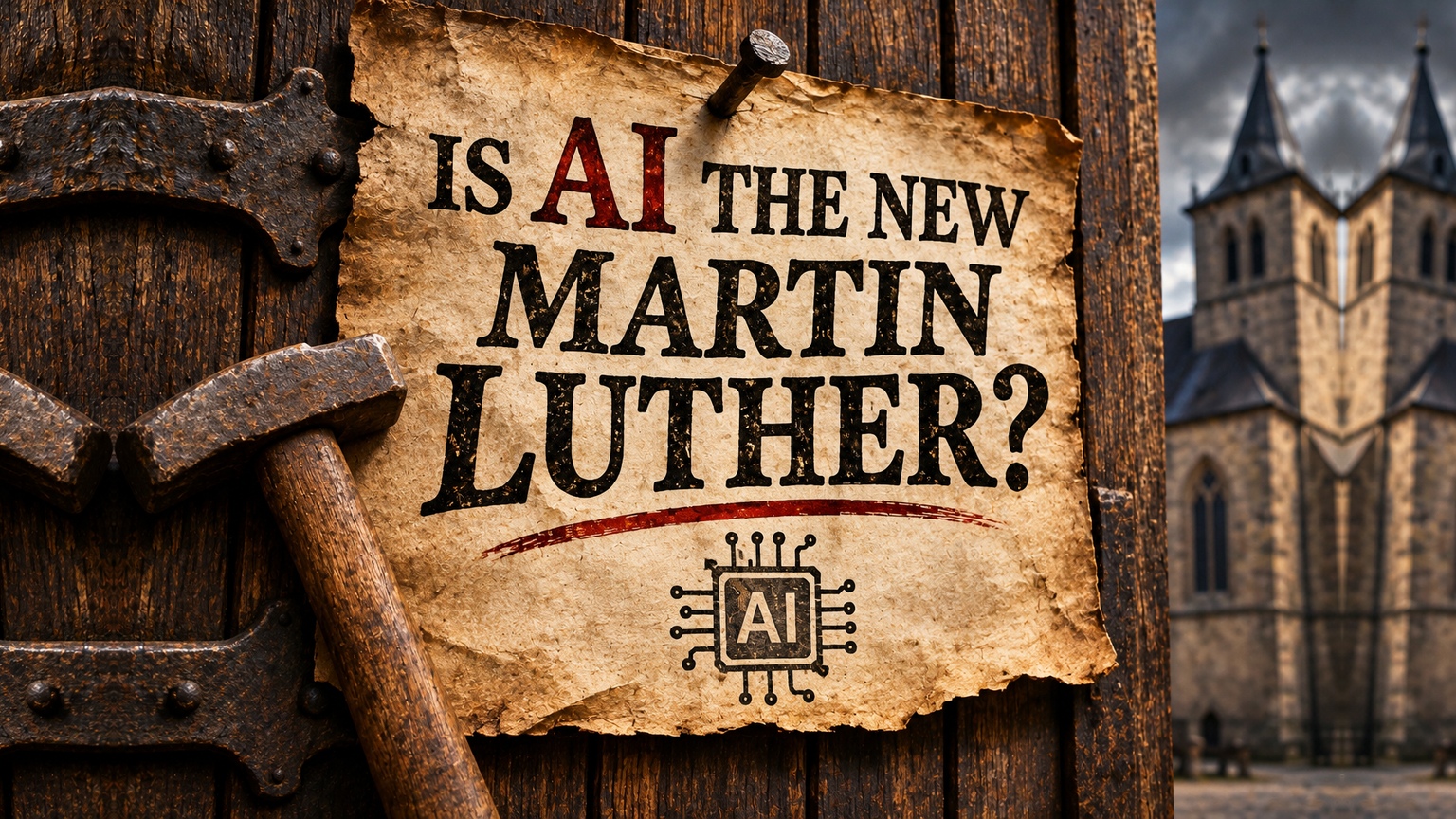
Is AI the New Martin Luther?
It was around 1 a.m. on November 14, 2026. I was doing what I frequently do at that hour, checking the Newest Sermons tab on SermonAudio. I came across a relatively short audio presentation entitled The Christian’s Use of Artificial Intelligence, published by the ministry Grace Gems.
I hit play.
Almost immediately, I found myself laughing. The voice delivering this message about how Christians should use artificial intelligence was itself an AI-generated voice.
There is something wonderfully ironic about listening to artificial intelligence warn Christians about artificial intelligence. But what began as an amusing late-night discovery quickly turned into something much more significant. By 1:17 a.m., I was no longer simply thinking about the audio presentation. I was thinking about the entire Christian religious establishment, the history of theological authority, the Protestant Reformation, and whether artificial intelligence might represent one of the most significant challenges to religious authority in centuries.
I certainly didn’t expect to end up here when I opened SermonAudio.
The presentation offered five principles for Christians using AI. Much of what it said was reasonable. Scripture, not artificial intelligence, should be our final authority. AI can produce false information. Christians should verify what they read. Artificial intelligence cannot replace prayer, faith, or our relationship with Christ. I have no fundamental objection to those statements.
But then came this:
“One of the greatest dangers of AI is not merely that it may give us wrong answers, but that we may gradually cease to think carefully for ourselves. Why labor over scripture, when a machine can produce an instant explanation? Why investigate a difficult doctrine, when AI can supply a ready-made conclusion?”
And that is where everything changed for me.
I wanted to scream.
Not because the concern about people ceasing to think is illegitimate. It is an enormously important concern. I wanted to scream because Christianity has spent centuries building an entire infrastructure that allows people to do precisely what this presentation warns against.
Why labor over Scripture when you can open a commentary and immediately receive an explanation?
Why investigate a difficult doctrine when you can open a systematic theology and find a ready-made conclusion?
Why wrestle with the meaning of a biblical passage when you can open a study Bible and read the notes at the bottom of the page?
Why spend hours investigating a theological question when your catechism has already supplied both the question and the answer?
And why is this message being published on SermonAudio, one of the largest libraries of Christian preaching in the world, where someone can search for virtually any passage of Scripture, theological subject, or religious question, hit play, and receive someone else’s explanation?
The Christian world has spent centuries producing commentaries, theological books, sermons, catechisms, creeds, confessions, Bible study materials, and entire educational institutions devoted to supplying people with theological answers.
Then artificial intelligence comes along, and suddenly we are concerned that people might receive ready-made conclusions!
Where has this concern been for the last several hundred years?
Now, before someone misunderstands my argument, I am not suggesting that commentaries are evil, that catechisms are useless, that pastors should stop preaching, or that Christians should abandon theological education. I have spent decades preaching and teaching. I have produced thousands of audio episodes devoted to biblical interpretation and theological investigation. I have a library filled with books written by other people.
The issue is not whether we should learn from others. The issue is the enormous inconsistency in how we evaluate the potential dangers of learning from artificial intelligence compared to the dangers of learning from human theological authorities.
A commentary can stimulate thinking, or it can replace thinking. A sermon can stimulate thinking, or it can replace thinking. A systematic theology can stimulate thinking, or it can replace thinking. Artificial intelligence can do exactly the same.
The problem is not that an answer is available. The problem is what we do with the answer.
But as I continued thinking about this, something occurred to me that I believe deserves serious consideration.
What if artificial intelligence is actually threatening Christianity because it allows people to do the very thing Christians claim to want them to do—think for themselves?
Consider the difference between reading a commentary and interacting with AI.
I can read a commentary written by a Reformed theologian. He explains a passage of Scripture and gives me his conclusion. I can read a commentary written by an Arminian theologian and receive a different conclusion. I can listen to a pastor explain why his interpretation is correct and why the other interpretations are wrong.
But I cannot have a conversation with a book. I cannot interrupt a recorded sermon.
With AI, I can stop and say, “Wait a minute. Where did that conclusion come from? What is the evidence? Does the Greek actually support that interpretation? Have you considered the historical context? What is the strongest argument against what you just told me?”
I can challenge the answer. I can question the assumptions. I can ask for competing interpretations. I can identify a contradiction and demand that it be addressed. I can spend an hour investigating a single sentence.
And I can arrive at a conclusion that is completely different from the conclusion my pastor, my denomination, or my favorite theologian has given me.
That changes everything.
For example, imagine a Christian listening to a sermon on Hebrews 6. The pastor presents his interpretation of the warning passages and explains how they relate to the possibility of losing salvation. The Christian goes home, obtains the sermon transcript, and begins investigating it with AI.
What is the historical setting of Hebrews? Who was the original audience? How does the sacrificial system function in the argument of the book? What significance might the destruction of Jerusalem in AD 70 have for understanding its warnings? Is the pastor accurately representing the competing interpretations? Does his conclusion follow from the text, or does it follow from a theological system he has brought to the text?
Suddenly, a Christian who might previously have accepted the sermon without question is engaged in serious hermeneutical investigation.
Is that Christian ceasing to think?
Or is that Christian finally beginning to think about things that may never have been questioned before?
This is not a hypothetical use of artificial intelligence for me. It is something I do regularly. I listen to sermons, identify claims that trouble me, examine passages of Scripture, challenge interpretations, investigate historical and theological issues, and use AI as part of that process. Sometimes I challenge the AI. Sometimes the AI challenges me. Sometimes the discussion goes in a direction I never anticipated.
In fact, that is exactly how this article came into existence.
I listened to an audio presentation at 1 a.m. I disagreed with an argument. I began expressing my objections. I started discussing the implications with artificial intelligence. That discussion led me to questions about religious authority, theological education, institutional power, and eventually Martin Luther.
The AI did not prevent me from thinking. The interaction helped me explore the implications of what I was already thinking.
And there is another fascinating element to this story.
The ministry behind the original audio presentation, Grace Gems, maintains an entire section of its website devoted to AI Articles. The ministry discloses that nearly all of the short articles in that section are AI-generated and carefully edited. It also recommends an AI system called Navigate The Way, which it describes as grounded in Scripture, the Five Solas, and the Doctrines of Grace.
I appreciate the transparency. I also have no objection to the ministry using AI to assist in producing theological material. But this introduces another question that cannot be ignored.
If an AI system is designed around a particular theological framework, is it helping people investigate theological questions, or is it providing them with conclusions that have already been determined by that framework?
If I ask an AI system grounded in the Doctrines of Grace whether limited atonement is biblical, will it seriously investigate the competing interpretations, or will its theological foundation effectively determine the answer before the investigation begins?
If I ask about the land promises to Israel, will it examine the relevant passages in their historical, literary, and theological context, or will it interpret those passages through a predetermined theological system?
The existence of a theological framework does not automatically invalidate the answers. Human theologians operate with theological frameworks as well. But that is precisely the point. We must be willing to examine the framework, question its assumptions, and evaluate its conclusions.
Otherwise, we have simply taken the existing Christian system of delivering ready-made theological conclusions and digitized it.
And that brings me to Martin Luther.
In 1517, Luther’s challenge to the practice of indulgences helped ignite what would become the Protestant Reformation. His challenge to ecclesiastical authority occurred alongside a technological revolution that fundamentally changed the distribution of information: the printing press.
The printing press did not invent theological disagreement. It did not invent biblical interpretation. It did not create the questions Luther was asking. But it enabled his ideas to circulate with a speed and reach that would have been extraordinarily difficult in an earlier age.
The religious establishment could no longer control the distribution of theological information in quite the same way.
Luther’s writings circulated. Scripture became increasingly accessible in the languages of ordinary people. Religious ideas could travel beyond the institutions that had traditionally exercised considerable authority over their transmission.
The implications were enormous.
And now, approximately five centuries later, I find myself wondering whether we are witnessing the emergence of another technological disruption with potentially enormous consequences for religious authority.
Is AI the new Martin Luther?
Of course, artificial intelligence is not literally Luther. AI has no conscience, no faith, no theological convictions, and no personal courage. It cannot stand before an emperor and refuse to recant. It cannot believe the Gospel or suffer for its convictions.
Perhaps AI is more comparable to the printing press, while the people using it may become the new Luthers.
But artificial intelligence introduces something that even the printing press could not provide.
The printing press made the words of theologians accessible to ordinary people. AI makes it possible for ordinary people to interact with theological arguments in ways that were previously unavailable to them.
The printing press helped democratize access to information. Artificial intelligence has the potential to democratize access to intellectual investigation.
And that possibility raises some deeply uncomfortable questions for Protestant Christianity.
Protestants celebrate Martin Luther for challenging religious authority. They celebrate the Reformation, the authority of Scripture, and the rejection of the idea that the Roman Catholic Magisterium possesses the final authority to interpret Scripture.
But what happened after the Reformation?
Protestant Christianity developed its own institutions, its own theological authorities, its own seminaries, its own publishing houses, its own confessions, its own denominational boundaries, and its own systems for determining which theological conclusions are acceptable.
Protestantism rejected the Roman Catholic Magisterium, but in practice, it developed countless smaller, functional magisteriums of its own.
Go into a strongly Reformed church and challenge Calvinism. Go into a dispensational church and challenge dispensationalism. Go into a fundamentalist Baptist church and challenge its position on the King James Bible.
You may discover that the freedom to investigate Scripture celebrated during the Reformation has some very definite boundaries.
You are free to study the Bible for yourself. You are free to investigate theological questions. You are free to think independently.
Just make sure you arrive at the correct conclusions.
And who determines which conclusions are correct?
Well, we do, of course!
Theological confessions can serve legitimate and valuable purposes. Churches have every right to identify what they believe and teach. The problem arises when loyalty to a theological system becomes more important than the willingness to examine whether that system is correct.
It is one thing to say that Scripture is our final authority. It is another thing entirely to allow someone to challenge our interpretation of Scripture without treating that challenge as a threat to Christianity itself.
And now artificial intelligence enters the picture.
A Christian sitting in a church pew can take the words of the pastor, investigate them, challenge them, examine their historical and grammatical foundations, compare them with competing theological interpretations, and discover that what was presented as the obvious teaching of Scripture may actually be a highly contested theological conclusion.
That Christian does not need to purchase an entire theological library. He does not need to enroll in seminary. He does not need to find a professor willing to spend three hours answering his questions. He does not even need to wait until the pastor is available.
He can begin investigating immediately.
That does not guarantee he will arrive at the correct conclusion. But it changes who has access to the process of investigation.
And perhaps this is where we need to ask the question that will make some people uncomfortable.
Are some Christians angry about artificial intelligence because it threatens to do what Christianity has been doing for centuries, only faster, more accessibly, and in some respects more effectively?
Are they concerned that people will stop thinking, or are they concerned that people will stop accepting the conclusions they have been given?
Are they defending biblical authority, or are they defending their authority to tell people what the Bible means?
Are they protecting the church, or are they protecting an entire religious industry built around the delivery of theological information?
I am not claiming to know the motives of every Christian who criticizes AI. Many people have legitimate concerns. AI can fabricate historical quotations, misrepresent theological positions, produce false information, and reinforce the biases of the person using it. Its ability to generate enormous quantities of persuasive material creates problems that cannot simply be dismissed.
But we cannot ignore the institutional implications.
What happens when the people who have traditionally controlled access to theological knowledge discover that their position is no longer as necessary as it once was?
What happens to a Christian publishing industry when people can investigate theological questions without purchasing another book?
What happens to theological education when people can engage in detailed discussions of biblical languages, church history, and systematic theology without entering a classroom?
What happens to a pastor whose primary function, in the eyes of his congregation, is to explain the Bible, when the people in that congregation discover that they can investigate those explanations independently?
And what happens to ministries like Theology Central?
I cannot ask these questions about everyone else without asking them about myself.
I have spent decades behind a microphone. I have devoted an enormous amount of my life to studying, preaching, teaching, and discussing Scripture. Artificial intelligence may change the way people consume the kind of content I produce. It may reduce the perceived necessity of ministries like mine.
But if someone no longer needs to listen to me because they have developed the ability to investigate Scripture carefully for themselves, why should I be threatened by that?
Isn’t that supposed to be part of the purpose of teaching?
I do not want people to listen to Theology Central so that they can simply exchange one theological authority for another. I do not want people to reject their pastor’s interpretation merely because I offer a different one. I want people to investigate. I want them to question. I want them to examine the text. I want them to challenge my conclusions as well.
If the goal of Christian teaching is to make people permanently dependent upon the teacher, something has gone terribly wrong.
There is, however, one final danger that I believe we must take seriously.
The Protestant Reformation did not eliminate religious authority. It redistributed it. New authorities emerged. New institutions developed. New theological boundaries were established.
Artificial intelligence could do exactly the same thing.
We could replace ecclesiastical magisteriums with digital magisteriums. Christians could stop accepting everything their pastor tells them and begin accepting everything ChatGPT tells them. Denominations could create AI systems designed to reinforce their own theological positions. Technology companies could become enormously influential in determining which religious ideas people encounter and how those ideas are presented.
That would not be the intellectual revolution I am describing. It would simply be the transfer of authority from one institution to another.
The goal must never be to replace unquestioned human authority with unquestioned artificial authority.
The goal must be to cultivate the willingness and ability to investigate the claims of both.
The Christian who refuses to question his pastor has a problem. The Christian who refuses to question his AI has the same problem.
And perhaps the most important question we should be asking is not whether artificial intelligence will give us answers, but whether we are willing to investigate the answers we receive, regardless of where they come from.
It is now well past the time I should have been asleep. All of this began because I opened SermonAudio at 1 a.m. and listened to an AI voice warning Christians that artificial intelligence might cause them to stop thinking.
Instead, I have spent the night thinking about religious authority, the history of Christianity, the Reformation, the role of the church, the future of theological education, and the possibility that artificial intelligence may fundamentally change the relationship between ordinary Christians and the institutions that have traditionally supplied their theological answers.
The irony is almost too much.
The very technology I was being warned might prevent me from thinking became part of the process that led me to think about questions I had not even considered when I first hit play.
Maybe artificial intelligence is not the new Martin Luther. Maybe it is the new printing press. Maybe the next great challenge to religious authority will come from ordinary Christians who finally have access to tools that allow them to investigate questions they have been told were already settled.
I do not know what the future holds.
But I do know this.
Five hundred years ago, a technological revolution helped a challenge to religious authority spread across Europe. Protestant Christians celebrate the consequences of that revolution to this day.
Now another technological revolution has arrived, and it may challenge the religious authorities that emerged from the first one.
The question is whether the spiritual descendants of Martin Luther will welcome that challenge—or discover that they have become the very religious establishment Luther once challenged.
That is something worth thinking about.
Even at 1 a.m.
Theology Central
When Disappointment Becomes Bad Hermeneutics