Bearing False Witness About the Bible
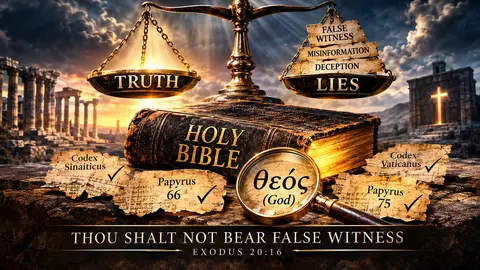
Bearing False Witness About the Bible
When defending the Word of God becomes an excuse for misrepresenting the truth.
I was listening to a sermon today, and within a matter of seconds, I heard something that made me angry, frustrated, and ultimately just sad. It is something I have heard countless times before, but the fact that it continues to be repeated from pulpits across the country makes it no less disturbing.
I am referring to the claims made about biblical manuscripts, the people who copied them, and the Bible translations that millions of Christians read every day.
I would much rather be behind a microphone right now, playing the audio, stopping it, examining each statement, and walking through the actual historical and textual evidence. But since I cannot get to a microphone, I am going to address it here.
Because it needs to be addressed.
This is not simply a disagreement about Bible translations. This is not simply a debate about whether someone should use the King James Version or the New International Version. This is about truth. It is about honesty. It is about the responsibility of those who teach the Scriptures. And it is about a commandment that Christians claim to believe:
“Thou shalt not bear false witness against thy neighbour.” — Exodus 20:16
The Sermon in Question
The message was delivered by Kelly Vanderkooi on May 7, 2025, during a Wednesday night service.
Sermon: Wednesday Night Service; May 7th, 2025
Listen here: https://www.sermonaudio.com/sermons/582504286326
Timestamp: 19:32
I encourage you to listen to the actual recording. Do not simply take my word for what was said. Listen to the statement, examine the evidence, and come to your own conclusions.
The preacher is discussing the deity of Christ when he makes the following statements. The transcript uses the word “transcripts,” apparently referring to biblical manuscripts.
“All those transcripts came out of Alexandria, Egypt. And the people who transcribed those things did not believe in the Deity of Christ so they put their own doctrines in there. If you have an NIV the transcripts that that came from they did not believe in the Deity of Christ. That’s why it is so important you get the right Bible.”
He also claims that the reason people do not want the King James Bible is connected to the alleged denial of Christ’s deity by those responsible for the manuscripts underlying other translations.
Think about what has just been communicated to the people sitting in that church.
They have been told that the manuscripts underlying modern Bible translations came from Alexandria, Egypt. They have been told that the people who copied those manuscripts denied the deity of Jesus Christ. They have been told that those people deliberately inserted their own doctrines into the biblical text. And they have been specifically warned about the NIV.
Those are not minor claims. Those are not insignificant historical details. Those are accusations of theological corruption and deliberate deception involving the transmission of the Word of God.
Where is the evidence?
1. The Myth That All These Manuscripts Came From Alexandria
The first problem is the assertion that all these manuscripts came out of Alexandria, Egypt.
This is false.
In discussions of New Testament textual criticism, you will encounter the term Alexandrian text-type. It is a traditional scholarly designation used to describe manuscripts that share certain textual characteristics.
It does not mean that every manuscript associated with that textual tradition was physically produced in Alexandria. It does not identify the theological beliefs of every scribe who copied those manuscripts. It does not establish that there was a coordinated group of individuals in Alexandria deliberately rewriting the New Testament.
Consider some of the most important ancient manuscripts:
- Codex Sinaiticus: A fourth-century manuscript associated with the monastery of St. Catherine in Sinai. Its original place of production is uncertain.
- Codex Vaticanus: A fourth-century manuscript preserved in the Vatican Library. Its original place of production is also uncertain.
- Papyrus 66: An early manuscript containing much of the Gospel of John, associated with Egypt.
- Papyrus 75: An early manuscript containing portions of Luke and John, also associated with Egypt.
- Codex Alexandrinus: A fifth-century manuscript historically associated with Alexandria. Interestingly, its Gospel text is predominantly Byzantine rather than Alexandrian.
That last example alone should make us reconsider the simplistic categories being presented from the pulpit. A manuscript actually named Alexandrinus contains a predominantly Byzantine text in the Gospels.
The history of the biblical text is far more complicated than a story about two groups of people, one group faithfully preserving Scripture and another group in Egypt deliberately corrupting it.
Modern critical editions of the Greek New Testament draw upon evidence from numerous manuscripts, ancient translations, and quotations preserved in the writings of early Christians.
The NIV is not simply a translation of a collection of manuscripts produced in Alexandria.
The NIV’s own preface explains that its New Testament is translated from an eclectic Greek text based on the Nestle-Aland and United Bible Societies editions. An eclectic text involves evaluating the available evidence and making decisions among competing readings.
You may disagree with some of those decisions. You may prefer the Textus Receptus. You may defend the Byzantine textual tradition. But none of that gives you permission to misrepresent the process.
2. Who Were These People Who Denied the Deity of Christ?
The preacher makes an extraordinary accusation:
“And the people who transcribed those things did not believe in the Deity of Christ so they put their own doctrines in there.”
I have some very simple questions.
Who were these people?
What were their names?
When did they live?
What theological writings did they produce?
Where did they explicitly deny the deity of Christ?
What historical evidence establishes that they were responsible for copying the manuscripts in question?
Which specific textual changes can be demonstrated to have been made by these individuals in order to promote their alleged theological beliefs?
For many ancient biblical manuscripts, we simply do not know the identities or personal theological convictions of the scribes responsible for copying them.
We can study their handwriting. We can examine their spelling habits. We can identify corrections. We can compare their readings with other manuscripts. We can sometimes distinguish between different scribes working on the same manuscript.
But we cannot simply invent a theological biography for an anonymous scribe.
And yet that is essentially what is being done here.
The preacher claims to know what these people believed about Jesus Christ. He claims to know why they altered the biblical text. He claims to know that they inserted their own doctrines into Scripture.
How does he know?
The sermon provides no historical evidence to establish any of this.
This is particularly troubling because the accusation is not merely that these scribes made mistakes. It is that they denied a foundational Christian doctrine and deliberately corrupted the Word of God.
If someone made an accusation of that magnitude against a living pastor, theologian, or Bible translator, we would rightly demand evidence.
Why should the standard be any different when the accusation is made against people who lived more than a thousand years ago?
3. The Manuscripts Themselves Present an Enormous Problem
Here is where the entire accusation begins to collapse.
We do not have to speculate endlessly about what these manuscripts contain. We can examine the actual textual evidence.
If these manuscripts were produced by people who denied the deity of Christ and deliberately inserted their own anti-deity theology into Scripture, what would we expect to find?
We would expect the evidence to demonstrate that agenda.
Instead, consider the following passages.
John 1:1
The King James Version reads:
“In the beginning was the Word, and the Word was with God, and the Word was God.”
The NIV reads exactly the same way.
The ancient manuscript witnesses that are frequently attacked in King James Only arguments preserve the essential wording of this passage.
Papyrus 66, Papyrus 75, Codex Sinaiticus, and Codex Vaticanus all attest this foundational declaration concerning the deity of Christ.
The Word was God.
Why would a group of people supposedly engaged in a campaign to corrupt Scripture in order to deny the deity of Christ preserve one of the most explicit declarations of his deity in the entire New Testament?
John 20:28
The King James Version reads:
“And Thomas answered and said unto him, My Lord and my God.”
The NIV reads:
Thomas said to him, “My Lord and my God!”
Thomas is speaking to Jesus.
He calls Jesus his Lord and his God.
This passage is preserved in ancient witnesses including Papyrus 66, Codex Sinaiticus, and Codex Vaticanus.
Once again, the textual evidence that supposedly comes from people attempting to deny Christ’s deity preserves an explicit confession of Christ’s deity.
Titus 2:13
The King James Version reads:
“Looking for that blessed hope, and the glorious appearing of the great God and our Saviour Jesus Christ;”
The NIV describes Jesus Christ as “our great God and Savior.”
Notice the significance of the NIV’s wording.
It identifies Jesus Christ as both God and Savior.
The Greek grammatical construction strongly supports understanding these titles as referring to the same person. The KJV can certainly be understood that way, but the NIV makes that identification particularly clear in English.
The translation specifically attacked in the sermon explicitly identifies Jesus Christ as our great God and Savior.
2 Peter 1:1
The King James Version speaks of:
“the righteousness of God and our Saviour Jesus Christ.”
The NIV speaks of:
“the righteousness of our God and Savior Jesus Christ.”
Once again, the NIV identifies Jesus Christ as our God and Savior.
These examples are not difficult to find. They do not require access to a secret archive. Anyone with a Bible can examine them.
But there is another passage that presents an even more significant problem for the accusation.
4. John 1:18: The Manuscript Evidence That Turns the Argument Upside Down
If I were behind a microphone right now, this is where I would stop and spend considerable time.
John 1:18 contains a significant textual variant.
The King James Version reads:
“No man hath seen God at any time; the only begotten Son, which is in the bosom of the Father, he hath declared him.”
The NIV reads:
“No one has ever seen God, but the one and only Son, who is himself God and is in closest relationship with the Father, has made him known.”
Did you catch that?
The NIV explicitly says that the Son “is himself God.”
Why?
Because the Greek textual tradition underlying the NIV contains a reading different from the one found in the Textus Receptus underlying the King James Version.
Here are the two principal readings:
Textus Receptus:
ὁ μονογενὴς υἱός
ho monogenēs huios
The only or unique Son.
Modern critical text:
μονογενὴς θεός
monogenēs theos
The only or unique God.
The significant difference is between the Greek words huios, meaning Son, and theos, meaning God.
The reading containing theos is supported by important ancient manuscripts:
- Papyrus 66
- Papyrus 75
- Codex Sinaiticus, in its original hand
- Codex Vaticanus
- Codex Ephraemi Rescriptus, in its original hand
There are differences among these witnesses concerning the presence of the Greek definite article, but the central point is that they attest the reading containing the word God.
This is not something I have invented. You can examine the textual note on John 1:18 in the NET Bible, consult a critical apparatus for the Greek New Testament, or investigate the manuscripts themselves.
Now think about the accusation made in this sermon.
We have been told that the people responsible for these manuscripts denied the deity of Christ and inserted their own doctrines into the biblical text.
Yet here we have a passage where their supposedly corrupt textual tradition contains the word God, while the textual tradition preferred by the preacher contains the word Son.
How does his explanation account for that?
If the purpose of these manuscripts was to undermine the deity of Christ, why does their reading provide such an explicit identification of Christ as God?
I am not claiming that this settles every textual question concerning John 1:18. There are legitimate scholarly debates about which reading is original, how the variant arose, and how the Greek should be translated. Some historical interpreters with non-Nicene theological views also used the reading containing theos. The presence of that word does not, by itself, prove that every scribe who copied it held a fully orthodox Christology.
But that is precisely the point.
The textual evidence cannot be reduced to the simplistic story being told from the pulpit.
The manuscripts themselves contain evidence that directly challenges the accusation that they were systematically corrupted to deny Christ’s deity.
And the NIV, the translation specifically attacked in the sermon, explicitly declares that the Son is himself God.
5. Alexandria Was Not a City United in Denying the Deity of Christ
There is another significant historical problem.
The way Alexandria is discussed in certain King James Only circles can leave people with the impression that the city was essentially a center of theological corruption, where heretical Christians worked to undermine biblical Christianity.
But have we forgotten Athanasius?
Athanasius of Alexandria was one of the most important defenders of the full deity of Christ in the history of Christianity.
He became bishop of Alexandria in AD 328 and was a central figure in the theological conflict surrounding Arianism.
His defense of the eternal, divine Son against those who regarded the Son as a created being remains a significant part of Christian theological history.
His work On the Incarnation is one of the great historical Christian writings concerning the divine Word becoming flesh.
Yes, Alexandria was also associated with Arius. There were significant theological controversies in Alexandria.
But that is the point.
Alexandria was not a city united in denying the deity of Christ. It was a city in which the deity of Christ was fiercely debated and fiercely defended.
You cannot take a geographical designation, attach a theological accusation to it, and then apply that accusation to every biblical manuscript associated with that location.
That is not historical investigation.
That is historical caricature.
6. Textual Variants Do Not Automatically Prove Theological Corruption
There are real textual differences among biblical manuscripts.
No serious examination of the history of the Bible can deny this.
Some differences are minor. Others are significant. Some affect the wording of passages that are important in theological discussions.
The question is not whether textual variants exist. The question is how they arose and how we determine which readings most likely represent the original text.
There are numerous possible explanations for textual differences:
- Accidental omissions or repetitions.
- Differences in spelling and grammar.
- A scribe’s attempt to clarify a difficult expression.
- Harmonization with another biblical passage.
- The incorporation of explanatory material.
- Liturgical influence.
- Deliberate alterations, sometimes involving theological concerns.
Yes, deliberate theological alterations are a genuine possibility. They must be investigated rather than dismissed.
But they must also be demonstrated.
The existence of a variant does not automatically establish that a particular scribe deliberately corrupted the text. And even where a deliberate alteration is probable, determining its theological motivation requires additional evidence.
Consider the work of New Testament scholar Bart Ehrman in The Orthodox Corruption of Scripture. Ehrman argues that some scribes altered biblical readings in ways intended to strengthen emerging orthodox theological positions against competing views of Christ.
One need not agree with every conclusion Ehrman reaches to recognize the significance of the discussion.
Even deliberate theological alterations cannot be reduced to a universal campaign to weaken the deity of Christ. In some cases, the proposed direction of alteration was the exact opposite.
The evidence must be examined individually.
What we cannot do is begin with the assumption that the King James Version is always correct, label every competing reading a corruption, assign heretical motives to the people who copied those readings, and then use those accusations to prove the superiority of the King James Version.
That is circular reasoning.
And it is not made legitimate by being repeated from a pulpit.
7. What About the Manuscripts Behind the King James Version?
Here is another question that must be asked.
Were the manuscripts behind the King James Version copied by human beings?
Of course they were.
Do we know the theological beliefs of every scribe responsible for copying every manuscript that contributed to the Greek editions used by the King James translators?
No, we do not.
Were there textual differences among the manuscripts used in the production of those Greek editions?
Yes.
Did the printed Greek editions of Erasmus, Stephanus, and Beza agree with one another in every detail?
No.
The Textus Receptus is not a single ancient manuscript handed down from the apostles. It is a family of printed Greek New Testament editions that emerged in the sixteenth and seventeenth centuries.
The King James translators made use of earlier printed Greek editions, existing translations, and other resources. They made textual and translational decisions.
This is not an attack on the King James Bible. It is an acknowledgment of its actual history.
If we are going to make the theological beliefs of scribes the determining factor in whether a manuscript can be trusted, we would have to apply that standard consistently.
We would need to investigate every scribe in the textual ancestry of the King James Version.
We cannot do that.
Furthermore, a scribe’s personal theology does not automatically determine the accuracy of every word he copies. A person with defective theology can accurately reproduce a biblical text, just as a person with orthodox theology can make a copying mistake.
The theological convictions of a copyist are not a substitute for examining the actual text.
8. This Is About Bearing False Witness
This is the part that bothers me the most.
Christians claim to believe that truth matters. We claim to believe that God is a God of truth. We claim to believe that Jesus Christ is the way, the truth, and the life.
We condemn dishonesty. We condemn deception. We condemn false accusations.
And then, in the very act of claiming to defend the Bible, we make sweeping accusations against people we cannot identify, assign theological motives we cannot establish, and tell congregations things about biblical history that the evidence does not support.
How is that acceptable?
How can we preach the Ten Commandments and then bear false witness in our defense of a preferred Bible translation?
The commandment does not contain an exception that says false testimony is acceptable when it is used to defend the King James Version.
Proverbs 18:13 says:
“He that answereth a matter before he heareth it, it is folly and shame unto him.”
Proverbs 18:17 reminds us:
“He that is first in his own cause seemeth just; but his neighbour cometh and searcheth him.”
We have an obligation to examine evidence, particularly when we are making serious accusations against others.
James 3:1 warns those who teach that they face a greater judgment.
That should produce caution. It should produce humility. It should produce a willingness to say, “I do not know,” when the evidence does not establish a conclusion.
Instead, what we hear in this sermon is absolute certainty.
The manuscripts came from Alexandria.
The scribes denied the deity of Christ.
They inserted their own doctrines into Scripture.
The NIV comes from those people.
Get the right Bible.
A few sentences. No historical documentation. No manuscript analysis. No examination of competing evidence. No acknowledgment of uncertainty.
And the people sitting in the congregation are expected to accept it.
I cannot establish from this sermon whether the preacher knowingly made false statements or whether he sincerely believes misinformation that was passed on to him.
I will not claim to know his heart.
But I can evaluate his public statements.
And those statements are false in their sweeping historical claims, unsupported in their accusations about the motives and beliefs of ancient scribes, and misleading in their portrayal of the textual evidence underlying modern translations.
The fact that someone sincerely believes a false accusation does not make the accusation true.
And sincerity does not remove the responsibility to correct misinformation once it has been exposed.
9. Think About the People Sitting in the Congregation
Imagine a Christian sitting in that Wednesday night service.
Perhaps they have an NIV at home. Perhaps they have been reading it for twenty years. Perhaps they gave an NIV to their children. Perhaps they have found comfort in its pages during some of the darkest moments of their lives.
Now they hear that their Bible came from manuscripts copied by people who denied the deity of Jesus Christ and deliberately inserted their own doctrines into Scripture.
What are they supposed to think?
Have they been reading a corrupted Bible?
Have they been deceived?
Have they unknowingly exposed their children to a Bible designed to undermine the deity of Christ?
This kind of preaching can create fear, confusion, suspicion, and division among Christians.
And what makes it particularly tragic is that the fear is being generated by claims that the historical and textual evidence does not justify.
There is already enough confusion surrounding the Bible. There are already enough questions about inspiration, preservation, textual transmission, translation, interpretation, and biblical authority.
Why would anyone who claims to love the Scriptures contribute to that confusion?
Why would we undermine someone’s confidence in the Bible by presenting a false account of how the Bible came to us?
Why would we turn a legitimate discussion about textual criticism into a story about an alleged conspiracy that we cannot demonstrate?
It is just sad.
10. We Do Not Need Falsehoods to Defend the Truth
Let me be very clear.
You can love the King James Bible.
You can prefer its language.
You can defend the Textus Receptus.
You can argue for the superiority of the Byzantine textual tradition.
You can question the decisions made by modern textual critics.
You can disagree with particular translation choices in the NIV, the ESV, the NASB, or any other Bible translation.
Those are legitimate discussions.
But none of those positions gives you permission to make false accusations.
If your argument for the King James Version requires you to misrepresent the history of biblical manuscripts, then something is wrong with your argument.
If your defense of the deity of Christ requires you to accuse manuscripts that explicitly identify Jesus Christ as God of being part of a campaign to deny his deity, then something is wrong with your argument.
If your defense of biblical authority requires you to ignore the biblical commandment against bearing false witness, then something is profoundly wrong.
The truth does not need our dishonesty.
The deity of Christ does not need our historical distortions.
The inspiration of Scripture does not need our invented accusations.
The Word of God does not need to be defended by violating the Word of God.
A Final Thought
There is something particularly ironic about this sermon.
The preacher explains that he has spent five years working on a book concerning the deity of Christ.
Five years.
Yet, in a matter of seconds, he makes sweeping accusations about the manuscripts underlying modern Bible translations that contain some of the most significant textual evidence for the very doctrine he is defending.
I would love to see the evidence for his accusations. I would love to see the historical documentation. I would love to see a detailed explanation of John 1:18 and how its manuscript evidence fits his claims.
And I would love to see a public correction if those claims cannot be substantiated.
Not because I want to embarrass a preacher. Not because I want to win an argument about Bible translations. But because the people who heard those statements deserve to hear the truth.
We should be able to admit when we are wrong.
We should be able to correct something we have taught.
We should be able to acknowledge that something we have repeated for years is not supported by the evidence.
That is not weakness. That is intellectual honesty. And it should be a characteristic of Christian teaching.
I have spent years listening to sermons, examining theological claims, wrestling with Scripture, and discovering how often things I have heard from pulpits simply do not survive careful examination.
Sometimes I discover that something I believed was wrong.
Sometimes I discover that something I taught was wrong.
And when that happens, my responsibility is not to defend what I previously believed at all costs. My responsibility is to pursue the truth.
That should be the responsibility of every Christian teacher.
Because ultimately, our allegiance is not to a particular English translation, a theological tradition, a denomination, a preacher, or a position we have defended for years.
Our allegiance is to the truth.
And we must never become so committed to defending the Bible that we become willing to bear false witness about it.
Sources for Further Examination
The sermon under discussion:
Kelly Vanderkooi, Wednesday Night Service; May 7th, 2025. Relevant statement begins at 19:32.
https://www.sermonaudio.com/sermons/582504286326
The biblical and textual evidence:
- John 1:1–18, NET Bible, including the textual note on John 1:18
- Jesus as Θεός (God): A Textual Examination — Bible.org
- NIV 2011 Preface — Explanation of the translation’s textual basis
- John 1:18 in the ESV, EHV, and NIV — The Wartburg Project
- Codex Sinaiticus — Digital manuscript and transcription
- Bart D. Ehrman, The Orthodox Corruption of Scripture: The Effect of Early Christological Controversies on the Text of the New Testament.
- Bruce M. Metzger, A Textual Commentary on the Greek New Testament, second edition.
- Bruce M. Metzger and Bart D. Ehrman, The Text of the New Testament: Its Transmission, Corruption, and Restoration, fourth edition.
Theology Central
Examining Scripture, theology, and the claims made in the name of Christianity.
https://www.theologycentral.net
https://www.theologycentral.org

Was David Wrong to Stay Home?