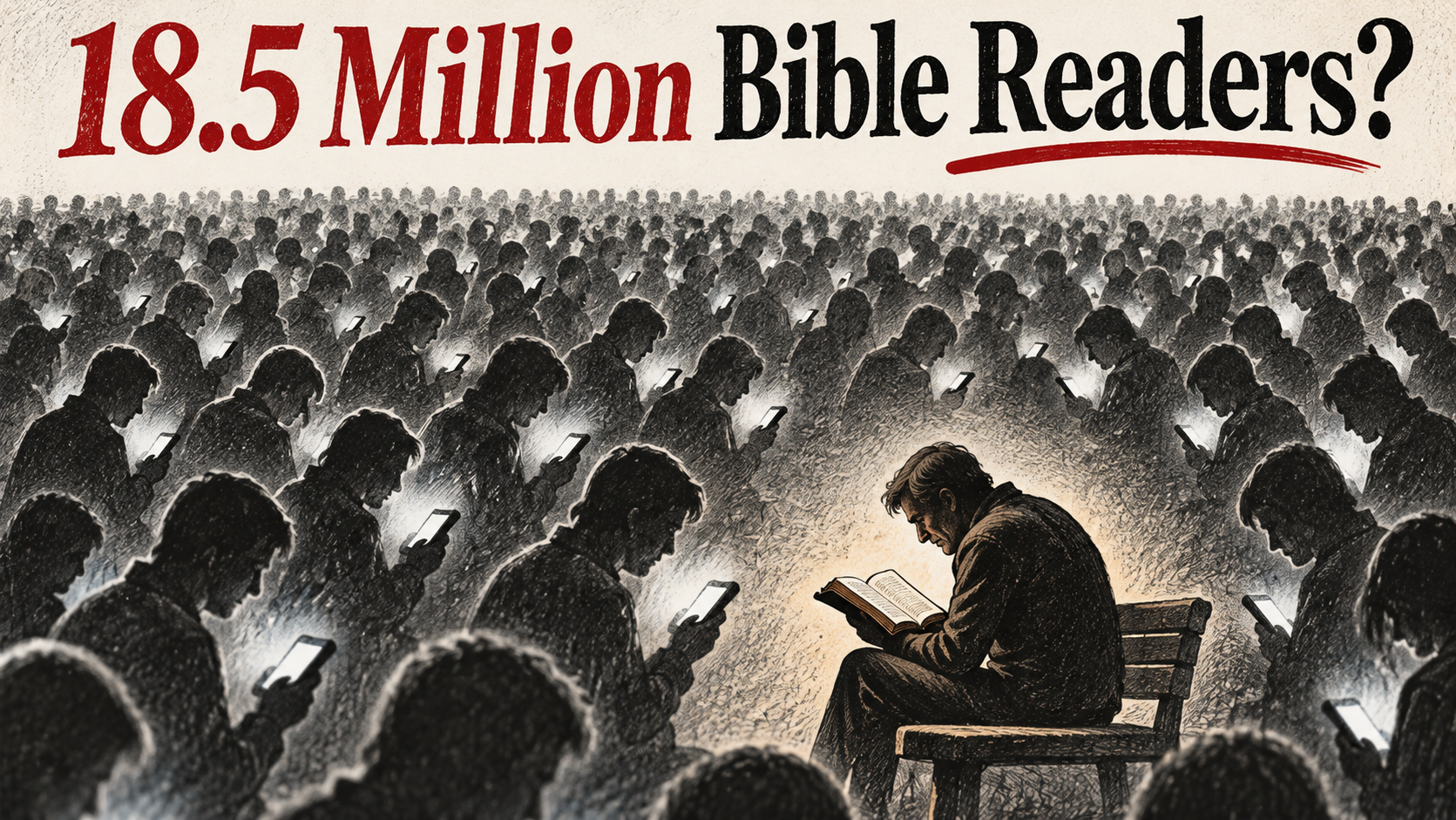
18.5 Million Bible Readers?
According to a recent Crosswalk article, YouVersion is experiencing record Bible engagement around the world. The organization reports approximately 18.5 million daily users, more than 160 million new app installations in 2026, and significant growth in countries across the globe. Scripture is now available through its platform in approximately 2,400 languages.
Those are remarkable numbers. They represent an extraordinary accomplishment in making Scripture accessible to people around the world. There was a time when obtaining a Bible was difficult, expensive, or even dangerous. Today, millions of people can access Scripture in their own language through a device they carry in their pocket.
I am thankful for that.
But as I read the article, I found myself asking a question that I think Christianity desperately needs to consider.
Are there really 18.5 million people reading the Bible every day, or are there 18.5 million people opening a Bible app?
And even if every one of those people is reading the Bible, what does that tell us about their understanding of the Bible?
The Crosswalk article begins with a rather extraordinary declaration: “A global movement of God is drawing people to Scripture.”
Before we even examine the statistics, we have been given a theological interpretation of them. YouVersion is experiencing tremendous growth, and we are being told that this growth represents a global movement of God.
But how do we know that?
We have statistics demonstrating increased app usage. We have evidence of technological expansion, increased accessibility, international partnerships, and growing digital engagement. What we do not have is a means of determining that these numbers represent a particular movement of God.
If YouVersion reports a 13 percent increase in daily usage, we celebrate a movement of God. What happens if next year YouVersion reports a 13 percent decrease? Will we conclude that God has withdrawn? Will we declare that the movement of God has ended?
Christianity has developed an unfortunate habit of interpreting favorable statistics as evidence of divine activity while finding alternative explanations for unfavorable statistics.
A church grows, and God is blessing it. A church declines, and we blame the culture. A conference sells out, and God is moving. A conference struggles to attract people, and we blame spiritual apathy.
We seem to have developed a theological system in which every number can be interpreted to support whatever conclusion we want.
But there is another issue here that I find even more significant.
In an April 2026 report, YouVersion explained that its daily active user metric measures unique users opening one of its apps on a given day.
Opening an app.
That is a legitimate and useful metric for a technology company. But opening a Bible app is not necessarily reading the Bible. Reading the Bible is not necessarily studying the Bible. Studying the Bible is not necessarily understanding the Bible. And understanding the Bible is not necessarily believing what the Bible teaches.
Those distinctions matter.
Someone could open YouVersion, read the verse of the day, and close the app. Someone could read an inspirational devotional without examining the biblical passage on which it is supposedly based. Someone could spend thirty minutes searching for verses that appear to support a theological conclusion they have already reached.
All of those activities may contribute to impressive engagement statistics.
None of them necessarily demonstrates biblical literacy.
And that brings us to what may be the most fascinating detail in the entire article.
According to YouVersion, the most searched term was Psalm 91.
Think about that for a moment.
Psalm 91 contains some of the most comforting language in Scripture. It speaks of refuge, protection, deliverance, and God’s care. In a world filled with anxiety, illness, uncertainty, violence, and fear, it is not difficult to understand why people would be drawn to it.
But what happens when millions of people read Psalm 91?
Do they understand its literary genre? Do they understand its theological context? Do they understand how its language relates to the suffering experienced by God’s people throughout Scripture?
Consider Psalm 91:10:
There shall no evil befall thee, neither shall any plague come nigh thy dwelling.
What does that mean?
Does it mean that Christians who trust God will never experience tragedy? Does it mean that if I have enough faith, I will not develop cancer? Does it mean that if I claim this promise over my family, nothing terrible will happen to them?
What happens when someone reads Psalm 91 in the morning and receives a devastating medical diagnosis in the afternoon?
What happens when a mother claims the promises of Psalm 91 over her child, and that child dies?
What happens when the Bible app provides comfort through a promise that the reader has fundamentally misunderstood?
And here is the extraordinary biblical irony.
The most searched passage in the world’s most popular Bible app is a passage that Satan himself quotes in the temptation of Christ.
In Matthew 4, Satan takes Jesus to the pinnacle of the temple and quotes Psalm 91:11–12:
He shall give his angels charge concerning thee: and in their hands they shall bear thee up, lest at any time thou dash thy foot against a stone.
Jesus responds:
It is written again, Thou shalt not tempt the Lord thy God.
Satan had access to Scripture. Satan knew the words of Scripture. Satan could quote Scripture.
The problem was not access. The problem was the use of the text.
That should cause us to think very carefully about what we are celebrating when we celebrate increased Bible engagement.
I am not suggesting that the millions of people searching for Psalm 91 are misusing it. I have no way of knowing that. But that is precisely the point. Neither does YouVersion. Neither does Crosswalk. The statistics cannot tell us whether those millions of searches are producing sound biblical understanding or reinforcing serious theological misunderstandings.
This is not an isolated example.
YouVersion’s most popular verse in 2025 was Isaiah 41:10, a verse that has repeatedly appeared at the top of its annual rankings.
Fear thou not; for I am with thee: be not dismayed; for I am thy God: I will strengthen thee; yea, I will help thee; yea, I will uphold thee with the right hand of my righteousness.
It is a beautiful passage. It is also a passage with a context.
Just two verses earlier, we read:
But thou, Israel, art my servant, Jacob whom I have chosen, the seed of Abraham my friend.
The promise is addressed to Israel. It exists within a larger prophetic discussion involving God’s covenant faithfulness, Israel’s circumstances, and God’s promises to his people.
How many people reading Isaiah 41:10 are reading Isaiah 41:8? How many are studying Isaiah 40–55? How many understand the historical, literary, and theological context in which those words were written?
Christians can certainly find comfort in this passage. But finding comfort does not eliminate the responsibility to interpret it correctly. We must establish what the text means before deciding how it applies to us.
What concerns me is that Christianity may increasingly be promoting a form of Bible engagement that is primarily therapeutic. People approach Scripture looking for something to address their anxiety, fear, loneliness, disappointment, or suffering.
There is nothing inherently wrong with seeking comfort in Scripture. Scripture itself speaks of the comfort and hope it provides.
But there is a significant difference between approaching Scripture to understand what it says and approaching Scripture primarily to find something that makes me feel better.
If we are not careful, the Bible becomes a collection of inspirational quotations. We extract promises from their contexts. We turn historical narratives into motivational lessons. We transform prophetic declarations into personal messages from God. We make the Bible about ourselves before we have even established what the Bible is actually saying.
And we can do all of that while setting new records for Bible engagement.
We could have more people opening Bible apps than ever before while biblical literacy continues to decline.
We could have more verses shared on social media than ever before while those verses are increasingly misunderstood.
We could have more people completing Bible reading plans while fewer people understand the historical, literary, and theological structure of Scripture.
Those possibilities are not contradictions. They are entirely compatible.
I think about the countless sermons I listen to through SermonAudio. I hear pastors with access to numerous Bible translations, commentaries, theological books, Bible software, and educational resources. Many have attended Bible colleges or seminaries. Many have been preaching for decades.
And yet, repeatedly, I hear biblical passages removed from their contexts, theological conclusions imposed upon texts, historical details ignored, and applications constructed that have little connection to what the passage actually teaches.
If people who have spent years studying and preaching Scripture can make those mistakes, why would we assume that millions of people opening a Bible app are necessarily becoming more biblically literate?
We need to stop confusing access with understanding.
And we need to stop confusing numerical growth with spiritual success.
That applies to Theology Central as much as it applies to YouVersion. I can look at the number of podcast downloads, streams, listeners, and website visitors. I can celebrate the fact that people around the world are listening. But none of those numbers proves that what I am teaching is correct. None of those numbers proves that people are understanding Scripture. None of those numbers establishes that God is doing something extraordinary through the podcast.
The numbers tell me something about reach.
They do not tell me whether I am right.
If we really want to know whether biblical literacy is increasing, we need to ask different questions. Can people explain biblical passages in their contexts? Can they distinguish between biblical genres? Can they identify the original audience of a text? Can they follow the argument of an entire biblical book? Can they distinguish between law and gospel? Can they recognize when a pastor is making a claim that the biblical text does not support?
Can they explain why Satan’s use of Psalm 91 was inappropriate?
Those questions might tell us far more about the state of biblical literacy than the number of people opening an app.
YouVersion has accomplished something remarkable, and I hope its reach continues to grow. I hope millions more people gain access to Scripture. I hope people who have never owned a Bible discover that they can read one in their own language.
But I also hope Christianity will resist the temptation to turn every impressive statistic into a declaration of spiritual revival.
We may be living in the most biblically accessible generation in the history of Christianity without necessarily living in the most biblically literate generation.
The Bible has never been easier to obtain. It has never been easier to search. It has never been easier to carry.
But has it ever been easier to misunderstand?
Eighteen and a half million daily users.
That is an extraordinary number.
Now comes the question that the statistics cannot answer.
What happens after they open the Bible?
Theology Central — Exploring Scripture, theology, and the questions we cannot afford to ignore.

Is AI the New Martin Luther?